Museum
CastleJablonné v Podještědí (Deutsch Gabel)
Lemberk Castle
More pictures
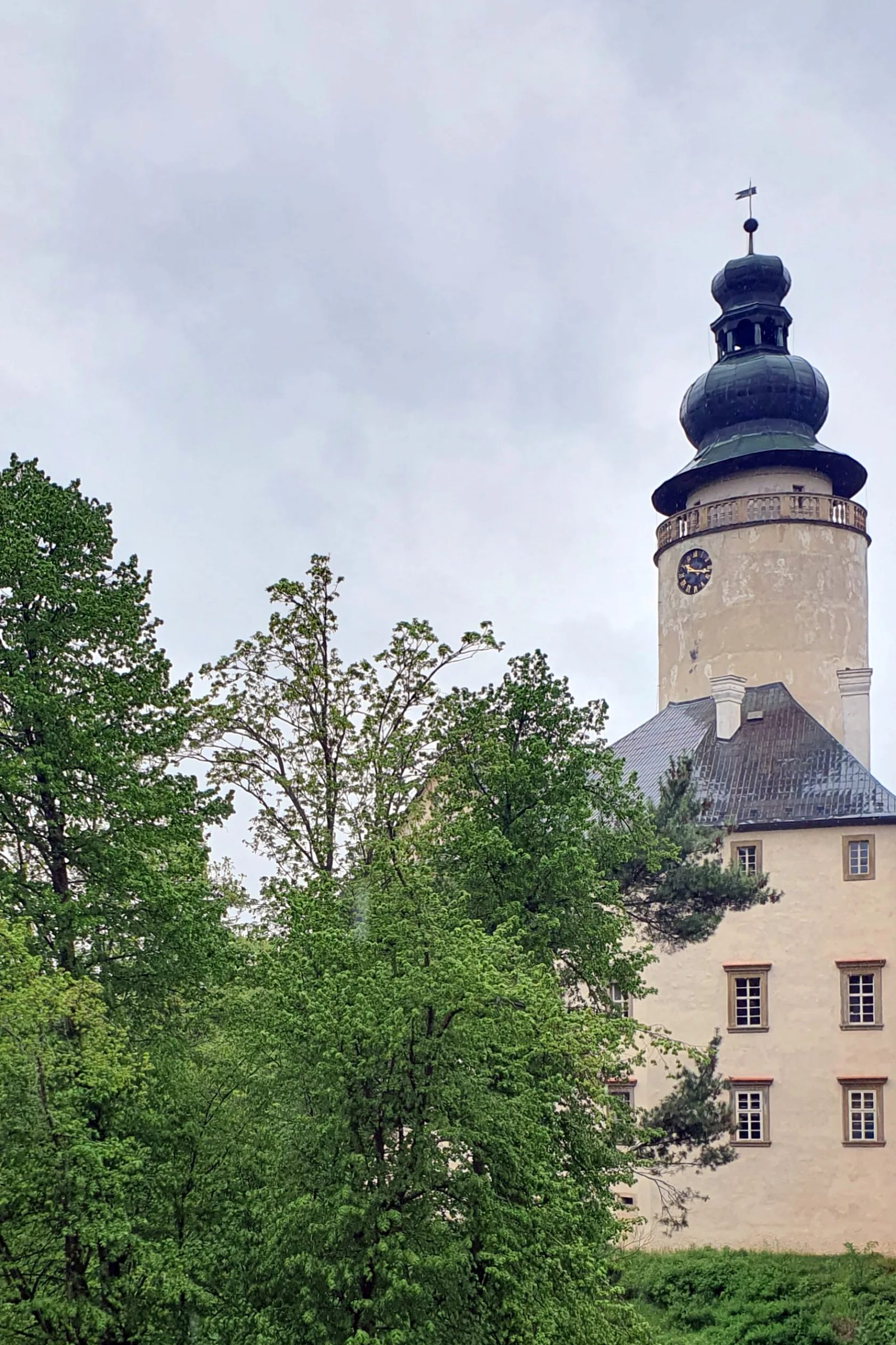
Lemberk Castle (German: Schloss Lämberg) is located northeast of Jablonné v Podještědí on a hill in the Lusatian Mountains above the valley of the Panenský potok in the Liberec District, Czech Republic.
History+
The first records of a fortress in Lämberg date back to the first half of the 13th century. Jaroslav from the noble family of the Markwartinger, burgrave of Königstein Fortress in Saxony since 1239, and his brother Gallus I von Lämberg (Havel z Lemberka; Latin: Gallus de Yablonni) were initially joint feudal tenants in the Gabel dominion. To protect against the Mongols, they built a stone castle before 1241, which was named Löwenberg after the coat of arms of their family, from which Lämberg developed. This castle construction proved its worth when parts of the Mongol army fled across northern Bohemia after the Battle of Legnica. Gallus I von Lämberg was an advisor at the court of King Wenceslaus I, who, in recognition of his services, enfeoffed him with the Glatz region in 1248, where he was burgrave of Glatz from 1252–1253. The founding of the town of Habelschwerdt there is attributed to him. He was married to Zdislava von Lämberg, who was canonized in 1995. At her initiative, the Dominican monasteries in Gabel and Turnau were founded. Hasko (Hašek) von Lämberg († 1398), imperial councilor at the court of Charles IV, was the last owner of Lämberg from the Markwardinger family. During the Hussite Wars, ownership changed rapidly, mostly belonging to Lusatian or Saxon noble families. Only the lower part of the tower with a Gothic window remained of the originally built castle. In 1518, the Upper Lusatian Vogt Wilhelm II von Ileburg (Eulenburg) bought the neglected dominion with its depopulated villages. After his death in 1538, the dominion passed to his wife, then later to his daughter Anna († 1554), married to Heinrich I von Kurzbach. Ileburg's grandson Heinrich II von Kurzbach inherited the dominion, bought additional villages, settled farmers, built a mill, sawmills, a brewery, and a hammer mill. Around 1570, he had the castle converted into a Renaissance palace; the western Renaissance wing with its Gothic arrangement of rooms dates from this period. In 1581, Lämberg Castle came into the possession of the Berka von Dubá of Neufalkenburg, and in 1600 to the Burgraves of Dohna. Further extensive alterations followed; the coffered ceiling in the Knights' Hall, which depicts Aesop's fables with 77 paintings, presumably dates from this period.
In 1623, Lämberg Castle came into Wallenstein's possession through purchase; he later became Duke of Friedland. Shortly before his assassination on February 25, 1634, in Eger, he sold it to the imperial field marshal Johann Ludolf von Breda. Between 1660 and 1680, his descendants commissioned artists and builders from Holland and Italy and had Lämberg Castle expanded into their family residence in the early Baroque style. The north and east wings were erected, and the castle received a new facade richly decorated with stucco elements and reliefs. At the same time, a summer house with a garden was built near the castle. Lämberg Castle is one of the largest and oldest monuments of fortress architecture in Bohemia. It has an almost square floor plan with wide courtyards, a drawbridge, a fortified house, a mighty tower with a Baroque dome, a Knights' Hall, ladies' chambers, vaults, and a kitchen with an open hearth. In 1726, the Counts Breda sold the Lämberg dominion with its associated villages to Count Philipp Josef von Gallas. From him, his nephew Christian Philipp von Clam-Gallas inherited the dominion in 1757. At the beginning of the Seven Years' War, on April 21, 1757, a skirmish occurred between Prussian and Austrian troops near Reichenberg, and a field hospital was set up at Lämberg Castle. Due to poor provisions, more than 1000 soldiers died here; a wooden cross in their burial place in the nearby forest commemorates them. During the Napoleonic Wars and the German War of 1866, Lämberg Castle was used as a military hospital. A mass grave of cholera victims is still known today. Presumably for disinfection reasons, furniture from the castle's furnishings was burned at that time.
The Clam-Gallas family, who mostly resided in Prague, had the castle, almost desolate from the Seven Years' War, restored. Count Clam-Gallas donated the undeveloped land behind the garden wall to the local community for the construction of a school, which was completed in 1796 and existed until 1879. After the end of the First World War in 1918, Lämberg Castle was fully furnished again. After a land reform in Czechoslovakia, the furnishings of the hunting lodges in the Jizera Mountains were brought to Lämberg. Later, the inventory of the expropriated Clam-Gallas Palace in Prague also followed. After the death of the last male descendants of the Clam-Gallas family, Lämberg Castle passed to their daughter Gabriele von Auersperg. She owned the castle until its expropriation by Czechoslovakia in 1945. The building was administered by the Czechoslovak Monument Office and also used as a magazine for objects from other castles in Bohemia. On June 11, 1992, Lemberk Castle was opened to the public as a museum. In addition to the castle rooms, a museum dedicated to St. Zdislava von Lämberg with memorabilia from her life can be visited on the ground floor of the west wing.
Take Mobile History with you
You are reading this text for free. Premium adds what matters on the road: descriptions read aloud, sites found through your camera, whole regions taken offline.
- Every description, including the ~17,700 Premium sites
- Audio guide: have descriptions read to you on location
- AR finder: see sites through your camera, with distance and bearing
- Unlimited saved sites
14 days free, then from €2.99 a month. Cancel anytime.
Source: Wikipedia · Licence: CC BY-SA 4.0 · Image: Foto: Jörg Heldt (Community)
This description is a machine translation of an excerpt from the linked Wikipedia article. The source text was written by its authors, the translation is by Mobile History; like the original it is licensed under CC BY-SA 4.0.
Location: 50.7771, 14.7882