Cultural Events
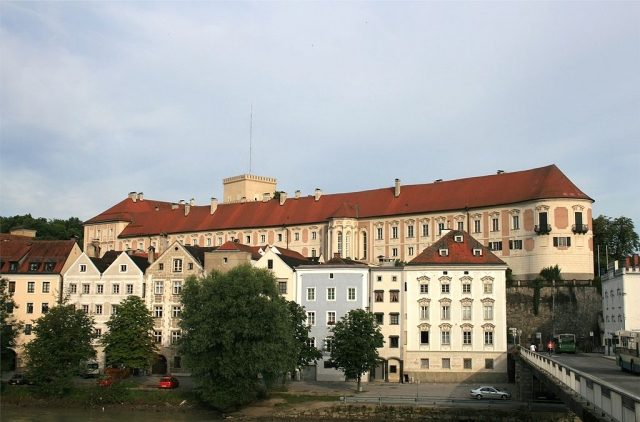
Lamberg Castle

Lamberg Castle is a castle in Steyr, Upper Austria. It is situated on a high terrace above the confluence of the Steyr and Enns rivers. The castle originated from the Styraburg, which gave its name to the city of Steyr and the federal state of Styria. Since the building was owned by the Lamberg family from 1666 to 1938, their name was transferred to the castle.
The Styraburg, Stiraburg, Styrapurg, or Styrapurch, was built at the beginning of the 10th century and first mentioned in a document in 985. It belonged to the Traungau counts (Otakars). In 1078, Otakar II is first mentioned in a document. In 1079, the Styraburg became his residence. In 1192, the castle came into the possession of the Babenbergs, and later the Habsburgs, due to the Georgenberg Charter. In 1666, the castle and its dominion came into the possession of the Counts of Lamberg. In 1727, the complex was destroyed by a fire and rebuilt by Johann Michael Prunner. Around 1750, the dominion belonging to the castle was the largest landed estate in Upper Austria. The castle was severely damaged during the Coalition Wars in 1800, 1805, and 1809. The Roman Tower received its current distinctive crenellated platform after the city fire of 1824.
Vollrat Count Lamberg sold Lamberg Castle, along with its extensive forest holdings in the Enns and Steyr valleys, to the German Reich (Deutsche Reichsforste) in 1938. After World War II, Lamberg Castle initially came into the possession of the state of Upper Austria and in 1961, the Federal Forests. On the occasion of Steyr's 1000th anniversary in 1980, the castle was restored starting in 1977 – in 1980, it hosted the provincial exhibition on the Hallstatt culture.
Today, it is used for cultural events, among other things.
Founding Legends
In the legend of Biterolf and Dietleib, the founding of the castle is associated with Attila the Hun King, who appears here as Etzel. The Visigoth Biterolf was Prince of Toledo, but for several years participated in Etzel's campaigns as part of his retinue. He left behind his wife Dietlinde, his son Dietleib, and his daughter Künhilde. When Dietleib had grown up, he left home against his mother's will and sought his father. After a stopover at King Gunther's court in Worms on the Rhine, he finally arrived at Etzel's court, where Margrave Rüdiger of Pechlarn greeted him. Like his father, he joined Etzel's enterprises and distinguished himself, like Biterolf, in a Polish campaign. However, since neither father nor son knew each other, Rüdiger of Pechlarn mediated this. After returning to the court, which is said to have been located in the lowlands between the Danube and the Theiss, Etzel rewarded Biterolf with the Steyerland. Father and son then built the Steyrburg on the rocky outcrop and named the land Styria. Afterwards, they rode back to Spain and brought Dietlinde and Künhilde to them. This tradition is then followed by the legend of the abduction of the beautiful Künhilde by the dwarf king Laurin.
Another tradition seeks to explain the castle's building site: Two brothers, both knights, rode through the area on horseback. When they reached the Tabor (the place where the Tabor Tower stands today), one decided to build the castle here on the hill, as this place was the most beautiful. His brother, however, insisted on the rocky outcrop at the confluence of the Enns and Steyr, as a safer building site. When they could not agree, they decided to fight, and according to the will of the victor, the castle was built on the rocky outcrop.
Points of Interest+
- Main Portal: The main portal in the southeast wing of the castle is accessible via Berggasse. It displays the coats of arms of the Lamberg and Harrach families.
- Roman Tower: The oldest part of the complex is the Roman Tower. The crenellated tower was the keep of the old castle. During its construction, ashlar blocks from the former Roman legionary camp Lauriacum are likely to have been used.
- Clock Tower: The clock tower from 1731 was originally covered with a dome-like cap.
- Staircase Vestibule: The hall of the baroque gatehouse leads into the staircase, from which the rooms of the police headquarters are accessible.
- Former Castle Chapel: The two-story baroque facade of the former castle chapel dominates the southeast wing. The chapel now serves as a ceremonial hall for the registry office.
- Courtyard with Fountain and Dwarf Figures: In the center of the courtyard, enclosed by the three main wings of the castle, there is a fountain from 1666. The water-spouting dog sculpture represents the heraldic animal of the Lambergs. The sandstone dwarf figures come from the dwarf garden of the former Gleink Abbey.
- Lower Castle Gate: The Berggasse leads through a Gothic archway to Lamberg Castle. The castle gate shows a view of the medieval castle beneath the Lamberg coat of arms. Emperor Frederick III and his son Maximilian I are depicted as knights in the fresco. In reference to the founding legend of Steyr Castle, the two are also interpreted as the knights who determined the castle's location through a duel.
Castle Park+
From 1476, a castle garden was laid out for the first time under Johannes Beckenschlager, the exiled Archbishop of Gran and later Archbishop of Salzburg. In March 1844, the former French ornamental garden received its current design as an English landscape park. It has been publicly accessible since July 23, 1919, and on August 1, the municipality leased it. In 1938, the Imperial Forest Administration took over the park along with Count Lamberg's allodial property, and in 1942, this property passed to the Reichsgau Oberdonau. From this, the city acquired the park along with greenhouses, a water tower, and a garden pavilion. The garden pavilion (Blumauergasse 1) remained unused for a long time and was only revitalized in 1969/72; the last renovation was in 2002. The Trinity Column at the Blumauergasse entrance dates from 1714 and previously stood on Leopold-Werndl-Straße. It received its current location in 1974.
Take Mobile History with you
You are reading this text for free. Premium adds what matters on the road: descriptions read aloud, sites found through your camera, whole regions taken offline.
- Every description, including the ~17,700 Premium sites
- Audio guide: have descriptions read to you on location
- AR finder: see sites through your camera, with distance and bearing
- Unlimited saved sites
14 days free, then from €2.99 a month. Cancel anytime.
Source: Wikipedia · Licence: CC BY-SA 4.0 · Image: http://commons.wikimedia.org/wiki/File:Schloss_Lamberg.jpg
This description draws on the facts documented in the linked Wikipedia article; Wikipedia content is licensed under CC BY-SA 4.0. Wording and editing: Mobile History.
Location: 48.0417, 14.4189