CastleLangenselbold

Langenselbold Castle
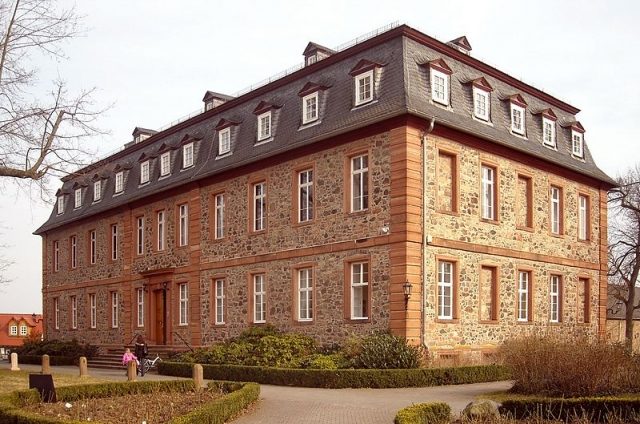
Langenselbold Castle

Public library
Local government


Langenselbold Castle was built by the Counts of Isenburg-Birstein in Langenselbold between 1722 and 1752 (with interruptions).

The building site was the grounds of the Selbold Premonstratensian canons' monastery, dissolved in 1543. The architect was the master builder of the County of Hanau, Christian Ludwig Hermann, who worked on this project and for the parallel construction project of the Evangelical Parish Church of Langenselbold for Count Wolfgang Ernst von Isenburg-Birstein.

The complex consists of six individual buildings, some of which are grouped in pairs around the four sides of an inner courtyard measuring 95x127m. A Baroque garden was originally laid out here, whose central fountain was later moved to Birstein Castle. On the eastern and western long sides of the courtyard are barns and coach houses, on the southern narrow side is a building that formerly contained servants' quarters and is now used as a restaurant. All these buildings are single-story. The northern side of the complex consists of two two-story buildings with mansard roofs. The western one, from 1722, is the oldest of the complex and served as a granary. The eastern one, from 1749, is the youngest of the ensemble and was the stately residential building. Inside are several rooms with Rococo furnishings, silk wallpapers, and paintings from the period of construction, including a portrait of Elector-Archbishop Clemens August of Cologne by George Desmarées and one of Landgrave Wilhelm VIII of Hesse-Kassel by Johann Heinrich Tischbein the Younger. Another part of the furnishings comes from the circle around Johann August Nahl.

Christian Ludwig von Isenburg-Birstein moved into the castle in 1757 after resigning from military service. His father, Count Wolfgang Ernst, took care of the furnishing.

In 1940, the city of Langenselbold bought the granary and converted it into the town hall after the Second World War; in 1976, it bought the rest of the complex. A lifelong right of residence remained for some members of the princely family. This included the art historian Princess Margarete von Isenburg. The former stately residential building now houses the municipal library, meeting rooms, and a ballroom.

Take Mobile History with you

You are reading this text for free. Premium adds what matters on the road: descriptions read aloud, sites found through your camera, whole regions taken offline.

  • Every description, including the ~17,700 Premium sites
  • Audio guide: have descriptions read to you on location
  • AR finder: see sites through your camera, with distance and bearing
  • Unlimited saved sites

14 days free, then from €2.99 a month. Cancel anytime.

Source: Wikipedia · Licence: CC BY-SA 4.0

This description draws on the facts documented in the linked Wikipedia article; Wikipedia content is licensed under CC BY-SA 4.0. Wording and editing: Mobile History.

Location: 50.1743, 9.0378