CastleWandlitz - Lanke

Lanke Castle

Lanke Castle

To be privately owned

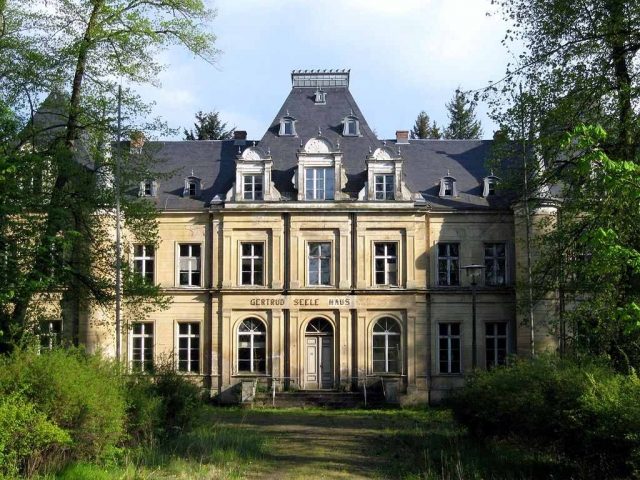
Lanke Castle is a former possession of the comital family von Redern in the village of Lanke near Hellsee. Based on a baroque country house, it was expanded and redesigned in the mid-19th century as a two-story plastered building in the style of the French Renaissance by architect Eduard Knoblauch. After passing into Berlin ownership in 1914 and undergoing several reuses, it has been back in private ownership since 2006 and is currently being renovated in accordance with monument protection regulations for private residential purposes, holiday apartments, and cultural use.

Conversion of a former manor into the von Redern Castle

When Knoblauch received the commission to convert the baroque manor house, which had existed since the 17th century, into a stately castle, he presented the builder and new owner, Count Friedrich Wilhelm von Redern, with ten hand drawings as a preliminary project for the new Redern Castle in Lanke around 1853. Knoblauch incorporated parts of the previous manor house (especially the historic groin-vaulted cellars) of the Counts von Sparr into his building plans.

Architecture and Park

Since the mid-19th century, the main building has featured steep hip roofs, a three-axis central risalit, and two-axis side risalits, framed by eight corner towers. The facade design corresponds to the French Renaissance style. Around 1859, the conversion of the building complex at Lanker Dorfstrasse 9–10 was completed according to Knoblauch's plans.

In addition to the main house, the castle complex includes the old octagonal stable, the Green House, the two-winged coachman's house made of brick half-timbering in the Swiss style, and the farmyard with the estate manager's house, distillery with chimney, cattle shed, forge, farm barn, and granary, as well as the two stable buildings of the shepherd's farm and the shepherd's residence. The outbuildings were skillfully adapted stylistically to the design of the main house.

The park, which adjoins to the southwest towards Hellsee, was redesigned in the style of an English landscape park according to plans by Peter Joseph Lenné even before the castle's conversion. The park is in a Sleeping Beauty slumber and is also part of the monument ensemble. Among the structural elements preserved in the park are a fountain basin and the burial site on the artificial burial island of the von Wülknitz family. This artificially created island forms the end of the axis of the garden hall of Lanke Castle – garden theater – fountain.

Uses+

1315 to 1826/27

Lanke was first mentioned in a Latin document dated December 24, 1315. Around 1415, Lanke came into the possession of Biesenthal Castle and thus fell to the old Marchian noble family von Arnim. In 1620, the property was sold to Friedrich von Götze. During the Thirty Years' War, the settlement was almost completely burned down. It was not until Field Marshal Otto Christoph von Sparr zu Prenden bought the abandoned farms of Lanke from Electress Luise Henriette in 1654, following the Thirty Years' War, and combined them into an outpost. After his death in 1668, the property came into the ownership of the von Happe families - who built the first permanent knight's seat with stately buildings. Subsequent owners were the von Holwede families in 1763/64 and von Wülknitz (1783). Major Hans Heinrich Otto von Wülknitz established a perpetual family fideicommiss in Lanke. His only son, Heinrich Otto von Wülknitz, decided to sell the Lanke estate in 1826.

1826/27 to 1932

In 1826/27, a leading member of the comital family von Redern, the theater director of the Royal Stages of Berlin, Chamberlain Friedrich Wilhelm Graf von Redern, acquired the Lanke estate with the villages of Prenden, Ützdorf, Werder, Sophienstädt, and Neudörfchen. Count Redern was one of the most important personalities in Berlin's intellectual life. With approximately 4,500 hectares of land, Lanke was the largest of the 45 Redern possessions and became the Count's favorite residence after Berlin.

The estate and castle were leased several times by the von Redern family. The last tenant was the Privy Councillor of Commerce Fritz von Friedlaender-Fuld since 1894. In 1914, the great-grandson of Count von Redern sold the entire property of the castle, estate, surrounding park, arable land, and forests for 20 million Reichsmarks to the city of Berlin, which integrated it, among other things, into its concept of local recreation for city dwellers. Friedlaender-Fuld remained the tenant. He waived his right of first refusal but had the right of residence and the lease agreement guaranteed for 25 years by the Berlin City Council. Fritz von Friedländer-Fuld lived in Lanke Castle until his death in 1917. After that, it was only inhabited by the family during the summer months until 1932. In March 1920, his daughter Marie-Anna married the Frankfurt banker Rudolph de Goldschmidt-Rothschild at Lanke Castle.

1932 to 2006

During the 1930s and 1940s, Lanke Castle had a checkered history. In 1939, the Reich Labor Service was housed in its rooms, from June 1945 a military hospital, and in the same year, a Soviet commandant's office. In 1947, the conversion into a hospital was decided. Lanke, which until then was under the administration of the Berliner Stadtgüter GmbH as the Lanke Estate Administration, became the Lanke People's Estate in 1949. Lanke Castle was renamed Gertrud Seele Hospital on January 12, 1951 – in memory of the nurse of the same name. From 1966 to 1968, the castle stood empty, and since then, it was used as an outpatient clinic of the Eberswalde District Hospital until the 1990s.

After the nursing home moved out in the late 1990s, the buildings stood empty for several years. In 2005, the State of Berlin leased the castle ensemble to the Temporär e.V. association for interim use, which organized cultural events there in the summer but did not develop any activities for the preservation of the buildings or the park.

Renovation, Development, and Future Use

The castle was finally sold by the State of Berlin and has been back in private ownership since 2006. Since then, it has been renovated in accordance with monument protection regulations. In addition to the owners' living areas, a salon for cultural events and several holiday apartments are to be created.

In the park, against the backdrop of the castle, individual events have already taken place with the support of the new owners, such as photo and film shoots or a benefit jazz concert in the summer of 2009, which raised funds for the restoration of the chapel of the Lanke cemetery. Further such events are planned.

A date for the completion of the renovation work has not been set; investments are being made gradually and taking into account aspects of monument preservation. The private commitment to the renovation of Lanke Castle ensures both the preservation of the listed complex and contact with the residents of Lanke and their guests.

Take Mobile History with you

You are reading this text for free. Premium adds what matters on the road: descriptions read aloud, sites found through your camera, whole regions taken offline.

  • Every description, including the ~17,700 Premium sites
  • Audio guide: have descriptions read to you on location
  • AR finder: see sites through your camera, with distance and bearing
  • Unlimited saved sites

14 days free, then from €2.99 a month. Cancel anytime.

Source: Wikipedia · Licence: CC BY-SA 4.0 · Image: http://commons.wikimedia.org/wiki/File:Schloss_Lanke_06.jpg

This description draws on the facts documented in the linked Wikipedia article; Wikipedia content is licensed under CC BY-SA 4.0. Wording and editing: Mobile History.

Location: 52.7598, 13.5657