Hospital
Lauersfort Castle

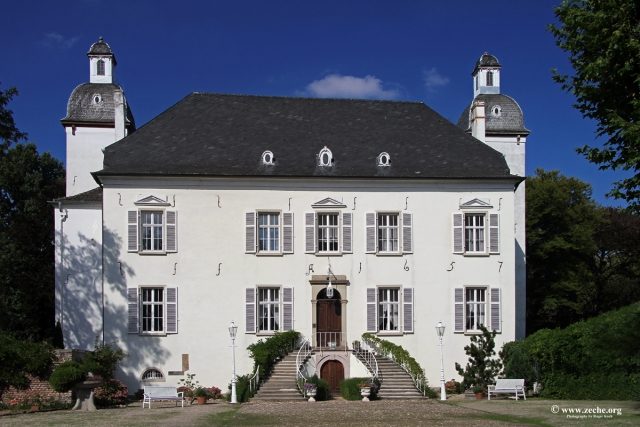
Lauersfort Castle in Moers-Holderberg is a moated castle and former knight's estate, whose oldest part, the outer bailey, dates from the 14th century. The original owners were the Lords of Friemersheim, who received Lauersfort as part of a fief from Werden Abbey. The name of the castle derives from "Löwenfurt" (Lion's Ford) and refers to the heraldic animal, a red lion on a golden background, of the Lords of Friemersheim.
In the oldest document from 1344, "Sweder von Vrimmersheim" is listed as the enfeoffed tenant. The next documented owner in 1399 was Bernt von Sleswig, as the Lords of Friemersheim had in the meantime pledged the estate to the Counts of Moers, and the "Lordship of Friemersheim" now belonged to the County of Moers. In 1403, the estate was divided, and for the second part of the estate without the farmstead, the Counts of Kleve were now responsible as feudal lords. The other part with the knight's seat was granted as a fief by the Counts of Moers to "Sibert von Eyll" and remained in this family until the end of the 16th century. Reinhard von Eyll received the estate as the last enfeoffed tenant in 1576.
After the death of Reinhard von Eyll, in 1590, the Droste family Pelden, called Cloudt, became the enfeoffed tenants and owners of the knight's estate. Jost Winrich II. von Pelden had married Katharina von Eyll. Already in 1558, his father Wilhelm von Pelden had been made Droste of the County by Count Herrmann von Neuenahr-Moers (1520–1578). Jost Wirich was also appointed Droste by the Oranges in 1600. The estate now remained as a manor house in the family von Pelden, called Cloudt, until 1811, and was sold in that year to the widow vom Rath.
The west wing of the estate was built around 1650. The current castle building was erected as a manor house in 1716. Its ground floor houses the so-called "Schinkel Hall," which was designed according to the plans of Karl Friedrich Schinkel. The park behind the manor house, like Moers Castle Park, was laid out as a landscape garden according to the plans of Maximilian Friedrich Weyhe, who also designed the Düsseldorf Hofgarten. The castle and the adjacent Peterhof, built in 1830 on behalf of Peter vom Rath, have been in the private possession of the Block family since 1976. The Peterhof, also designed in the style of Schinkel, has housed a specialized clinic for drug addicts of the Diakoniewerk Duisburg since 1981.
Lauersfort Phalerae+
On November 12, 1857, during drainage work on the knight's estate, the Lauersfort Phalerae were recovered, which have since been exhibited in the Berlin Collection of Classical Antiquities. Copies can be seen in the Burg Linn Museum Center.
Take Mobile History with you
You are reading this text for free. Premium adds what matters on the road: descriptions read aloud, sites found through your camera, whole regions taken offline.
- Every description, including the ~17,700 Premium sites
- Audio guide: have descriptions read to you on location
- AR finder: see sites through your camera, with distance and bearing
- Unlimited saved sites
14 days free, then from €2.99 a month. Cancel anytime.
Source: Wikipedia · Licence: CC BY-SA 4.0 · Image: http://www.zeche.org/
This description draws on the facts documented in the linked Wikipedia article; Wikipedia content is licensed under CC BY-SA 4.0. Wording and editing: Mobile History.
Location: 51.4117, 6.6072