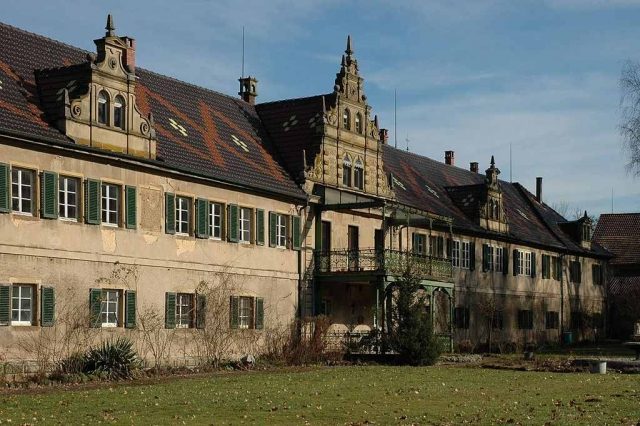
CastleOedheim

Lautenbach Castle

Lautenbach Castle

To be privately owned

Lautenbach (formerly also Latenbach or Lutenbach) is a manor with its own district within the municipality of Oedheim in the district of Heilbronn in Baden-Württemberg. The first traces of settlement are known from the Mesolithic period; in the Middle Ages, a village that has since disappeared was located here. After a checkered history, a castle in the Neo-Renaissance style was built at the end of the 19th century under August Freiherr von Wächter.

Prehistory and Antiquity

In the area around Lautenbach, there are traces of settlement from the Mesolithic period: in addition to pottery shards and a flint knife, a burial site from this period was found. Neolithic finds also include the remains of a settlement with pottery shards, tools, and burial mounds north of the present-day farm.

Middle Ages

The name Lautenbach was first mentioned in documents in 1254 in connection with the Lichtenstern Monastery. In 1335, a village was first documented when Engelhard VII von Weinsberg sold the lordship of Scheuerberg, including the Lautenbach district, to the Archbishopric of Mainz. In 1467, Lautenbach, along with the surrounding villages, came into the possession of Hans von Sickingen, and in 1484, through exchange, to the Teutonic Order. After 1484 – possibly during the German Peasants' War – the place was destroyed, and the inhabitants settled in Oedheim and Dahenfeld. Other known landowners in Lautenbach in the 14th century included the Ritterstift Wimpfen, the Schönthal Monastery, the Lords of Sindringen, and the Capler von Oedheim family.

Later, Lautenbach was mentioned in the form of two hamlets or farms, the Lautenbacher Hof and the Mönchhof or Helmstadter Hof. While the Lautenbacher Hof remained continuously in the hands of the Teutonic Order until 1687, the Mönchhof experienced numerous changes of ownership. In 1419, Philipp von Wittstatt received the farm as a reward for his loyal service from the Count Palatine; in 1490, von Wittstatt sold it to the Carmelite monastery in Heilbronn, which renovated the farm and later leased it to the Teutonic Order officials of the Scheuerberg office. In 1525, Wilhelm von Wittstatt, Philipp's son, unsuccessfully demanded the farm back. Instead, the Carmelites sold it in 1537 to Eberhard von Gemmingen zu Bürg († 1572).

16th to 18th Century

In 1621, the property passed by inheritance through Elisabetha von Gemmingen to Georg Philipp von Helmstädt, who in turn sold it in 1624 to the Teutonic Order under Karl von Österreich. In 1643, Karl Friedrich von Helmstädt attempted to regain the farm by contesting the 1624 sale. The years-long legal dispute only ended with the extinction of the Helmstädt family during the Thirty Years' War, which also led to the destruction of the Helmstadter Hof, whose estates subsequently lay fallow.

After the Thirty Years' War, the Teutonic Order restored the two farms around 1664 and united them, until on August 18, 1687, it sold the entire district due to poor yields to the later Heilbronn mayor Johann Esaias von Rühle. In 1726, Lautenbach passed by inheritance to Rühle's daughter Johanna Elisabeth von Rühle, widow of the Royal Prussian Chief War Commissioner Daniel Heinrich Frederking, and later to their common son, the imperial Lieutenant Colonel Johann Friedrich von Frederking. Under the von Frederking family, the farm experienced an economic boom through the acquisition of land and numerous investments and was considered a model enterprise.

After a 60-year hiatus, the Teutonic Order reappeared in Lautenbach for the first time in 1747 by contesting the 1687 sale, thereby again triggering a lengthy legal dispute that was only decided on June 9, 1777, by the Imperial Chamber Court in Wetzlar in favor of the von Frederking family, at a time when they had already sold Lautenbach again: On January 14, 1772, the city of Heilbronn under Georg Heinrich von Roßkampff became the new owner, after the Teutonic Order had also expressed interest in purchasing. From 1772 to 1823, the city leased the farms, whose district in 1780 comprised 926 Morgen of land.

Since the 19th Century

After failed sales in 1814 and 1818, Lautenbach passed on August 1, 1823, to the Legation Councillor August Heinrich Christoph von Wächter (* 1776; † 1852), who paid a purchase price of 75,000 guilders for the estates. To obtain Oedheim citizenship, his son Johann August Freiherr von Wächter applied in 1855 for Lautenbach to be incorporated into the municipality of Oedheim. Together with Willenbach, the new status of a partial municipality with its own district came into force in 1860 and lasted until 1936.

Von Wächter distinguished himself through his extensive social commitment: he supported the children's brine bath in Jagstfeld and organized an annual children's festival. In 1860, he founded a foundation for a new school, whose assets were used in 1909 for the construction of the Backhausschule in Oedheim.

Under Wächter's direction, the castle, which at its core consists of buildings from the 17th or 18th century, received its present form in the Neo-Renaissance style; other residential and operational buildings were also renovated and beautified. In addition, a park-like complex with a pavilion and tree-lined avenues was created. The family also acquired hunting rights in the Lautenbach, Willenbach, and Oedheim districts. The farm developed well and was considered a progressive operation. In 1843, 18 people worked permanently on the estate, as well as numerous day laborers from the surrounding area. At that time, the farm included 4226 fruit trees, and 131 cattle and 203 sheep were counted. In 1856, the dirt road to Oedheim was expanded into a paved road.

In 1869, the von Wächter family handed over the farm to a tenant named Heinrich Landes, whose family still manages it today in the fourth generation. The owners of the manor now lived mainly in Stuttgart but returned to their country estate during the summer months. Baroness Josephine von Wächter (*1833; † 1930) was a sister-in-law of Count Alfred von Waldersee, who had married her younger sister Mary Esther (*1837; † 1914) in Lautenbach in 1874 and subsequently often visited Lautenbach Castle with his wife.

In 1923, the first tractor was put into operation, and in 1925, a steam plow. Most recently, the Lautenbacher Hof comprised around 240 hectares of cultivated land, and there were 300 fattening pigs. It is currently no longer farmed. The owner today is a community of heirs, after Wilhelmine Pauline Blanche, the last representative of the von Wächter family, died in 1941.

Take Mobile History with you

You are reading this text for free. Premium adds what matters on the road: descriptions read aloud, sites found through your camera, whole regions taken offline.

  • Every description, including the ~17,700 Premium sites
  • Audio guide: have descriptions read to you on location
  • AR finder: see sites through your camera, with distance and bearing
  • Unlimited saved sites

14 days free, then from €2.99 a month. Cancel anytime.

Source: Wikipedia · Licence: CC BY-SA 4.0 · Image: https://commons.wikimedia.org/wiki/File:Schloss_Lautenbach_Feb2008.jpg

This description draws on the facts documented in the linked Wikipedia article; Wikipedia content is licensed under CC BY-SA 4.0. Wording and editing: Mobile History.

Location: 49.2185, 9.2766