CastleLéchelles

Lechelles Castle

Lechelles Castle

To be privately owned

From the end of the 16th century, the von Gottrau family owned a property in Léchèlles. The sparse sources referring to the history of the lordship explain that Francois-Stein-Nicolas von Gottrau (1705-1770) had the existing building restored, or largely rebuilt - perhaps with a view to his marriage to Marie-Françoise von Reynold in 1743. The main stages of Pierre von Gottrau's political career were his election to the municipal council of Fribourg in 1727, his election to the Council of Sixty and his nomination as municipal chancellor in 1742, then his involvement in intelligence in 1745 and as Vogt of Attalens in 1762.

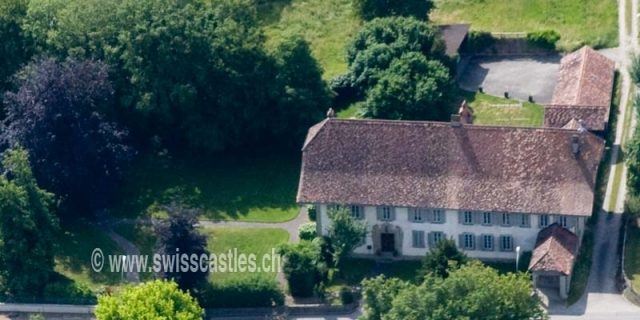
Gottrau Castle proves to be a two-story construction on an elongated floor plan with a half-hipped roof with an overhang. Almost without any rhythm and without any plastic ornamentation, the castle would give the impression of modest rural architecture, were it not for the eastern wall, whose trompe-l'oeil paintings transform it into a baroque facade. For this work, von Gottrau employed the Rorschach painter Melchior Eggmann (born in 1711), whose talent he recognized when he viewed the ceiling paintings of the summer dining room in the Augustinian monastery (1748) in Fribourg.

In Léchèlles, the trompe-l'oeil paintings very skillfully hide the facade irregularities: the entrance on the eastern front was slightly offset, and to create a successful optical illusion that it was re-aligned with the axis, the artist painted a second identical opening as an extension of the real door. He then framed the whole with a precious gate with columns and carved cornices. He crowned it with the coats of arms of Gottrau and Reynold. A facade staircase, completely integrated into this simulated architecture, increasingly deceives the viewer. The four windows on the ground floor and first floor also show elements of painted architecture with moldings and volute gables.

On the attic floor, a trompe-l'oeil projection "carries" two windows that simulate flat-bottomed roof hatches. On the south side, the door leading to the antechamber and the one opening to the cellar are integrated into an architectural composition with Tuscan columns and gables populated with allegorical figures and putti: it is another optical illusion that compensates for the height differences of the two doors. The painting of the northern facade contrasts with the frame of the double door and is adorned with more frivolous forms and Rococo inspiration. Before this commission in Léchèlles, Melchior Eggmann had already had the opportunity to prove his talent on the facade.

Indeed, in 1740, in the Brandenberg House (Sankt Oswaldgasse in Zug), he executed paintings which - as in Léchèlles - adorned the asymmetry of a late Gothic facade through optical illusion.

Take Mobile History with you

You are reading this text for free. Premium adds what matters on the road: descriptions read aloud, sites found through your camera, whole regions taken offline.

  • Every description, including the ~17,700 Premium sites
  • Audio guide: have descriptions read to you on location
  • AR finder: see sites through your camera, with distance and bearing
  • Unlimited saved sites

14 days free, then from €2.99 a month. Cancel anytime.

Source: Wikipedia · Licence: CC BY-SA 4.0

This description draws on the facts documented in the linked Wikipedia article; Wikipedia content is licensed under CC BY-SA 4.0. Wording and editing: Mobile History.

Location: 46.8282, 7.0155