Restaurant
CastleWleń (Lähn)
Lehnhaus Castle
More pictures
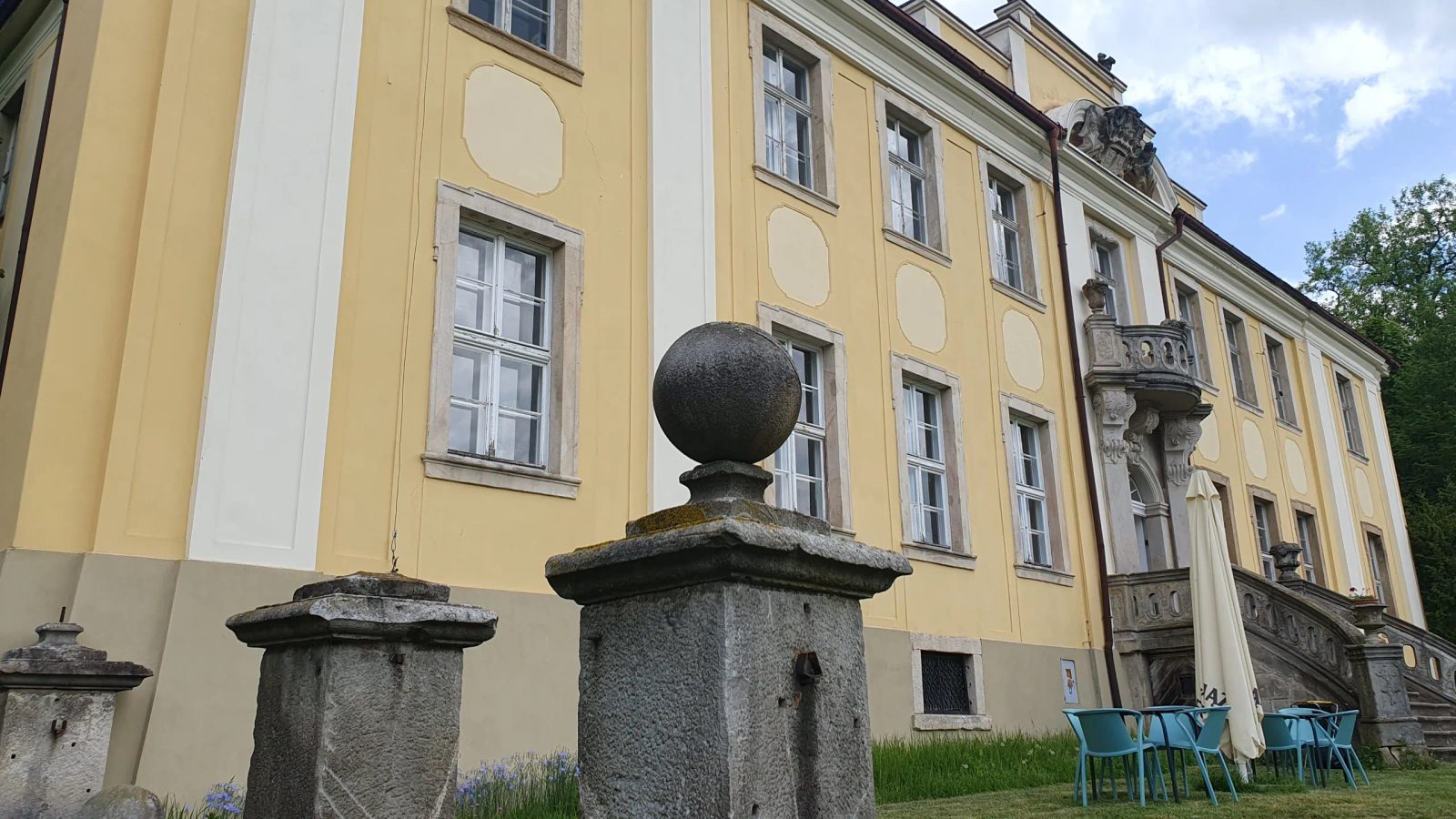
Lehnhaus Castle (Polish Pałac Lenno) in Wleń in the Lwówecki County of the Lower Silesian Voivodeship in Poland stands on a mountain saddle below Lehnhaus Castle.
History+
The castle presumably dates back to a fortified house from the 16th century. In 1652, Heinrich von Reichenbach owned Lähnhaus. The house was acquired in 1653 by the French colonel Adam Koulhas, which is why it was also called Kohlhaus. In 1662, he built the stately castle a little further downhill. In the same year, he also had the new castle church (Hedwigskirche) built. After Koulhas' death, his widow Anna Ursula, née von Debschütz und Neukemnitz, remained in possession of Lähnhaus until her son Leopold Rudolph took it over in 1685. After his death, Andreas Wilhelm von Grunfeld und Guttenstädten became the new owner in 1728 and had the building transformed in Baroque style around 1750. His son Friedrich Wilhelm von Grunfeld und Guttenstädten (1726–1783), district administrator of the Löwenberg-Bunzlau district, was the heir to the castle fief. This fief in turn passed to his son Friedrich Gotthard Ehrenreich von Grunfeld und Guttenstädten (1755–1804). He had been married to Charlotte Auguste von Richthofen from the house of Leschwitz since February 1, 1785. After his death, she had a stele of gray-blue marble with allegories of religion, the angel of death, and the broken coat of arms of the family erected by Gottfried Schadow not far from the castle. She also took care of the preservation and improvement of the estate. In 1808, she married Georg Friedrich von Tempsky auf Ottendorf in her second marriage. When his only son Friedrich Wilhelm Leopold fell on May 26, 1813, near Hainau, she also had a monument erected for him in the small house between the castle garden and the old castle. After 1827, the castle was owned by the von Haugwitz family. In 1933, a severe fire destroyed the interior of the castle. After 1945, the castle was used as a sanatorium by the Polish State Railways. Today, the castle is restored and has a café and guest rooms.
Structure+
The building has nine axes with two side risalits and a narrow central risalit. A vaulted gable bears the marital coat of arms of the von Grunfeld and von Unruch families. Inside, the Baroque staircase and wall paintings created around 1800 are preserved.
Take Mobile History with you
You are reading this text for free. Premium adds what matters on the road: descriptions read aloud, sites found through your camera, whole regions taken offline.
- Every description, including the ~17,700 Premium sites
- Audio guide: have descriptions read to you on location
- AR finder: see sites through your camera, with distance and bearing
- Unlimited saved sites
14 days free, then from €2.99 a month. Cancel anytime.
Source: Wikipedia · Licence: CC BY-SA 4.0 · Image: Foto: Jörg Heldt (Community)
This description is a machine translation of an excerpt from the linked Wikipedia article. The source text was written by its authors, the translation is by Mobile History; like the original it is licensed under CC BY-SA 4.0.
Location: 51.0161, 15.6629