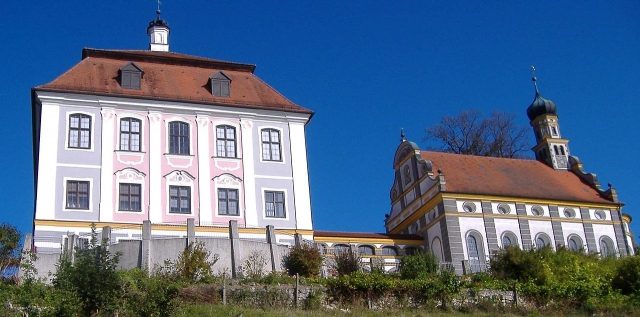
CastleLeitheim

Leitheim Castle

Leitheim Castle

To be privately owned
Cultural Events


Schloss Leitheim, the former summer residence of the abbots of the nearby Kaisheim Monastery, is a three-story square building situated on a hill above the north bank of the Danube near Donauwörth, with a distant view of the Danube-Lech plain. The entire area was built as a prototype of a representative spiritual manor.

The court of Litun (Leiten, today Leitheim) was first mentioned in 1147, and a chapel is documented here in 1185. Until 1770, profitable viticulture was practiced on the Danube slopes (in peak years up to 50,000 liters of wine):

The potential of the Leitheim vineyards, which were operated and cultivated as a kind of 'outpost' in the founding years of Kaisheim Monastery, was only recognized by the 20th Cistercian Abbot Leonhard Weinmayr: Nomen est omen. In 1427, he ensured the extensive expansion and cultivation of viticulture.

In 1542, the Leitheim vineyard was surrounded by a solid wall and a magnificent vintner's house was built, from which one could 'see the entire imperial city of Augsburg with the most splendid prospect on a clear day.'

Abbot Elias Götz had the court complex, which had been destroyed during the Thirty Years' War, expanded into the representative summer residence of Kaisheim Monastery:

After a construction period of 15 years, the castle and church were completed, thus completing the core of the present complex in 1696. An impressive arcade connected the initially two-story manor with the St. Blasius Church, named after the local saint. From 1748-1750, the square castle building received a third story and its mighty mansard hip roof.

In 1751, the art-loving Abbot Coelestin I. Mermos had the castle decorated as a magnificent residence with a large ballroom in Rococo style. Particularly noteworthy is one of the most significant fresco cycles of Southern German Rococo, designed by Gottfried Bernhard Göz, which forms a unified iconographic concept: the five senses, the four elements, the four temperaments, and the periodic time cycles of the four ages of life, the four seasons, and the alternation of day and night and night and day.

After the secularization (1802), difficult times began for the castle and church. It was considered to demolish both buildings. Finally, in 1820, King Maximilian I Joseph of Bavaria arranged the sale of the property to his chief court master and later chief court marshal Friedrich Ludwig Camil Marquis de Montperny. He furnished living quarters in the Biedermeier style. When the painter Joseph Carl Cogel visited him, the Brussels-born artist Cogel died on Tuesday, May 31, 1831, at the small Danube castle.

Through marriage, Schloss Leitheim passed to the Barons Tucher von Simmelsdorf in 1835. Albrecht Freiherr Tucher von Simmelsdorf began in 1953 with the consistent safeguarding of the castle, which was severely endangered in its substance. In 1959, he also founded the Leitheim Castle Concerts. In 1983, the "Freundeskreis Schloß Leitheim e. V." (Friends of Schloss Leitheim) was founded.

In 1997, another extensive overall safeguarding of the building fabric took place. In 2008, the entire area passed to the Messerschmitt Foundation. Although the castle church is owned by the Catholic Church, the new owner took over the patronage. The Tucher von Simmelsdorf family continues to be responsible for the annual castle concerts and other events.

Take Mobile History with you

You are reading this text for free. Premium adds what matters on the road: descriptions read aloud, sites found through your camera, whole regions taken offline.

  • Every description, including the ~17,700 Premium sites
  • Audio guide: have descriptions read to you on location
  • AR finder: see sites through your camera, with distance and bearing
  • Unlimited saved sites

14 days free, then from €2.99 a month. Cancel anytime.

Source: Wikipedia · Licence: CC BY-SA 4.0

This description draws on the facts documented in the linked Wikipedia article; Wikipedia content is licensed under CC BY-SA 4.0. Wording and editing: Mobile History.

Location: 48.7419, 10.8834