To be privately owned
Lichtenau Castle

Lichtenau Castle is a castle complex in Upper Austria, located in the municipality of Lichtenau, about two kilometers northeast of the municipality of Haslach in the Mühlviertel region. A castle was built at the beginning of the 13th century, converted into a palace in the 17th century, and burned down in World War II. Since 1965, the castle has been rebuilt and is now in private ownership.
It is believed that the castle was built around 1217 as a refuge castle and belonged to the Rosenbergers. The first documented mention occurred in 1293, when the then owner Sifrit der Hugenberger died. Lichtenau was then a fief of the Rosenbergers. Sifrit was succeeded by his namesake son and later his grandson. In 1399, the castle came to Elisabeth Anhanger, a widowed Jörger. Her son, Hans Jörger, inherited the castle but did not live there. From Bernhard Jörger, the castle passed to the Oeder family before 1426.
Until 1483, the Wallseer were the feudal lords of the castle, and they enfeoffed Marx Oeder with Lichtenau. Through marriage, it came into the possession of the Herleinsperger family before 1555, remaining in their possession until 1624. Around 1594, during the time of the Turkish invasions, the castle was designated as a bulwark for the upper Mühlviertel. Under the Herleinsperger, the castle was converted into a fortified Renaissance castle at the beginning of the 17th century. Elisabeth Herleinsperger married Dietmar Schifer von Dachsberg in 1608, into whose possession the castle came after 1624. In 1661, the castle came through marriage as a dowry to Count Johann Secundus von Sprinzenstein, and in 1728, again through marriage, to Count Philipp von Welsberg. The dominion then included about 150 subjects.
Georg Fölser, a textile merchant from Haslach, bought the castle in 1831. In 1885, it again served as a dowry and thus came to the textile industrialist Heinrich Vonwiller. At the beginning of the 20th century, further alterations were made. After the end of World War II, the castle was occupied by Soviet soldiers, and a fire on September 8, 1945, destroyed parts of the castle. The severely damaged north and east wings were demolished. In 2001, the castle was sold. The new owners, the family of the expatriate Austrian B. A. Tibensky, carried out extensive general renovation and restoration, and the castle now serves as a second home. In 2004, the family was awarded the State Heritage Preservation Prize for the exemplary restoration of the entire complex. The castle is not open to the public.
Construction+
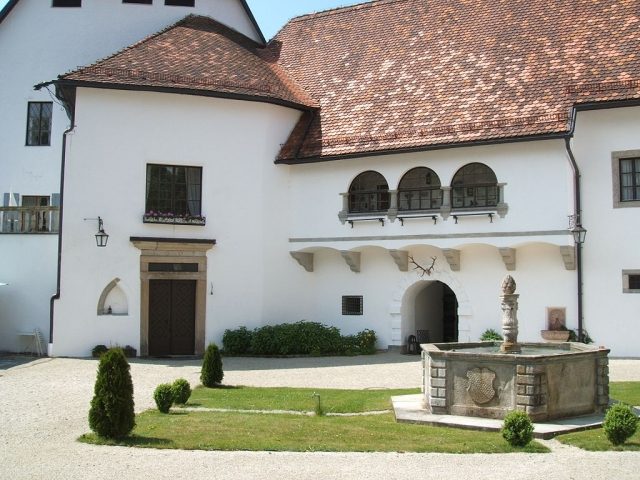
The castle is located above the Große Mühl on the southern edge of Lichtenau. It is surrounded by a landscaped garden with many old trees. The current complex consists of several buildings arranged around a trapezoidal inner courtyard. The entrance wing with the gatehouse in the north is best preserved. Roller holes in the portal indicate a former drawbridge; the dry moat was filled in around 1600 during the castle's conversion. From the street, the castle is entered through a multi-part, wrought-iron gate system that also leads into the park. A simple wall forms the eastern part.
In the south stands the almost square, tower-like main building, the Palas. The ground floor houses a Renaissance hall with a barrel vault with lunettes supported by a massive central pillar. A fireplace in this room is dated 1556, and the door frames are even older. The two upper floors of the main house have been largely restored. On the courtyard side, the main house has an arcaded gallery. In the west is the chapel, which occupies the entire west front. The chapel, to which a Renaissance portal leads, dates from around 1600. The ceiling is richly decorated and adorned with rib-like stucco bands.
In the castle courtyard stands a fountain with a hexagonal basin. On the side are the coats of arms of the Oeder and Herleinsperger families. The castle courtyard is designed in Renaissance style.
West of the castle stands the former Meierhof (manor farm), which was built in the first quarter of the 17th century.
Take Mobile History with you
You are reading this text for free. Premium adds what matters on the road: descriptions read aloud, sites found through your camera, whole regions taken offline.
- Every description, including the ~17,700 Premium sites
- Audio guide: have descriptions read to you on location
- AR finder: see sites through your camera, with distance and bearing
- Unlimited saved sites
14 days free, then from €2.99 a month. Cancel anytime.
Source: Wikipedia · Licence: CC BY-SA 4.0 · Image: http://commons.wikimedia.org/wiki/File:Palas-Lichtenau.JPG
This description draws on the facts documented in the linked Wikipedia article; Wikipedia content is licensed under CC BY-SA 4.0. Wording and editing: Mobile History.
Location: 48.5893, 14.0364