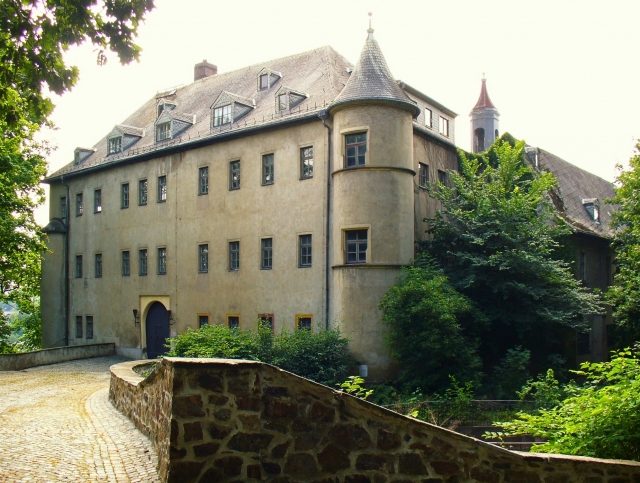
CastleLichtenstein

Lichtenstein Castle

Lichtenstein Castle

The Castle can be visited

Lichtenstein Castle is a Renaissance-style castle above the Saxon town of Lichtenstein. The castle stands at an elevation of 340 meters above sea level, about 300 meters northeast of the town center of Lichtenstein. It is located in a strategically advantageous position on a spur of land on the eastern high bank of the Rödlitzbach stream and is separated from the plateau of the hinterland by a formerly deep section ditch.

Description+

The main entrance is followed by a gate hall adorned with coats of arms and the castle courtyard, which has been surrounded by arcades since the 19th century. The open walkway of the upper floor was added later. At the top of the tower is a weather vane with the Schönburg family coat of arms.

In the Middle Ages, a drawbridge secured the entrance. The sliding channels for the bridge weights can now be seen in a room under the castle's access road.

From Angergasse to the castle, 178 castle steps lead up, overcoming a height of 34 meters.

From the palace near the castle, which was the center of the Saxon State Garden Show in 1996, the Käpplerschlucht gorge stretches to the district of Schäller, the timber use of which formerly belonged to the castle chaplain.

The castle was first mentioned in 1212 as "Castrum Lichtenstein" (disputed). The Schönburgs are named as the earliest owners of the castle, first attested in 1286, which was then still called a "Burg" (fortified castle). The first castle complex was single-story and had wooden battlements and a watchtower. Later, the defensive structure was built in ashlar masonry of porphyry.

During the Thirty Years' War, the castle was destroyed by the imperial army on August 18, 1632. In 1648, it was rebuilt in its present form and remained the center of the Schönburg feudal lordship of Lichtenstein until the 19th century. During the March Revolution of 1848, Klemens Wenzel Lothar von Metternich, a relative of the Schönburgs, is said to have hidden in the castle. Although the agitated populace forced a search of the castle, it was fruitless. In 1945, the owners were dispossessed and expelled by the communists.

Since 1945, the interior of the castle has been completely rebuilt and serves the Catholic Caritas Association as the "St. Elisabeth" retirement home.

In the 1950s, the local history enthusiasts of the Kulturbund uncovered the underground passages beneath the castle and the Schönburg family crypt, making them accessible for visits. At the entrance of the castle, a system of underground outer bailey passages, a torture chamber, and a dungeon were also discovered. Since 1999, the castle has been back in the possession of the Schönburg family; Prince Alexander von Schönburg-Hartenstein acquired it from the Diocese of Meissen.

Family Crypt+

The crypt was built in 1797 under the castle chapel. It contains the remains of 20 members of the House of Schönburg. Until 1958, the entrance was a ventilation shaft. The coffins, made of wood, zinc, copper, and cast iron, were lowered through an opening in the floor of the chapel.

One of the coffins stands slightly ajar. Otto Victor von Schönburg-Waldenburg feared being buried alive, so he had wooden wedges placed between the lid and the base. A rope led from the coffin through a hole in the crypt's ceiling to his chambers and was connected to a bell, which he intended to ring for his servants if he awoke from apparent death.

Take Mobile History with you

You are reading this text for free. Premium adds what matters on the road: descriptions read aloud, sites found through your camera, whole regions taken offline.

  • Every description, including the ~17,700 Premium sites
  • Audio guide: have descriptions read to you on location
  • AR finder: see sites through your camera, with distance and bearing
  • Unlimited saved sites

14 days free, then from €2.99 a month. Cancel anytime.

Source: Wikipedia · Licence: CC BY-SA 4.0 · Image: Thomas Eichler

This description draws on the facts documented in the linked Wikipedia article; Wikipedia content is licensed under CC BY-SA 4.0. Wording and editing: Mobile History.

Location: 50.7578, 12.6347