CastleNiederwiesa-Lichtenwalde

Lichtenwalde Castle
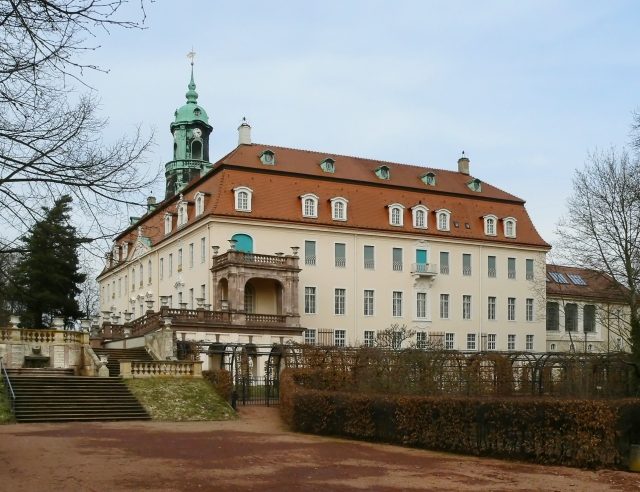
Lichtenwalde Castle

Museum
Public library


Lichtenwalde Castle is a Baroque castle located in the eponymous district of the municipality of Niederwiesa in the Mittelsachsen district, owned by the Free State of Saxony. The castle is surrounded by a Baroque park with numerous water features, which was named one of the most beautiful parks in Germany in 2005.

Castle

Around 1230, a castle complex was built on the left bank of the Zschopau, 60 m above the valley. The Margraves of Meissen are considered to be the builders, who had colonized the entire surrounding area south and west of the river some years earlier from Rochlitz. The castle initially served as a bulwark against the imperial immediate lordships of Mildenstein and Schellenberg to the north and east and was administered by a margravial castellan, in which capacity a knight Heidenreich von Lichtenwalde served in 1280.

After the castle was administered by the Empire for a short time at the end of the 13th century, it fell back to the Margraves in 1307, who pledged the property with all its appurtenances to the Burgraves of Meissen in 1336 and later also enfeoffed them with it. The Burgraves, in turn, granted the castle some years later to the von Honsberg family, who ruled here until 1439, while the burgravial feudal suzerainty had already fallen back to the Margraves in 1426. In 1439, Apel Vitzthum the Younger of Roßla and Konrad von Stein exchanged their possessions with those of Honsberg and thus became the new owners of the castle and lordship, but lost them again in the course of the Saxon Fratricidal War in 1447.

From 1447 to 1561, the new owners were the von Harras, an old noble family originating from Thuringia. Initially, Hermann von Harras was enfeoffed with Lichtenwalde in 1447. The most important representative of the family was Dietrich von Harras († 1499), who took over the castle from about 1474 after the death of his mother Ilse together with three brothers. This Dietrich von Harras is the one from the Harras legend, to whom Theodor Körner erected a lasting monument in his ballad "Harras the Bold Jumper".

After Dietrich's death, the lordship first passed to his son Georg II von Harras († 1538) and then to Eustachius von Harras, who had the old castle converted into a residential palace in 1550 and died in 1561 without male heirs, whereupon the lordship of Lichtenwalde fell to the Electorate of Saxony and was transformed into a princely office.

In 1694, the von Bünau family acquired Lichtenwalde in exchange for Pillnitz near Dresden, which Elector Johann Georg IV wanted to give to his mistress Magdalena Sibylla von Neitschütz.

Palace

In 1719, Jakob Heinrich Count von Flemming bought the indebted property of the von Bünau family at auction and sold it in 1722 to Christoph Heinrich Imperial Count von Watzdorf († 1729), who had the remains of the old castle as well as the Harras palace demolished and erected a large Baroque palace in their place. His son Friedrich Carl von Watzdorf († 1764) had an extensive park laid out around the complex from 1730 onwards.

When Watzdorf died without descendants, Lichtenwalde came into the possession of his widow, Henriette Sophia, née Countess Vitzthum von Eckstädt, in 1764. Thus, after more than 300 years, the property once again came to the Vitzthums. The Counts Vitzthum von Eckstädt remained lords of Lichtenwalde until their expropriation in 1945.

The building suffered severe damage due to a major fire that destroyed the roof and upper floor on Walpurgis Night in 1905. Until 1908, the lord of the castle, Friedrich Count Vitzthum von Eckstädt, had it rebuilt by the Dresden court architect Gustav Fröhlich, largely true to the original, but with eclectic alterations.

In July 1945, the Russians confiscated the castle and expelled the last lady of the castle, Sibylle Countess Vitzthum von Eckstädt († 1951), who had taken in several refugee families, from the house. While the old lady found a new home with friends in the village of Lichtenwalde until her death, the castle was plundered. After the military withdrew in 1946, the furniture and the porcelain and painting collection of the Vitzthum family were no longer present.

The now nationalized castle was used from 1948 first as a sanatorium, then as a TB sanatorium. In 1972, an educational institution of the state health system of the GDR was established in the house. In 1990, the castle became the property of the re-established Free State of Saxony, which used the property as an educational center for the Saxon State Ministry for Social Affairs until 1995. With the relocation of the school to the newly built educational center in Niederbobritzsch, the castle initially stood empty.

Since 1999, the property management of the State Office for Finance has managed the castle, which received a new – museum – use. The castle, owned by the Free State of Saxony, has been extensively renovated in recent years. On March 28, 2010, a completely new museum complex was opened after extensive renovation work. Previous exhibitions, such as the Clock Museum, have moved to Chemnitz.

Manorial Lordship

The judicial lordship, which existed until 1855, included, in addition to the village of Lichtenwalde, the villages of Ebersdorf (today part of Chemnitz), Nieder- and Oberlichtenau (today Lichtenau), Nieder- and Oberwiesa (today Niederwiesa), Ortelsdorf (today part of Frankenberg), Merzdorf, Ottendorf, Garnsdorf (half until 1724, then whole), Auerswalde (half until 1724, then whole), Braunsdorf and Gückelsberg (today part of Flöha).

Castle Complex+

Palace

The three-winged castle building, whose main wing is crowned by a large tower-like roof turret, houses the former reception rooms of the count's family in its south wing, including the library, the Red Salon, Chinese Salon, Dining Salon, and the Winter Garden, where the original festive furnishings have been partially preserved.

The Chinese Salon formerly served to display the Vitzthum porcelain collection and is today considered the most beautiful room in the house. Its interior dates back to before the fire. Extensive restoration of the room began in autumn 2006.

Lichtenwalde Castle also houses the Environmental Library of the Saxon State Foundation for Nature and Environment.

To the east, the castle courtyard adjoins, the renovation of which was completed in 2004. The adjoining castle chapel, which largely dates back to the 15th century, underwent extensive restoration and was reconsecrated in 2008.

Museum Areas

The Lichtenwalde Castle Museum houses exhibition areas on the history of the house, on silhouette art, and on the art and culture of West Africa, East Asia, and the Himalayan region. The reception rooms, furnished with paintings, historical furniture, and Asian porcelains, bring a piece of the past of this historic house to life. A gallery for design has been created in the north wing of the castle, maintained by the Department of Applied Arts Schneeberg of the Westsächsische Hochschule Zwickau.

Castle Park

The Baroque garden was created between 1730 and 1737 on behalf of the lord of the manor, Friedrich Carl von Watzdorf. The 10-hectare park became overgrown after the expropriation of the last castle owner in 1945. In 1954, work began on its restoration. Between 1990 and 1997, the park was renovated to its original form. The final work on the park was completed in 2004.

The landscape architecture of the park includes water features, of which the "Seven Arts" is the most famous.

The park is open daily, except Mondays, during opening hours for an admission fee.

Take Mobile History with you

You are reading this text for free. Premium adds what matters on the road: descriptions read aloud, sites found through your camera, whole regions taken offline.

  • Every description, including the ~17,700 Premium sites
  • Audio guide: have descriptions read to you on location
  • AR finder: see sites through your camera, with distance and bearing
  • Unlimited saved sites

14 days free, then from €2.99 a month. Cancel anytime.

Source: Wikipedia · Licence: CC BY-SA 4.0 · Image: Thomas Eichler

This description draws on the facts documented in the linked Wikipedia article; Wikipedia content is licensed under CC BY-SA 4.0. Wording and editing: Mobile History.

Location: 50.8836, 13.0109