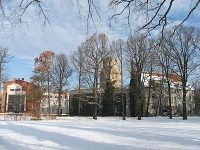
Museum
Liebenwerda Castle

Liebenwerda Castle, located in present-day Bad Liebenwerda, was built around the beginning of the 13th century and, after several fires and renovations, existed until the end of the 19th century. It was built as part of the German Ostsiedlung alongside other castles along the Black Elster river.
Liebenwerda Castle
When the castle was actually built is not yet scientifically confirmed. It probably originated at the same time as the preserved keep around 1207 during the period of territorial expansion, also known as the German Ostsiedlung. Within a few decades, six more castles with similar or identical towers were built on the left bank of the Black Elster in Mückenberg, Elsterwerda, Saathain, Würdenhain, Wahrenbrück, and Uebigau.
The original owners of the castle are unknown. However, with the first mention of Liebenwerda around 1231, it can be assumed that the Ileburg family ruled over the castle. To the north was the territory of the County of Brehna and the Margraviate of Lusatia, to the east parts of the Margraviate of Brandenburg, and to the south lay the Margraviate of Meissen. Although an affiliation with the County of Brehna has not yet been proven, the coat of arms of the city of Liebenwerda with its three hearts is very similar to that of the Counts of Brehna. In 1330, a castle chapel is mentioned. In 1384 or 1387, the castle was owned by the Knights of Rammelshayn, who apparently levied tolls on merchants and travelers and waged feuds against cities and other knights; later, such knights were also referred to as robber barons. With the help of a shooting guild founded in the city of Liebenwerda, this noble family was expelled.
It is documented that the widow of Elector Albrecht III the Poor, Euphemia of Oels, occupied the castle in 1420 as a dower. She initiated extensive construction measures, during which the front castle was built by 1424. The Electoral Saxon Office of Liebenwerda moved into the front castle in 1440. After the death of Frederick II, his widow Margaretha of Austria was granted, among other things, the castle and the city of Liebenwerda as a dower.
During a fire around 1487 or 1490, some buildings were destroyed.
Castle Chapel and its Altars
Details about the form and location of the chapel have not been preserved. In 1504, the castle chapel had two altars. The older altar was donated by the Lords of Ileburg, the younger by the bailiff Hans Marggraue with the support of Elector Johann Friedrich I.
At the request of the bailiff, in 1505, on the Sunday after Simon and Jude, the pastor of Liebenwerda with all his priests and students had to sing vespers on the eve of the church fair. On the day, the pastor was then to sing and preach Holy Mass.
In 1505, the castle was amply equipped with cannons and gunpowder. On October 8, 1519, Martin Luther met with the papal nuncio Karl von Miltitz in Liebenwerda Castle for a discussion.
Liebenwerda Palace
In 1543, the Lubwartturm received a new spire. Elector August and his wife Anna initiated a conversion into a magnificent Renaissance palace between 1568 and 1579.
The inhabitants of the Wendish village of Stadtwinkel (Sorbian Rukow), located west of the city of Liebenwerda, were obliged, like other official villages, to perform corvée services at the palace. Thus, the Stadtwinklers cultivated the vineyards, harvested hay, and, at the request of the lord, made the beds in the palace. In contrast, the inhabitants of Freiwinkel, the area around the palace in Schlossstraße and Hainschen Straße, were exempt from corvée as ministerial officials.
In the 16th century, Liebenwerda Palace was used as a hunting lodge. During a three-week hunt by Johann Georg I in 1650, a total of 400 pieces of game were caught. During a hunt by the then Electoral Prince Johann Georg III, up to 16 capercaillies were shot.
On July 9, 1699, the Lubwartturm burned down after a lightning strike. A larger fire was prevented by quick intervention. In 1699, the Liebenwerda Office was moved from the front castle to the rear castle. On April 26, 1733, the rear castle burned down, destroying the official archive. Due to its proximity to the city, this fire also devastated 28 houses, stables, and three barns. In 1766, the reconstruction of the rear castle began. However, the Lubwartturm remained a burnt-out ruin. During the Wars of Liberation in 1814/1815, the front castle served as a lazaret for about 150 wounded French soldiers. Due to the decisions of the Congress of Vienna, Liebenwerda came into Prussian possession.
In 1824, the carpenter Daniel Andreas Liebe bought the front castle from the Prussian state for 900 Thaler. Presumably after the abandonment of the complex from 1815, the country road towards Elsterwerda ran through the castle grounds. Until then, travelers had to bypass the castle to the south on Hainstraße or to the north via Luckauer Straße (later Bahnhofstraße).
However, there were increasing problems at the gate passage in the front castle because wagons repeatedly got stuck. Therefore, the Prussian state was forced to buy back the gate passage of the front castle at the inflated price of 1400 Thaler to demolish it in 1837.
Because loose stones repeatedly fell from the Lubwartturm, the upper stones of the tower were removed in 1830. The gate passage of the front castle was demolished in 1837. In 1868, a prison (Hafthaus) was built as a red brick building on the site of the former front castle.
In 1888, a serious fire occurred in the front castle, in which five people lost their lives.
The tragic circumstances of the death of the family of the district physician Dr. Meyer and his maid moved the inhabitants of the city of Liebenwerda so much that a few days later, the largest funeral procession in the city's history, with several hundred people, took place.
In 1890/1891, an attempt was made to demolish the castle wall by hand, as even a battering ram could not destroy the thick wall.
Demands by some employees of the district court to demolish the Lubwartturm to gain more light in the offices on the north side of the district court were prevented by Liebenwerda citizens under the leadership of district master builder Jost. In 1907, Jost submitted a proposal in the magazine Schwarze Elster to establish a museum in the remains of the castle complex. The tower was to be integrated into a museum building. Jost convinced the city of Liebenwerda of the idea of converting it into an observation tower, whereupon the city bought the tower in 1913 for 1 RM per square meter of floor space, i.e., 86 Marks.
The outbreak of the First World War initially prevented the implementation of this plan. From 1916, the country road no longer ran only north of the Lubwartturm through the castle complex, but also south.
District master builder Jost was able to begin the conversion of the Lubwartturm into an observation tower in 1928, after he had collected enough donations and the city of Liebenwerda had also taken over co-financing. The following year, the ceremonial opening of the tower took place. Inside the tower, Jost had installed a wooden staircase. In 1930, further safety work was necessary in the upper part of the tower. The newly created tower room also received its current form.
In the last days of the Second World War, the district court went up in flames after an arson attack. Many documents, including those on city history, were destroyed. Only in 1952/53 did the reconstruction of the court building begin. After completion, the Bad Liebenwerda District Court moved in. In 1953, Karl Fitzkow opened the District Museum in the former residential building of the electoral retinue. He also vehemently advocated for the renovation of the facade of the Lubwartturm. A lack of scaffolding material and insufficient construction capacities made a renovation possible only in 1965. The tower dungeon was cleared by the youth club of the District Museum in 1973. In January 1970, around 4:00 a.m., a fire destroyed the castle mill, which was used as a granary. In 1975, construction work in the museum yielded medieval finds. In 1984, the northern moat at the castle island was filled in to eliminate the odor nuisance to the spa clinic at the time.
Take Mobile History with you
You are reading this text for free. Premium adds what matters on the road: descriptions read aloud, sites found through your camera, whole regions taken offline.
- Every description, including the ~17,700 Premium sites
- Audio guide: have descriptions read to you on location
- AR finder: see sites through your camera, with distance and bearing
- Unlimited saved sites
14 days free, then from €2.99 a month. Cancel anytime.
Source: Wikipedia · Licence: CC BY-SA 4.0
This description draws on the facts documented in the linked Wikipedia article; Wikipedia content is licensed under CC BY-SA 4.0. Wording and editing: Mobile History.
Location: 51.5158, 13.3986