CastleKorschenbroich-Liedberg

Liedberg Castle
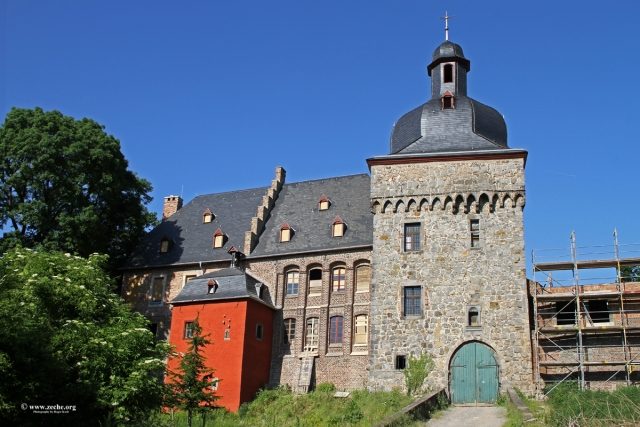
Liedberg Castle

To be privately owned

Liedberg Castle is a castle complex in the Liedberg district of Korschenbroich in North Rhine-Westphalia.

The complex originated as a hilltop castle with an outer and main bailey in the 14th century after the Römerwacht, on the western peak of Liedberg, and the Mühlensturm on the eastern peak as the third fortification.

The foundations of the current castle probably date back to the 11th century. The main or central tower can be dated to around 1270. It served as a gate tower and keep and features walls 1.60 meters thick.

Liedberg Castle and its lordship had been in the possession of the Archbishops of Cologne since 1279. In 1350, Archbishop Wilhelm von Gennep had further constructions carried out on the then castle, which was stormed in 1391 by Engelbert III. von der Mark. During the storming, the castle wall was damaged but rebuilt a year later.

In 1673, the town of Liedberg was almost completely destroyed in the Dutch War, and the castle was damaged. During the subsequent repair work, the complex presumably acquired its current Baroque character. Reconstruction began in 1680. At the instruction of the castle bailiff Damian Herman Nideggen, the tower received a Baroque dome. In 1707, he also had the new castle chapel built outside the castle. His initials D.H.N. are affixed at the entrance to the staircase of the residential wing and the castle chapel. The St. George's Chapel was consecrated on January 3, 1708. In a crypt beneath the choir lie Nideggen's wife and the later bailiff Kolvenbach with his wife. Nideggen himself, after his death, was buried at his own request in front of the chapel under a stone slab. The chapel became the parish church of Liedberg in 1862. In 1896, the castle consisted of the Gothic main or central tower, the gatehouse, the so-called Knight's Hall, and a residential building. In the same year, the gatehouse was demolished.

The castle was hit by a bomb in 1944 during World War II and partially destroyed. Until 1968, the building was left to decay. After that, initial restoration work began. After several changes of ownership, an entrepreneur acquired the castle in 2007 and has been carrying out renovation work on the complex since 2008. In 2010, during the renovation of the Gothic tower masonry at a height of over 12 m (third floor), eight individual shoes of different models were discovered: three women's shoes, two children's shoes, and three men's shoes.

Take Mobile History with you

You are reading this text for free. Premium adds what matters on the road: descriptions read aloud, sites found through your camera, whole regions taken offline.

  • Every description, including the ~17,700 Premium sites
  • Audio guide: have descriptions read to you on location
  • AR finder: see sites through your camera, with distance and bearing
  • Unlimited saved sites

14 days free, then from €2.99 a month. Cancel anytime.

Source: Wikipedia · Licence: CC BY-SA 4.0 · Image: http://www.zeche.org/

This description draws on the facts documented in the linked Wikipedia article; Wikipedia content is licensed under CC BY-SA 4.0. Wording and editing: Mobile History.

Location: 51.1636, 6.5441