Museum
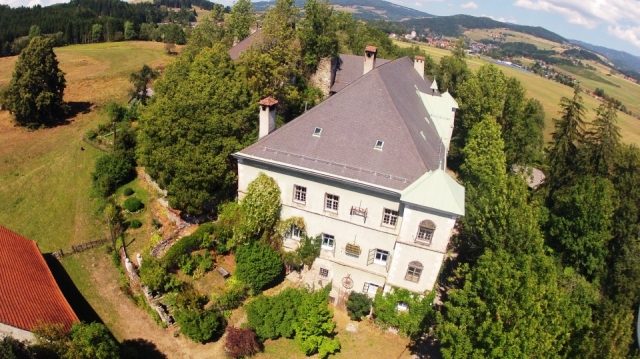
Lind Castle

Lind was probably a fortified house as early as the 11th century, belonging to the Lords of Eppenstein. In 1103, it passed to St. Lambrecht Abbey. The family residing here called themselves "von Linte". They probably only owned a part of their estates as a fief from the abbey and the sovereign, while the fortified building itself was likely their own property.
In 1287, Gebhard and Wulfing von Lind are mentioned, who belonged to the minor noble family of Hammerl. Hans Hammerl, mentioned in 1371, and his descendants owned the fortified court as a sub-fief of the sovereigns, who in turn were vassals of St. Lambrecht Abbey. Lind remained with the Hammerl family until the middle of the 15th century.
In 1542, the present Oberhaus (upper house) came into the possession of Georg Jöstl through his marriage to Margareta Hammerl. The Unterhaus (lower house) had emerged from a farm that had been expanded into a small noble residence by the Trienter family. In 1557, Matthias Jöstl, Georg's son, was able to acquire this farm and connect it with his Oberhaus. His son Moritz expanded this farm into a castle-like structure. Georg Amelreich Jöstl had to leave Styria in 1630 due to his faith. He sold Lind to his brother Wolf Andree, who had returned to Catholicism and now called himself "von Jöstlberg".
In 1658, Lind came as a dowry to Franz Philibert Schranz. When he died in 1680, his daughter Maria Anna von Gailberg inherited the property. She first attached Lind to her dominion of Feistritz in Katschtal, but then sold both estates in 1740 to Leopold Graf Herberstein. Lind was intended to serve as a summer residence for the abbot, but the abbey was dissolved in 1786, which led to the dominion becoming state property. However, when St. Lambrecht was re-established as an abbey in 1802 by Emperor Franz II (I), it received the estate and castle back. At that time, however, the Oberhaus was already described as a ruin, having been severely damaged by a fire.
From 1942 to 1945, the castle served as a sub-camp of the Mauthausen concentration camp. Lind still belongs to St. Lambrecht. However, it is not in good structural condition. The castle is partly rented out, and partly used by youth groups. Since 1996, a somewhat private local history museum has been housed here. Since the beginning of 2001, the "Andere Heimatmuseum" (Other Local History Museum) has been part of the Mauthausen Network and presents annual events under the title "Remembered Wounds", which in various ways address the wounds of recent Austrian history.
Take Mobile History with you
You are reading this text for free. Premium adds what matters on the road: descriptions read aloud, sites found through your camera, whole regions taken offline.
- Every description, including the ~17,700 Premium sites
- Audio guide: have descriptions read to you on location
- AR finder: see sites through your camera, with distance and bearing
- Unlimited saved sites
14 days free, then from €2.99 a month. Cancel anytime.
Source: Wikipedia · Licence: CC BY-SA 4.0 · Image: http://www.wehrbauten.at
This description draws on the facts documented in the linked Wikipedia article; Wikipedia content is licensed under CC BY-SA 4.0. Wording and editing: Mobile History.
Location: 47.0551, 14.4257