To be privately owned
CastleRuden-Lippitzbach
Lippitzbach Castle
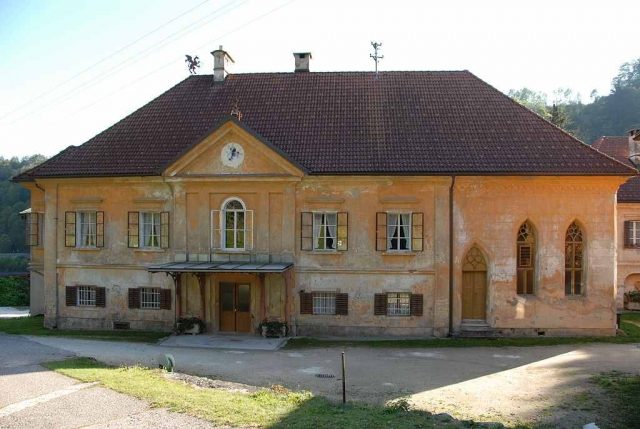
Lippitzbach Castle, a historic building in Carinthia, Austria, is located in the municipality of Ruden-Lippitzbach. It evolved from a hammer mill to one of Central Europe's first sheet rolling mills and has a Classical Biedermeier facade.
History+
The origins of Lippitzbach Castle lie in a hammer mill operated by Johann Baptist Mazzugon in the second half of the 17th century. In 1696, Georg Siegmund Christallnig acquired the facility. Under Josef Edler von Kronthal, production expanded to include bloom hammers for bar iron production. Max Thaddäus Graf Egger purchased the complex in 1791 and, in 1807, established Central Europe's first sheet rolling mill, which operated until 1894. Around 1820, the castle, with its Baroque core, received its Classical Biedermeier facade, which has remained unchanged. An attached chapel received its license for mass in 1843, and in 1864, a Neo-Gothic burial chapel was built for Ferdinand Graf Egger.
Source: Wikipedia · Licence: CC BY-SA 4.0 · Image: http://commons.wikimedia.org/wiki/File:Lippitzbach_Schloss_23.jpg?uselang=de
This description draws on the facts documented in the linked Wikipedia article; Wikipedia content is licensed under CC BY-SA 4.0. Wording and editing: Mobile History.
Location: 46.6367, 14.7693