CastleOstbevern

Loburg Castle

Loburg Castle

College
School

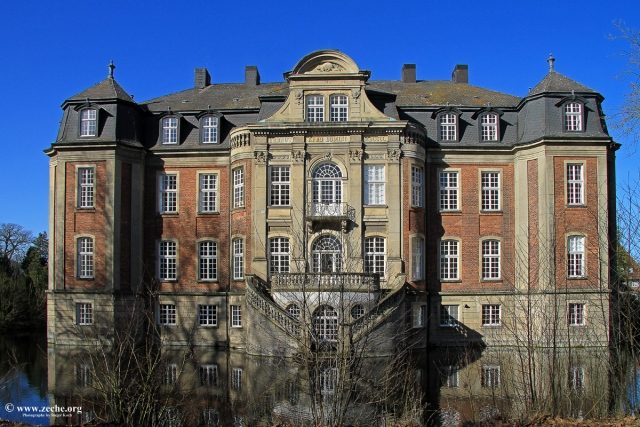
Loburg Castle is a moated castle near Ostbevern in Münsterland. Loburg Castle was first mentioned in a document in 1294. In the 15th century, it was expanded with partial fortifications, and in 1760, it was converted into a baroque pleasure palace according to the plans of Johann Conrad Schlaun. Today, the castle, rebuilt in neo-baroque style after a fire in 1900, houses a school with an associated boarding school. The castle is surrounded by Loburg Park with its rhododendron garden, and the Loburg Way of the Cross leads through the adjacent forest.

Schulzenhof Loburg

On July 19, 1294, a "Lohaus" is mentioned for the first time in a document. It was owned by the Schulzen of "Lohove". Knight Gerlach von Bevern and his son Hermann endowed a vicarage they founded with annuities. The first vicar bought the Wieschhaus inheritance. Loburg must have become a well-situated property and belonged to the considerable benefices.

Loburg Knight's Castle

Around 1400, it came into the hands of Dietrich Stael through the heiress Kunigunde von Bevern. From 1412, a "Lohoff castrum Johannes de Bevern" appears. Since a castle is mentioned for the first time, its origin can be assumed to be around the year 1400. The moats, still present in 1828, indicate a considerable size. The description, rediscovered in 1984, states:

"The other noble seat lies in the northeast, but it is not surrounded by any river. If one approaches the castle from the front, it lies open, protected only by a triple moat; if one comes from the back, by a single one... Around the castle stand huge trees that obscure the view of the castle unless one approaches closer. The arable land surrounding the castle on all sides is partly clayey, partly sandy, but very fertile for growing wheat, oats, barley, and that brown grain. (probably buckwheat)"

– Eugen Kotte

In 1517, the heiress Anna Stael zu Loburg married Heinrich von Münster, but the marriage remained childless. When Anna Stael died around 1559, an inheritance division occurred. One half of the farms and compensation of 3,500 thalers went to the siblings Heinrich, Johann, and Lenecke Korff, the other half of the farms and Loburg House went to the Droste zu Senden family. Loburg eventually passed to Elisabeth Anna Droste zu Loburg, who brought the estate into her marriage with Adolf von Nagel on April 14, 1649. In 1651, Adolf von Nagel zu Ittlingen is named as the owner, thus establishing the 134-year dynasty of the von Nagels at Loburg. There were several conflicts over jurisdictions with the neighboring Schenckinck family at Haus Bevern. The ongoing conflict between the two families is reflected in two disputes. Von Nagel applied for eligibility for the Landtag, which was granted to him, securing him limited participation in the Prince-Bishopric. The castle was in poor condition. Josef Marsil Wilhelm Xaver von Nagel zur Loburg and his wife Maria therefore dealt with the new planning of a Baroque castle. A knight's hall in the castle has been preserved to this day in memory of this period.

The Schlaun Building

In 1760, the dilapidated castle was demolished. According to plans by Johann Conrad Schlaun, a small Baroque castle with an oval courtyard and wide moats, over which three drawbridges lead, was built in 1766. The castle itself is two-story with a mansard roof, has a grand staircase in front of the central facade, and a three-sided projecting central risalit. In 1785, Clemens August Theodor Josef von Nagel zur Loburg, the builder's son, had to have Loburg Castle foreclosed for financial reasons. The construction of the castle had also contributed to the family's ruin. On June 7, 1785, he sold it with about 500 Morgen (1 Morgen = 0.25 ha) of land in a forced auction. The buyer was Friedrich Clemens von Elverfeldt zu Dahlhausen und Steinhausen, who made it the ancestral seat of the von Elverfeld called Beverförde-Werries. In 1899, this unique building fell victim to a devastating fire. The misfortune was prophesied by a local "Spökenkieker" (seer).

"He claimed to have seen sparks from the castle, ignited by lightning, flying far north to a 200-meter-high hedge. The man was laughed at. But then everything happened almost exactly as he said."

– Eugen Kotte

The Castle Fire

Due to two lightning strikes, the castle caught fire on July 22, 1899, and was destroyed down to its foundations.

"Ostbevern, July 23. Yesterday, Saturday evening at 8 o'clock, a very severe thunderstorm, which lasted until 10:30, discharged over our village and our community. Uncannily winding lightning bolts streaked through the air in all directions. ... Then suddenly a cloud of smoke became visible in the northeast of the village, and the bell reported fire. Everyone ran out of their houses and 'where's the fire' was the only question. 'Loburg is burning,' was the answer. The lightning had struck Loburg twice. The smoke clouds grew stronger and stronger, and despite the efforts of the fire department, the roof of the tall house collapsed, and everything that had not been carried out of the house burned. ... This morning, Baron von Beverförde-Werries moved with his family and Dr. Neteler to his residence in Münster."

– Neuer Emsbote of July 25, 1899

The Lost Beethoven Sonata

During the fire, an unpublished handwritten Beethoven sonata was also irretrievably lost – because it was in a safe, no copy had been made. Beethoven had dedicated it in the summer of 1791 to Maria Anna Wilhelmine von und zu Westerholt-Gysenberg. She was his student at Westerholt Castle and in Münster and was considered an excellent pianist. On April 24, 1792, she married Baron Friedrich Clemens von Elversfeldt called Beverförde-Werries, to whom she bore four sons and one daughter during their marriage. She remained in Ostbevern until her death and was buried in the Anna Chapel, named after her, alongside her husband.

The Schaedtler Building

Just one year after the fire (1900-01), the castle - the ancestral seat of the Beverförde zu Werries family - was rebuilt in an enlarged form (almost twice its original size) by the architect Hermann Schaedtler from Hanover in a neo-baroque style. It resembled the old castle, which was a condition imposed on the architect. The patron saints of the builders: Karl Borromäus and Empress Adelheid are depicted in the windows of today's Hubertus Chapel. The alliance coat of arms of the builder, as well as his motto "DEUS ADIUTOR ET PROTECTOR MEUS" (German: God my helper and protector) are affixed in the central risalit of the gable. In 1903, Loburg Park was laid out. After the Second World War, which the castle survived undamaged, there was a forced billeting of refugees. Meanwhile, on October 1, 1948, the Christian School Brothers had re-founded the Johanneum Gymnasium in Wadersloh, which was now to become an episcopal school and a boys' seminary. However, the episcopal General Vicariate wanted to move to Loburg in Ostbevern, as more space was available there. On March 10, 1951, the decision was made to lease the castle to the Diocese of Münster, and the seminary was now moved to Ostbevern, which is now today's Johanneum Loburg Ostbevern. The castle with all its outbuildings was handed over to the Diocese of Münster. The baronial family moved into the former rent office (Lütke Loburg). Bishop Michael Keller founded the Collegium Johanneum, a free Catholic boarding school. In 1973, the outbuildings of the castle were demolished and replaced by boarding school apartments for students. However, the form is reminiscent of the old servants' quarters, thus preserving the courtyard character.

Vinnenberg Fireplace

In Loburg Castle, a fireplace from the demolished Vinnenberg Monastery can still be seen. At the time of secularization, in the canton of Ostbevern under the leadership of Friedrich Clemens von Elverfeldt called Beverförde zu Werries, the monastery buildings, with the exception of the church, were partially demolished from 1810 onwards. Above the richly decorated fireplace mantelpiece made of Baumberg sandstone, the chronodistichon can be seen in the middle: InsIgnIa heroICa pla VIrtVtVM InDICIa (1724).

Boarding School 'Collegium Johanneum'+

General

The "Collegium Johanneum", a free Catholic boarding school of the Diocese of Münster, has existed since 1953. In 1967, the Johannes Church was consecrated. Since the school year 1994/95, girls have been admitted to the Gymnasium (initially only as "externals", i.e., not residents of the boarding school). The last graduating class of the all-boys school (1993/94) celebrated its farewell under the motto "No woman, no cry – the last true Loburgers", while the first mixed class (1994/95) chose the motto "Ladies & Gentlemen".

The boarding school was an all-boys boarding school until the school year 2000/01. Since the school year 2001/02, girls have also been admitted to the boarding school. Since then, the number of girls in the boarding school has been steadily increasing.

Boarding School Directors

  • before 1982: Ulrich Zurkuhlen, Walter Rensing, Ludwig Averkamp
  • 1982–1988: Ferdinand Schumacher, today City Dean of Münster
  • 1988-2010: Günter Witthake
  • from 2010: Konrad von der Beeke

School Principals

  • before 1988: Erwin Rose, Josef Stenmans, Gert Beutgen
  • 1988-2010: Günter Witthake
  • from 2010: Michael Bertels

Notable Alumni

  • Georg Ferdinand Freiherr von und zu Brenken, President of the Bonifatiuswerk der deutschen Katholiken
  • Erwin Josef Ender, Archbishop, former Nuncio of the Holy See in Germany
Events+
  • Summer festival on the last Sunday before the summer holidays
  • Advent bazaar on the 1st Advent
  • Loburg Forest Run, where thousands of elementary school students gather annually to determine the fastest on the 700 m long course and to enjoy the pea soup traditionally served at this event.
  • Loburg Castle is several times a year the venue for theater performances, some from its own house and others from professional stages, as well as concerts, to which top musicians are often invited.

Take Mobile History with you

You are reading this text for free. Premium adds what matters on the road: descriptions read aloud, sites found through your camera, whole regions taken offline.

  • Every description, including the ~17,700 Premium sites
  • Audio guide: have descriptions read to you on location
  • AR finder: see sites through your camera, with distance and bearing
  • Unlimited saved sites

14 days free, then from €2.99 a month. Cancel anytime.

Source: Wikipedia · Licence: CC BY-SA 4.0 · Image: http://www.zeche.org/

This description draws on the facts documented in the linked Wikipedia article; Wikipedia content is licensed under CC BY-SA 4.0. Wording and editing: Mobile History.

Location: 52.0453, 7.8604