CastleDresden - Lockwitz

Lockwitz Castle
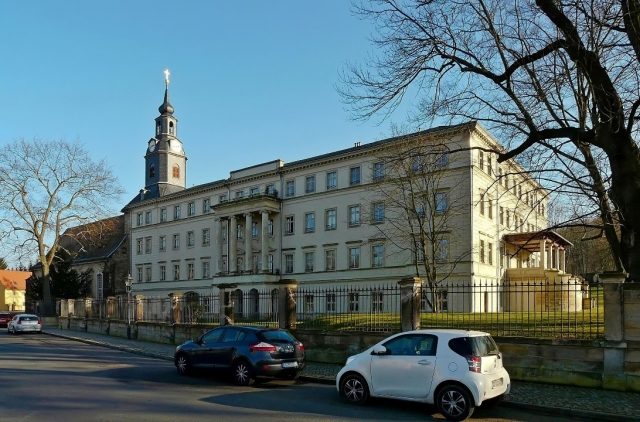
Lockwitz Castle

To be privately owned

Lockwitz Castle dates back to a manor first mentioned in 1349, which initially belonged to two owners. In 1402, the Dresden citizen family Ziegler owned a share of the estate, while the rest belonged to the noble family von Alnpeck. From 1512, the Alnpecks were the sole owners of the estate. Some tombstones are still in the Leubnitz church, to which Lockwitz once belonged. The church of Leuben also still possesses an old stained-glass window with the coat of arms of this family.

The manor house of the estate was converted into a castle by Johann Georg von Osterhausen in 1621 and significantly enlarged. At the same time, a church was built in place of the former castle chapel, which formed its own parish from 1623. A particular curiosity is the tower that connects both buildings but structurally belongs to the church. A prominent guest of the castle in 1756 was the Prussian King Frederick II, who took his headquarters here during the Seven Years' War. In the Wars of Liberation in 1813, the castle housed a hospital for Prussian and Russian soldiers who had been wounded in the fight against Napoleon.

In the 19th century, the ownership of the castle changed several times. In 1813, Johann Gottlob Preußer acquired the building with the associated manor. Preußer was considered one of the most progressive nobles of his time and voluntarily released his farmers from all corvée and interest payments. The estate was sold in 1866 to Heinrich Christian Kap-herr, who left the castle to his son Carl Johann for use. Shortly thereafter, a renovation of the building began in the style of the Italian Renaissance, giving the building essentially its appearance preserved to this day. The work was led by the Lockwitz master builders Carl Kirsten and Otto Kreyssig. The Kap-herr family used Lockwitz Castle as their residence until the end of the Second World War. A small local history museum was established in the dining room in 1929.

Lockwitz Castle, with its associated manor land, was expropriated in 1946 through land reform and distributed to new farmers. The former owners were deported to the island of Rügen, from where they later fled to the Western zones. In 1946, a State Fire Brigade School was initially established in the castle, later a training center for aspiring cartographers and geodesists. This was continued after 1990 as the Surveying School of the State Surveying Office of Saxony and only closed in 2001. In 1994, a renovation of the castle and church complex began with the removal of the tower spire. Since 2007, the building has been in private ownership and is currently being converted for residential purposes. The existing outbuildings are also to be renovated and supplemented with some detached houses.

The mausoleum was built in 1871/72 away from the village on Krähenhügel. Designed in the style of a neoclassical Greek temple, the building was designed by Bernhard Schreiber for the banking family von Kap-herr and served as the burial place for the castle-owning family. The construction was carried out by the master masons Kreysig and Kirsten. In 1944, Baron Hermann von Kap-herr was the last to be buried in the crypt. After the expropriation of the manor, the mausoleum fell into disrepair and was partially wantonly damaged. After graves had been broken into several times, the building was even to be blown up in the 1980s, which, however, was prevented by committed citizens. The mausoleum has thus been preserved to this day but requires renovation.

Take Mobile History with you

You are reading this text for free. Premium adds what matters on the road: descriptions read aloud, sites found through your camera, whole regions taken offline.

  • Every description, including the ~17,700 Premium sites
  • Audio guide: have descriptions read to you on location
  • AR finder: see sites through your camera, with distance and bearing
  • Unlimited saved sites

14 days free, then from €2.99 a month. Cancel anytime.

Source: Wikipedia · Licence: CC BY-SA 4.0 · Image: Thomas Eichler

This description draws on the facts documented in the linked Wikipedia article; Wikipedia content is licensed under CC BY-SA 4.0. Wording and editing: Mobile History.

Location: 50.9872, 13.8080