Public library
Lösnich Castle
Lösnich Castle in Lösnich was the ancestral seat of the Lösnich knightly family, which was first documented in 1226.
The first documented mention of the castle dates back to 1368 with its enfeoffment by the Electorate of Cologne to Knight Heinrich Beyer von Boppard and his wife Lisa von Lösnich. The early documented mentions of the Lösnich knightly family, going back to 1226, suggest that the castle existed even before 1368. In 1958, Kurt Böhner speculated in his text on the Frankish antiquities of the Trier region that the Lösnich moated castle might have replaced a Frankish farm near the river, which, according to Frankish custom, was often built in the immediate vicinity of water. This is supported by the fact that four Frankish sarcophagi were found nearby in the "Weidenrechs" area around 1900, and a Frankish grave was investigated in 1937 during excavation work by the Trier State Museum. More precise descriptions and sketches of the castle, however, only appear in the late 17th century, when it came into the possession of the Barons von Metternich and von Kesselstatt.
Castle+
A site plan from 1693 shows that the castle stood on the present-day property Fährgasse 1, opposite the current rectory. It encompassed an area of approximately 100 × 100 feet (pedes rhenanos) within a 25-foot-wide moat.
Even today, the impressive cross-vaulted cellar under the former press house and farm building, which now houses several holiday apartments, can be admired. The castle was a tower castle located in a valley, supplemented by additional solid residential and farm buildings to meet the living needs of the knights. In contrast to the well-known hilltop castles, it was located in the village, over which its owners ruled, i.e., near their agriculturally used land. To fulfill the economic and administrative functions of a castle, the necessary buildings for storing or processing agricultural products were usually housed within the castle area or in its immediate vicinity as a separate farmstead. This was also the case in Lösnich with the "Kelterhaus" (press house) belonging to the castle, which was converted into a stately residence in the 17th century, until it was finally used as a rectory in the 19th century. Typical for such castle complexes is also the enclosed space of a generously laid out garden, which often formed a counterpoint to the inevitable narrowness in the fortified area of the castle. In depictions from the 17th century, an extensive garden area is also shown in Lösnich.
That the castle itself was a residential and defensive complex is shown by its equipment with a central "residential tower", moat, and shield wall. The Moselle-side outer wall of the castle was fortified at its ends with two round towers. The tower in the northwest protruded with its foundation into this cellar. This tower is said to have housed the castle's "dungeon", which was allegedly walled up during the new construction of the farm and press house, extended in 1808. The cellar-side and also walled-up entrance to this tower, with its still existing archway of red sandstone and a no longer clearly legible year, is still clearly visible in the cross-vaulted cellar. On the south side of the cellar part extended in 1808, there is a water source that could have formed the well of the former castle. In the middle of the castle rose a square keep, to which a low residential building was attached. West of the castle, in the area of Obergasse, there was also an old mill. The church and mill ditch, now piped in this area, supplied the so-called mill pond, which provided the necessary water for operating the mill.
Farm Buildings+
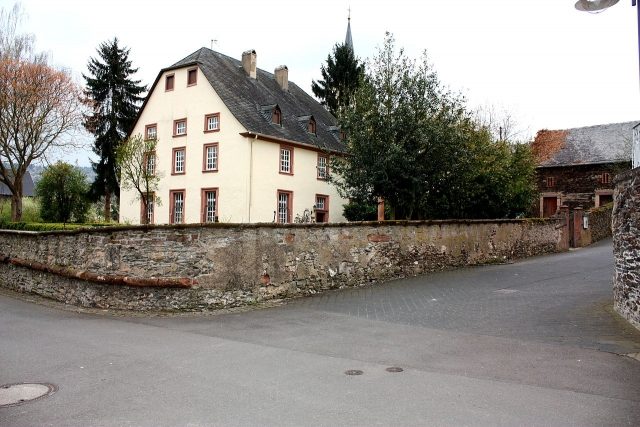
The "Old Rectory", a two-story solid building, located to the east opposite the former castle, in the middle of a large garden area, still served as a stately press house in 1683/84. It was only by Baron Wolf Heinrich von Metternich that this building, which until then housed a total of four presses, was converted into a residential house.
The floor plans show that the building has retained its internal and external structure without major changes to this day. In its construction, it corresponds to the former official residences in Zeltingen, Bernkastel, and Wehlen, which were also built at the end of the 17th century. The hipped gables, the three-axis sides, the rectangular windows in ashlar frames with massive iron grilles, as well as the wide central corridor, the stone fireplaces and stucco-covered beamed ceilings, and not least the very solid wooden staircase with a well-carved newel post embody typical features of late 17th-century construction. Not to be overlooked when entering the garden, shortly before the entrance door of the rectory, is the beautiful well column on the left side. Carved from red sandstone, it is crowned by a sphere with garland decoration.
The year 1827 with the initials "G.v.K" of Baron and Count Georg von Kesselstatt is still clearly visible on the rectangular well trough. Sketches of the castle from 1675 and 1689 show the already destroyed castle and can only give a limited impression of the original appearance of this late medieval complex. The already mentioned keep in the middle of the complex with the still recognizable remains of the castle wall and the moat indicate that this was a fortified complex. When the castle was exactly built can no longer be determined.
Occupations of the Castle+
Like many other castles and palaces in the Moselle Valley, Lösnich Castle also suffered the fate of multiple occupations and finally its destruction as a result of the turmoil of the Thirty Years' War.
After the extinction of the Beyer von Boppard family, the Barons, later Counts von Chrichingen, inherited three-quarters of the castle as a fief of the Electorate of Cologne in the 16th century, and the von Esch zu Selheim family inherited one-quarter. In 1622, it was Electoral Cologne Rachtiger and Zeltinger "Schützen" (marksmen) who expelled the then Chrichingen servants from Lösnich Castle. Count Lothar von Chrichingen recaptured the castle and forced the occupiers to retreat.
Swedish and French troops, who marched through the Moselle lands, subsequently also did not leave the castle unscathed and occupied and plundered it. During the war, around 1637, the three Counts von Chrichingen, Franz Ernst, Peter Ernst, and Lotharius, died one after another, leaving behind two minor children. In the same year, a Herr Hausmann von Namedy ("Husmann zu Namedy"), accompanied by an imperial "Commissario" with a letter of donation for the Lösnich lordship, appeared to take possession of the castle. However, the then Chrichingen servant Linius resisted and, in turn, sent a petition to the Electorate of Cologne to protect the lordship and Lösnich Castle from such harassments. However, a strange reaction followed this petition.
Immediately after the autumn of 1637, an Electoral Cologne Commissarius came to Lösnich, removed the Chrichingen servant from the castle, and confiscated the feudal and allodial estates belonging to the castle. These estates were soon after handed over by the Electorate of Cologne to a "Baron de Logier". The hopes for peace, which were nourished by the conclusion of the Peace of Westphalia in 1648 also in the Moselle and Eifel regions, were disappointed for years afterwards. Plundering and pillaging troops continued to roam for a long time, spreading fear and terror among the population.
Destruction of the Castle+
In 1652, the governor of Diedenhofen, also known as "Comte de Marolles", who was roaming in this area, occupied Lösnich Castle, set it on fire, and allegedly "demolished" it with the help of the neighboring subjects of Electoral Trier and Electoral Cologne. A reconstruction of the castle in its original form did not take place thereafter, as evidenced by the illustrations of the complex from the late 17th century.
Take Mobile History with you
You are reading this text for free. Premium adds what matters on the road: descriptions read aloud, sites found through your camera, whole regions taken offline.
- Every description, including the ~17,700 Premium sites
- Audio guide: have descriptions read to you on location
- AR finder: see sites through your camera, with distance and bearing
- Unlimited saved sites
14 days free, then from €2.99 a month. Cancel anytime.
Source: Wikipedia · Licence: CC BY-SA 4.0 · Image: http://de.wikipedia.org/wiki/Datei:Herrschaftliches_Wohnhaus_Loesnich_2012_C.JPG
This description draws on the facts documented in the linked Wikipedia article; Wikipedia content is licensed under CC BY-SA 4.0. Wording and editing: Mobile History.
Location: 49.9750, 7.0428