Restaurant
Museum
Lübben Castle

Lübben Castle is a castle in Lübben, Brandenburg, dating back to the Middle Ages.
The castle complex is located on the southern edge of Lübben's old town. South of the castle lies the Spreewald forest. Separated from the castle itself by a stream, there is the castle island, which has been transformed into a public park.
The castle was built on the site of a moated castle erected in the 12th century. The existing complex was then presumably built in the late Middle Ages. The oldest building is likely the tower. A first renovation of the castle took place in 1561. A major reconstruction was initiated under Duke Christian I of Saxony-Merseburg. During this time, the still existing stable and its counterpart on the east side, destroyed in World War II, were probably also built. Between 1899 and 1914 to 1917, a historical restoration led by Adolf Zeller took place, to which the current appearance of the complex can be attributed. During the fierce battles for Lübben in April 1945 at the end of World War II, the complex suffered significant damage. After the war, the owners were expropriated and expelled by the communists.
Buildings+
Tower
The tower, dating back to the late Middle Ages, has an almost square floor plan and features masonry 2.50 m thick. Renovations took place in 1686. The tower, originally serving as a defensive tower, received arched windows and corner rustication, as well as a half-timbered floor as an apartment for the Duke. This floor was demolished in 1914/15 and a mansard hip roof was added. In 1945, the tower was damaged during wartime actions. A restoration took place in 1982. During this, the interior painting from 1914 to 1917 was restored and the facade was plastered. The northern portal to the tower was also renewed in this year. At the entrance, there is a relief created in 1914/15 by Hermann Engelhardt, which addresses the change of Lusatia from Saxony to Prussia.
On the ground floor, a vault from the mid-17th century is preserved. The two upper tower floors are occupied by the Coat of Arms Hall. This room, originally probably intended as a homage hall, was deprived of its original function by the construction of the Landhaus or Estates House in 1717. The surrounding gallery, open to the west, was created during the renovations of 1914. Below the gallery, the coats of arms of the estates of Lower Lusatia were affixed. The inner side of the western wall is adorned by a large historical painting created in 1917 by August Oetken, depicting the homage of the city of Lübben to Elector Frederick II in 1488.
Oberamtshaus (Chief Administrative Building)
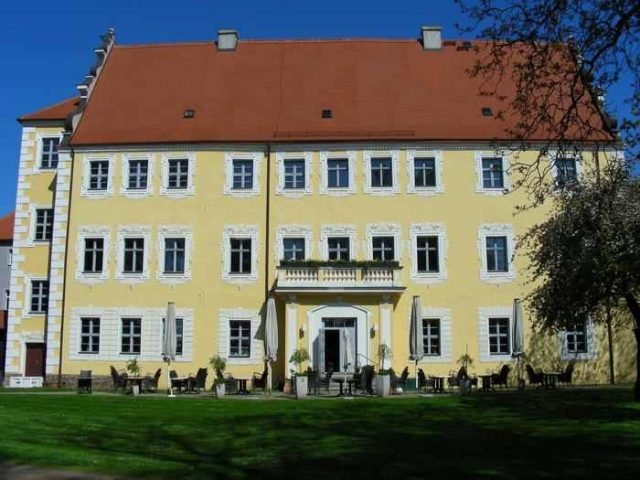
South of the tower, the distinctive, three-story, brick-built Oberamtshaus was erected between 1679 and 1682. The plastered building with a gabled roof served as the seat of the government of Lower Lusatia. Initially, the Oberamtshaus had seven transverse and three longitudinal axes. During the renovation of 1899, it was extended by three axes to the west. On the east side, there is a volute gable in the late Renaissance style. The two upper floors of the gable side are structured by Corinthian columns. The surfaces are decorated with stucco ornaments, and the cornices are stepped. The windows are rectangular and set off from the otherwise smooth wall by richly stucco-decorated frames.
On the northern side, there is a magnificent portal, executed as a flat arch with seating niches. The portal is framed by an aedicule resting on Ionic double columns. In the gable, the coat of arms of Lower Lusatia, dated 1682, can be seen.
The balcony with balustrade on the south side dates from 1899. On the western side, an annex was built, whose style was modeled on the late Renaissance to fit into the ensemble. From the Oberamtshaus, there is a covered passage to the tower, created in 1914/15.
Inside the building, fundamental renovations took place. However, some beamed ceilings have been preserved.
Marstall (Stables)
The Marstall was built in 1669 as a two-story, long, plastered building. The roof is designed as a half-hip roof. A restoration took place after 1980. Today, the building is used as a tourist information center.
Current Use+
The castle houses the City and Regional Museum, opened on June 1, 2001, and a café. An original small city museum had been closed in the 1960s. The museum's themes include the prehistory and early history of the region. For example, a replica of the Burg cult wagon is exhibited, the original of which dates from the 10th to 8th century BCE. Coin finds from Straupitz and Schlepzig are also shown. The person of the church poet Paul Gerhardt, active in Lübben, is also a theme, as is the city history of Lübben up to the present day. Interesting exhibits also include part of a corduroy road excavated during construction work in Lübben, a sled used for rides to executions, and a two-meter-long executioner's sword.
Take Mobile History with you
You are reading this text for free. Premium adds what matters on the road: descriptions read aloud, sites found through your camera, whole regions taken offline.
- Every description, including the ~17,700 Premium sites
- Audio guide: have descriptions read to you on location
- AR finder: see sites through your camera, with distance and bearing
- Unlimited saved sites
14 days free, then from €2.99 a month. Cancel anytime.
Source: Wikipedia · Licence: CC BY-SA 4.0 · Image: http://www.wehrbauten.de/thread.php?threadid=527
This description draws on the facts documented in the linked Wikipedia article; Wikipedia content is licensed under CC BY-SA 4.0. Wording and editing: Mobile History.
Location: 51.9401, 13.8990