CastleSchonungen-Mainberg

Mainberg Castle
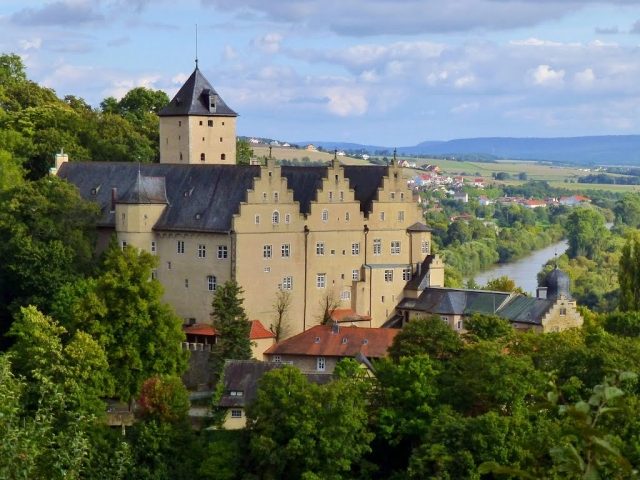
Mainberg Castle

Events

Mainberg Castle is located in the village of Mainberg near Schweinfurt in Lower Franconia.

13th Century+

Mainberg Castle was originally just a place of protection and defense in the form of a tower, which still stands today. According to estimates, it was built between 900 and 1000 AD. At that time, it was referred to as Mainberg Fortress. After several extensions, it was only called a castle from 1394 onwards. Mainberg Castle was first mentioned in 1245 and was owned by the Count of Wildberg;

1305-1542: Counts of Henneberg+

In 1305, it belonged to Count Berthold VII the Wise of Henneberg-Schleusingen. Between 1480 and 1486, the widow of Count Wilhelm III of Henneberg-Schleusingen, Duchess Margarethe of Braunschweig-Wolfenbüttel (1451-1509), had the castle extended into its current form with three gables as a widow's residence by the Heidelberg master builder Philipp von Hoestätt. At that time, it was the second-largest seat of power in Mainfranken after Marienberg Fortress in Würzburg.

During the Peasants' War in 1525, it was partially destroyed. In 1542, Mainberg, along with the entire Mainberg district, came into the possession of the Bishop of Würzburg (Konrad III von Bibra) from the Counts of Henneberg-Schleusingen in exchange for the city of Meiningen. After secularization, the ownership changed hands several times. Over time, the castle underwent many additions and alterations until it reached its present form. Mainberg Castle was the administrative seat for the Henneberg, and later Würzburg, district of Mainberg. Under the protection of the old castle, the settlement developed, to which the castle's name was transferred, tightly packed between the river and the hillside and in the narrow, cut-in Meerbach valley, which flows into the Main there.

1822-1901: Wilhelm Sattler and Descendants+

In 1822, the manufacturer Wilhelm Sattler had the by then dilapidated castle restored and the rooms furnished in a historicist style. He further expanded the already considerable art collection. Upon his death, the castle came onto the market. The art treasures were auctioned off at a sensational auction from October 29 to November 2, 1901, at Rudolph Lepke's Kunst-Auctions-Haus in Berlin. These included six sculptures by Tilman Riemenschneider and Gothic stained glass.

1902-1915: Alexander Erbslöh and Johannes Müller+

In 1902, the castle was acquired by the manufacturer Alexander Erbslöh, who lived at Haus Rauental moated castle near Barmen, to provide it to the writer and Protestant theologian Johannes Müller as a "sanctuary for personal life." After Elsa von Michael, born Haniel and later Countess von Waldersee, had Schloss Elmau built for Müller and his movement, and he had moved there, Mainberg Castle also served as a military hospital and convalescent home at the beginning of the First World War.

1915-1955: Privy Councillor Ernst Sachs and Consul Willy Sachs+

In 1915, it was sold to the entrepreneur Ernst Sachs, who had the interiors fundamentally rebuilt by Franz Rank in the style of the time. The historicist-late romantic interior decoration is largely preserved and represents a unique total work of art for Bavaria - in this quality and from this period. His son Willy Sachs sold the castle in 1955. After that, the castle changed owners several times.

1955-1961: Wilhelm Heger+
1961-1982: City of Schweinfurt+
1982-2005: Gerhard Eichhorn and Heirs+
Since 2005: Renate Ludwig+

The real estate agent Renate Ludwig acquired the castle in 2005 together with two business partners for €550,000. The latter withdrew after a short time, making Ludwig the sole owner. She initially continued the gastronomy concept pursued under Eichhorn. In 2007, the castle served as a film set for an episode of the crime series "Pfarrer Braun" with Ottfried Fischer (Das Erbe von Junkersdorf). Since 2006, water stains have been visible on the gable front in the area of the gutters, which steadily increased in the following years. Due to static problems, the Schweinfurt District Office extensively cordoned off the outer bailey area in 2009. In December 2011, District Administrator Leitherer publicly declared for the first time that the outer bailey was "already beyond saving." Due to a lack of fire protection measures, the Schweinfurt District Office prohibited any use until further notice. In spring 2011, large areas of stones broke off the northern curtain wall. Due to frozen pipes and penetrating moisture, mold growth became visible in several places in 2012. In the Lucretia room, the parquet had to be removed due to dry rot infestation. Local and national media reported on the alarming condition of the castle.

Take Mobile History with you

You are reading this text for free. Premium adds what matters on the road: descriptions read aloud, sites found through your camera, whole regions taken offline.

  • Every description, including the ~17,700 Premium sites
  • Audio guide: have descriptions read to you on location
  • AR finder: see sites through your camera, with distance and bearing
  • Unlimited saved sites

14 days free, then from €2.99 a month. Cancel anytime.

Source: Wikipedia · Licence: CC BY-SA 4.0 · Image: Reinhold Schulz

This description draws on the facts documented in the linked Wikipedia article; Wikipedia content is licensed under CC BY-SA 4.0. Wording and editing: Mobile History.

Location: 50.0571, 10.2897