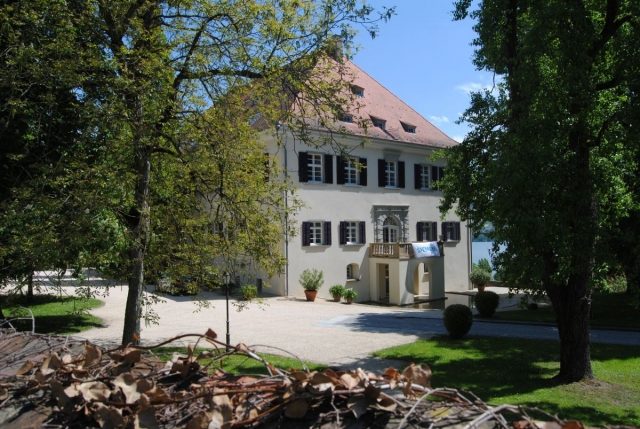
CastleÖhningen-Wangen

Marbach Castle

Marbach Castle

Hotel

Marbach Castle is located on the Höri peninsula on Lake Untersee - an offshoot of Lake Constance that flows into the Rhine at Stein am Rhein. Today it belongs to the municipality of Öhningen (Constance district, Baden-Württemberg state) and is situated on the L 192 between Wangen (a district of Öhningen) and Hemmenhofen, which is a district of Gaienhofen. Originally a castle, the current palace is used as a conference center.

Location+

In this area of the Höri, the shore rises relatively steeply. Marbach Castle is located about 40 m above the shore, although the property extends down to the lake. Directly opposite the lake, which has the appearance of a river there and is often mistaken for the Rhine, is the Swiss shore. The location is strategically very favorable, as it offers a view of a large section of the lake or river.

The castle was first mentioned in 1291 in the chronicle of Reichenau Abbey. Abbot Albrecht von Ramstein documented: "... in castro nostro quod Marbach dicitur."

In 1365, the Bernese Barons of Brandis launched raids on Rhine ships from Marbach Castle, causing trade to and from Constance to collapse. The Constance city bailiff was held captive at Marbach. Constance merchants conquered the castle in 1369; the nine defenders were beheaded in Constance.

In 1384, Mangold von Brandis, Abbot of Reichenau Abbey and Bishop of Constance, had the castle rebuilt.

In 1387, Nikolaus Sattler from Ravensburg bought Marbach Castle after the death of Mangold von Brandis and acquired the Kehlhof a year later. Now Marbach and Wangen were under one ownership for the first time.

In 1409, Nikolaus Sattler sold Marbach to Baron Jakob I von Ulm from the Constance city noble family.

During disputes in 1430 between the Constance patricians and the guilds, Jakob II von Ulm sided with the patricians and entrenched himself in Marbach Castle. The rebellious Constance citizens stormed and devastated the complex. After years of neglect, the castle burned down in 1461.

Due to inheritance division, the properties of the von Ulm family were fragmented, and in 1558 Marbach was sold to the Augsburg patrician family Peutinger. In 1581, Count Ulrich Fugger, Lord of Kirchberg and Weißenhorn, acquired the Marbach properties from the Peutingers, but only on credit, as the wealth of this branch of the Fugger family had already dwindled by this time. In 1587, imperial commissioners had to settle Ulrich Fugger's debts, and Marbach was returned to the Peutinger heirs, from whom Count Jakob Fugger, the Provost of Constance Cathedral, bought it back.

After 1461 and 1570, Marbach burned down a third time during the Thirty Years' War.

In 1598, Baron Kaspar von Ulm succeeded in buying back his family's former property. His son Ludwig, who held an influential position at the imperial court, obtained an imperial order that Marbach should be sold back to his family. For over 300 years, the manorial seat remained in the possession of countless members of the von Ulm family, who acquired Marbach through inheritance, sold it among themselves, or took over its maintenance.

In 1829, the French Count de Grimaudet bought the estate and had it renovated and beautified at great expense. The current foundation and outer walls date from this construction activity. The castle has since been referred to as "Schloss Marbach". In 1839, Count Grimaudet died in the renovated castle. He was buried in the cemetery in Wangen.

In the following years, the castle became a speculative object with frequently changing owners such as Gallus Reglin, a merchant from Überlingen, and Leopold Faller, a glass manufacturer from Lenzkirch. By 1863, Marbach Castle was finally unfurnished and dilapidated and was acquired by Johann Kasper Schmied, a pharmacist from Freiburg. In 1873, his widow sold Marbach for 15,320 guilders to Karl Heinrich Friedrich Kohler from Geneva; he sold it in 1874 for 24,000 marks to the widow of Gallus Reglin; in 1880, Marbach came into the possession of the Städtische Spar- und Waisenkasse Konstanz through forced auction for 10,000 marks. Four weeks later, the bank profitably sold the castle for 34,500 marks to Arnold Krücke from Jena; in 1885, Dr. Wieckenbach, a royal Prussian staff doctor from Stralsund, acquired the castle for 40,000 marks.

In 1888, August Smith bought the castle for 48,000 Reichsmarks and established a very well-attended clinic. Ten years later, the property was acquired by Oskar Hornung for 250,000 Reichsmarks. The building was extended to four floors. The clinic was converted into a public limited company after land purchases did not bring the desired increase in value.

After the end of the First World War, war wounded were cared for in the castle. In 1919, the estate came into the possession of Karl Lanz, a Mannheim manufacturer of agricultural machinery (Lanz Bulldog), who acquired it as a birthday present for his wife Gisella. He had the fairy tale fountain built, of which remnants still exist in the park today. The figures represent the Lanz children.

In 1924, Marbach Castle burned down to its outer walls and was rebuilt with a generous layout of the interior rooms.

In 1941, the widow of Karl Lanz, who died in 1921, sold Marbach for 600,000 Reichsmarks to the Reichsfiskus. The Luftwaffe used the castle as a recreation home for officers.

After the end of the war in 1945, the French army occupied Marbach and used it as a recreation home for soldiers, and the park as a campsite.

In 1978, Marbach Castle was returned by the French state to the German Federal Property Administration. The building and the park, covering over 10 hectares, were co-used by the opposite rural boarding school and the Protestant boarding school Schloss Gaienhofen.

In 1987, the international coffee and chocolate group Jacobs Suchard from Zurich bought Marbach Castle after it had been vacant for three years.

From 1988, the castle was extensively renovated, with additional buildings (the residential towers, the atrium, a swimming pool, and other outbuildings) being added. In June 1989, Marbach was opened as an internal communication center of Jacobs Suchard AG.

In 1990, Marbach Castle passed to the Johann Jacobs Foundation based in Zurich. The modern conference and seminar center was opened for institutions, associations, and companies.

In 1997, the manor house Bella Vista, located across the street, and the area of the former rural boarding school were acquired.

In 1999, three guesthouses, two tennis courts, and a four-hole golf course with a driving range and putting green were built.

In 2004, Barry Callebaut, the world's leading manufacturer of cocoa and chocolate products, took over the entire complex as a tenant. However, Marbach Castle continues to be available to third-party companies for conferences.

In 2005, the Jacobs Foundation completely rebuilt Villa Bella Vista and expanded the conference capacity with a modern new building, the Forum.

Current Use+

Marbach Castle is today a modern conference and seminar center equipped with all amenities, featuring 61 guest rooms, a restaurant, bars, an indoor pool, and a golf course. The conference rooms, ranging in size for eight to 120 participants, are booked by industrial companies, as well as private individuals for events such as weddings.

Take Mobile History with you

You are reading this text for free. Premium adds what matters on the road: descriptions read aloud, sites found through your camera, whole regions taken offline.

  • Every description, including the ~17,700 Premium sites
  • Audio guide: have descriptions read to you on location
  • AR finder: see sites through your camera, with distance and bearing
  • Unlimited saved sites

14 days free, then from €2.99 a month. Cancel anytime.

Source: Wikipedia · Licence: CC BY-SA 4.0 · Image: http://schloesserrundschau.de/bawue/schloesser/konstanz30.html

This description draws on the facts documented in the linked Wikipedia article; Wikipedia content is licensed under CC BY-SA 4.0. Wording and editing: Mobile History.

Location: 47.6699, 8.9504