The Castle can be visited
Marchegg Castle

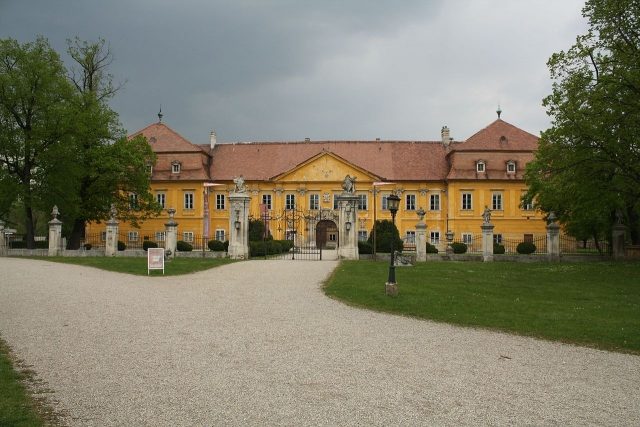
Marchegg Castle is a Baroque castle in Marchegg, Lower Austria.
The original castle was built as a town castle at the northwestern corner of the city wall after the Battle of Groißenbrunn, in which Ottokar II defeated the Hungarian King Béla IV, and was intended to provide protection on the border with Hungary. The first documented mention of the castle dates back to 1346.
The castle, like the town, was first conquered in the years 1426 and 1427 during the Hussite Wars.
In 1502, Niklas Graf Salm received the castle as a pledge. During the First Turkish Siege, Marchegg itself was burned down; the castle was not captured but was also severely damaged. Due to the help provided by the Salms in the defense of Vienna, the heirs were also confirmed in their pledge. Niklas Graf Salm died as early as 1530 in the nearby Salmhof. It was not until 1568 that the castle was made habitable again by Salm's son. However, at the beginning of the 17th century, the castle was again devastated by Hungarian rebels.
In 1621, the President of the Hungarian Court Chamber, Count Paul Pálffy von Erdöd, received the castle from Ferdinand II, first as a pledge and two years later as his own property. Pálffy also succeeded in acquiring large estates in neighboring Malatzka. Marchegg Castle was demolished except for one tower and rebuilt as a square moated castle according to plans by the imperial engineer and mining captain Lambert Lambion. However, the planned bastions and ravelins were not built.
On behalf of the Hungarian Palatine Nikolaus V. Pálffy, the master builder Christian Alexander Oedtl carried out a Baroque renovation of the castle around 1715. In the course of this, the moat was filled in. The corner bastion was also removed. The south front received its current appearance.
Over the next two centuries, the castle was primarily a hunting lodge and summer residence. Frequent hunting guests included Emperor Joseph II, Maria Theresia, and Francis Stephen of Lorraine.
Karl Graf Pálffy was elevated to the rank of prince in 1807.
Nikolaus Fürst Pálffy moved his residence to Marchegg after the First World War, having lost his possessions in Malacky.
After the Second World War, the castle itself was severely devastated and the inventory stolen. In 1947, with the death of Ladislaus Pálffy, the Marchegg line of the Pálffy family died out.
In 1957, the town of Marchegg acquired the castle with the help of the state of Lower Austria, after it had already been designated for demolition. In 1959, the Lower Austrian Hunting Museum was established by the state in two renovated state rooms. However, when the collections were concentrated in the State Museum in 2000, the exhibition in Marchegg was closed. Since 2010, an exhibition by the town of Marchegg, "From King Ottokar to the Princes Pálffy," has been held. It is open every year from April to October and can be visited from Thursday to Monday. From the directly adjacent flood protection dam, one has an impressive panoramic view of the white stork colonies, which nest both on the castle's chimneys and on the trees in the castle park or in the March floodplains of the Marchegg Nature Reserve.
Construction+
The building is consistently two-story and is situated in a large park. Inside, some rooms have stucco ceilings. The former chapel is also two-story. In front of the castle is an entrance with a wrought-iron gate.
Take Mobile History with you
You are reading this text for free. Premium adds what matters on the road: descriptions read aloud, sites found through your camera, whole regions taken offline.
- Every description, including the ~17,700 Premium sites
- Audio guide: have descriptions read to you on location
- AR finder: see sites through your camera, with distance and bearing
- Unlimited saved sites
14 days free, then from €2.99 a month. Cancel anytime.
Source: Wikipedia · Licence: CC BY-SA 4.0 · Image: http://commons.wikimedia.org/wiki/File:Marchegg_2111.jpg
This description draws on the facts documented in the linked Wikipedia article; Wikipedia content is licensed under CC BY-SA 4.0. Wording and editing: Mobile History.
Location: 48.2817, 16.9067