Private Property
Cultural Events
CastleTecklenburg
Marck Castle
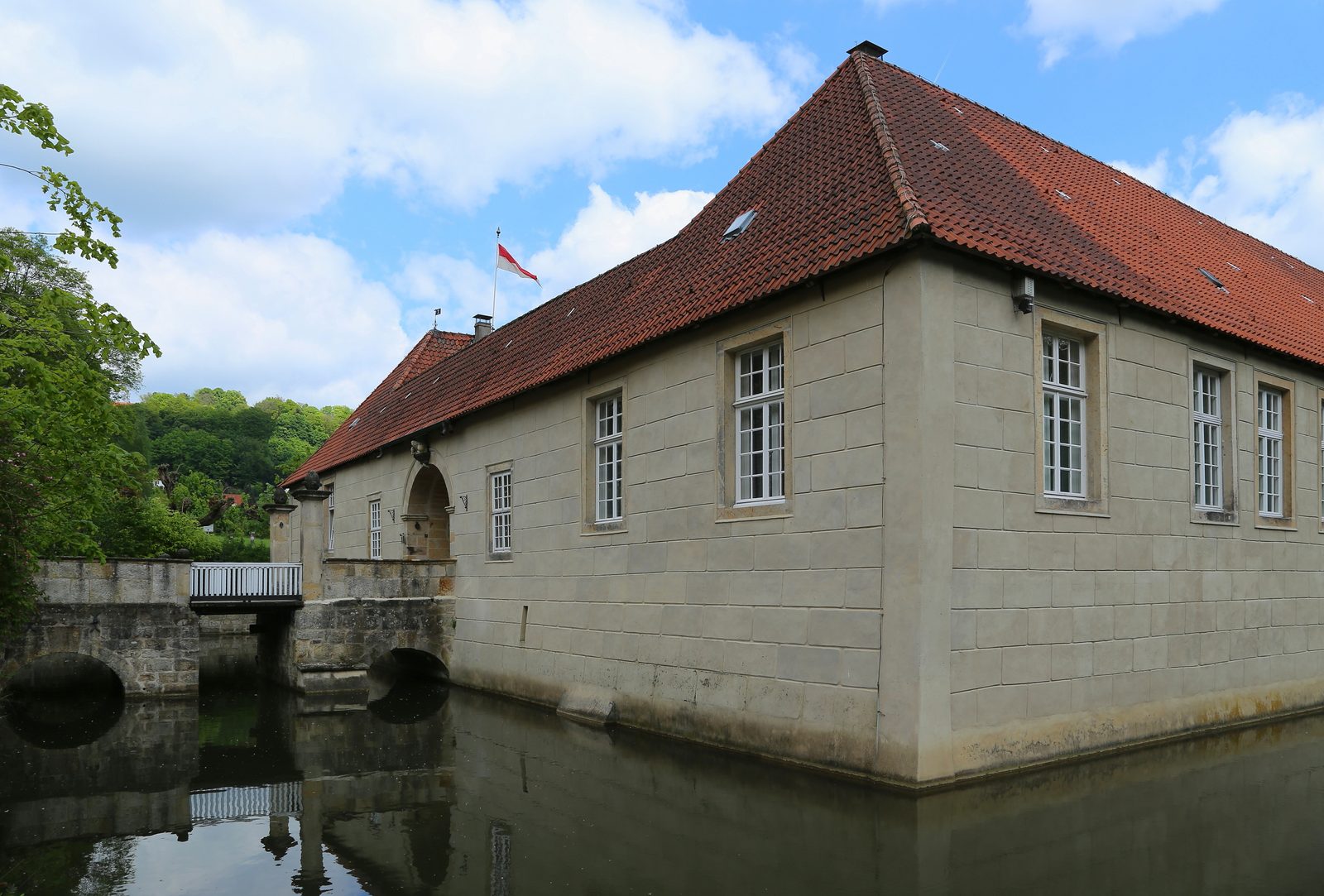
The moated castle Haus Marck is a manor house in the town of Tecklenburg in Tecklenburger Land (Steinfurt district) in North Rhine-Westphalia (Germany). The house is the birthplace of Friedrich von Bodelschwingh (1831–1910), the long-time director of the v. Bodelschwinghschen Stiftungen Bethel, named after him.
Location+
The moated castle is located south at the foot of the town of Tecklenburg in the immediate vicinity of the Teutoburg Forest, embedded in the Haus Marck floodplain nature reserve. The main buildings are surrounded by a historic moat system.
History+
Haus Marck is explicitly mentioned for the first time in historical records in 1470. At that time, the owners were the Knights of Horne, who appeared in written sources as ministeriales of the Counts of Tecklenburg from 1198 onwards. In 1368, they acquired the later castle grounds "up de Markete". In a document from 1490, there is talk of an older and a newer Haus Marck, so a new building must have been erected shortly before. In 1537, Gertrud von Horne, the heiress of Claus von Horne, married the mercenary leader Georg von Holle. From 1562, he expanded the complex in the Weser Renaissance style and erected the manor house. Its current form is predominantly based on alterations from 1754. In 1576, Haus Marck passed by inheritance to the von Diepenbroick family from Buldern Castle near Dülmen. In the early modern period, Gut Marck was the largest estate in the County of Tecklenburg eligible for the Landtag. During the Eighty Years' War of Independence of the Netherlands, the castle was plundered by Spanish troops in 1599. Haus Marck played an important role in the Peace of Westphalia. Preliminary negotiations took place here in 1643, before the peace treaties that ended the Thirty Years' War in Germany were concluded in Münster and Osnabrück on October 24, 1648. After the sale of the Tecklenburg County in 1707, the King of Prussia acted as liege lord. After the collapse of a corner tower of the manor house in 1754, its upper floors including the corner towers were removed and it was rebuilt in the Baroque style.
Source: Wikipedia · Licence: CC BY-SA 4.0 · Image: J.-H. Janßen · Wikimedia Commons · CC BY-SA 4.0
This description is a machine translation of an excerpt from the linked Wikipedia article. The source text was written by its authors, the translation is by Mobile History; like the original it is licensed under CC BY-SA 4.0.
Location: 52.2130, 7.8071