Tax Office
Local government
Melsungen Castle

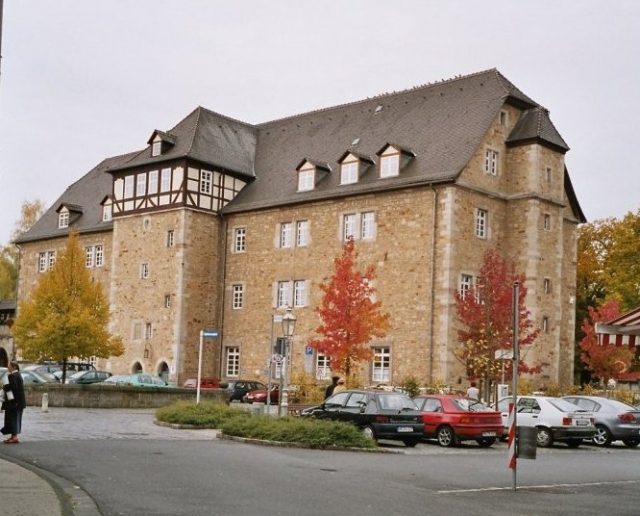
Melsungen Castle is a building in the style of the late Weser Renaissance in the middle of the North Hessian town of Melsungen in the Schwalm-Eder district. It was built from 1550 to 1557 by Landgrave Wilhelm IV of Hesse as a hunting lodge for his father, Landgrave Philipp the Magnanimous. Today, it houses the tax office of the Schwalm-Eder district and a court.
The Predecessor Castle+
From 802 to 817, Milisunge was repeatedly mentioned in documents as a strategically important defensive complex at a ford over the Fulda. In 973, Emperor Otto III gifted parts of his possessions in Elesenge in pago Hassim, including a military building, to a Dietrat von Melsungen. In 1040, Count Dietrich bequeathed all his Melsungen possessions to Fulda Abbey.
Heinrich Raspe II (1130-1155/57), Count of Gudensberg from the Thuringian Ludovingian house, as Vogt of Hersfeld Abbey, pursued the alienation of Melsungen from Hersfeld's possession and had a castle ("burgus Milsungen") built at the strategically important Fulda crossing of the road from Gudensberg to Thuringia. It secured the "Sälzerweg" (from west to east), the "Nürnberger Straße" (from north to south) and the trade and military road "Durch die langen Hessen". In 1123, the Archbishopric of Mainz gained feudal sovereignty over Melsungen Castle and town. In 1183, Archbishop Konrad I of Mainz bought the small complex for 350 marks from the Ludovingian Landgraves of Thuringia, but pledged it back to the Landgrave as early as 1193. In 1193/94, it was destroyed in a feud between Mainz and Thuringia, but was soon rebuilt by the Landgraves due to its important location. During this time, the town of Melsungen itself was also fortified with a town wall.
In the Thuringian-Hessian War of Succession after 1247, the castle was partially destroyed, but was also soon repaired. Subsequently, Melsungen was repeatedly an object of dispute between the Hessian Landgraves and the Archbishopric of Mainz. In 1385 and 1387, troops of Archbishop Adolf I conquered the castle. After a siege of Kassel by an alliance led by Mainz, the Hessian Landgrave Hermann II had to cede Melsungen Castle in the armistice agreement concluded on September 10, 1387. At the beginning of the 16th century, it was already dilapidated and fell into disrepair after 1550.
The Castle+
Philipp the Magnanimous, even before his five-year exile (1547 to 1552), which Emperor Charles V had imposed on him for his role in the Schmalkaldic War of 1546/47, had bought two gardens in the immediate vicinity of the old castle, in front of the Kassel Gate of the town of Melsungen. His son and governor Wilhelm IV (1532-1592) began construction of a hunting lodge between 1550-1557. After his return from exile in the Netherlands, Philipp continued the construction work. The old castle was demolished to make way for the stables, completed in 1577 under Landgrave Wilhelm IV.
During the Thirty Years' War, Tilly quartered himself in the castle in 1625; his troops remained in the town until 1626. From 1627 to 1632, the castle served Moritz the Learned of Hesse-Kassel as a temporary residence after he had abdicated as Landgrave. In 1643, it was significantly damaged by a flood of the Fulda. In 1648, the Swedish General Carl Gustav Wrangel briefly took up quarters in the castle. In 1675, the later "Great Elector" Friedrich Wilhelm of Brandenburg visited his sister, the Hessian Landgravine Hedwig Sophie, in Melsungen before the Battle of Fehrbellin. From 1733 to 1806, the castle and stables were used as a garrison for Landgravial and Electoral cavalry. Between 1807 and 1813, Napoleon's brother Jérôme Bonaparte, King of Westphalia, used the complex at irregular intervals.
From 1821, after the formation of the Electoral Hessian districts, the building served as an administrative building. From 1825 to 1868, it was the seat of the Electoral Hessian Forestry Academy; among others, Karl von Grebe, later professor of forestry at the Greifswald Forestry School, studied there from 1836-1837. In 1841, the castle was once again affected by a Fulda flood.
After the Prussian annexation of the Electorate of Hesse-Kassel, the castle became an administrative building. During the Second World War, the castle and the so-called Kreisgut in nearby Elbersdorf housed a prisoner-of-war camp for British officers. Since 1974, the building has been the seat of the tax office, the judicial authority, and at times also the cadastral office.
Complex
The complex today consists of the main building, the former residence of the burgraves, and the stables. The buildings are made of unplastered rubble masonry with corner quoins. The castle itself is a simple three-story, rectangular building with a rectangular risalit with a spiral staircase on the south side and risalit-like projections extending into the lower gable floor on the east and west sides. A two-story transition to the stables adjoins the west gable. The stables, built at a right angle to the castle, are two-story and now have a gabled roof. From the transition from the castle to the stables, two gates lead into the side forecourt of the burgrave's residence. This transition is two-story and connected on the outside with the town wall and a squat round tower.
A partial visit is possible by appointment.
Garden Complex
The associated English Garden is characterized by its old trees, a pond, and parts of the old town wall. It was laid out in place of an earlier baroque symmetrical garden.
Take Mobile History with you
You are reading this text for free. Premium adds what matters on the road: descriptions read aloud, sites found through your camera, whole regions taken offline.
- Every description, including the ~17,700 Premium sites
- Audio guide: have descriptions read to you on location
- AR finder: see sites through your camera, with distance and bearing
- Unlimited saved sites
14 days free, then from €2.99 a month. Cancel anytime.
Source: Wikipedia · Licence: CC BY-SA 4.0
This description draws on the facts documented in the linked Wikipedia article; Wikipedia content is licensed under CC BY-SA 4.0. Wording and editing: Mobile History.
Location: 51.1330, 9.5411