To be privately owned
Meseberg Castle

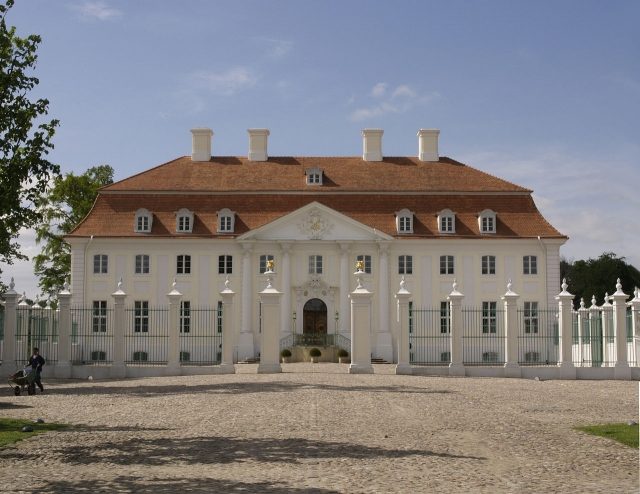
The Baroque palace Schloss Meseberg in Brandenburg is the guesthouse of the German Federal Government. It is located 70 kilometers north of Berlin in Meseberg, a district of the town Gransee with 150 inhabitants. The grounds are situated directly southeast of Lake Huwenowsee.
After the old manor house in Meseberg burned down in March 1721, Count Hermann von Wartensleben had the current palace built starting in 1736. His wife Dorothea, née von der Groeben, brought the estate into the family with their marriage in 1723; the knight's estate had been owned by the von der Groebens since the second half of the 16th century.
According to Bernhard Ludwig Bekmann, the garden was laid out in Meseberg in 1736 and the house construction began in 1737. The construction was completed in 1739. The architect is not known by name but is presumed to be in the circle of Berlin's chief building director Philipp Gerlach. The designer of the terraced Baroque garden was named Münther.
Hermann von Wartensleben had already had Schloss Rauschendorf built as his residence shortly after his marriage. His brother Friedrich Ludwig had begun the construction of Palais Wartensleben on Pariser Platz in Berlin in 1735, following a royal decree.
Ten years after Wartensleben's death, the estate, along with another complex of properties, was acquired in 1774 by Prince Henry of Prussia, who resided in Rheinsberg, and was gifted the following year to his favorite, Christian Ludwig von Kaphengst (1740–1800). The purpose of this generous gift was Kaphengst's removal from the Rheinsberg court, ordered by the Prince's brother. Kaphengst had the existing complex expanded with additional buildings, including the stables. He led an extravagant lifestyle in Meseberg, which eventually led him to financial ruin. Under him and his successors, the garden was primarily extended to the south and transformed into a park that encompassed large parts of the lake shore.
Later owners included the publisher of the Vossische Zeitung, Carl Robert Lessing. He bought the estate for his son Gotthold Ephraim Lessing d. J. (1861–1919), for whom a mausoleum was later built in the park. The publisher's wife, Emma von Gelbke, passed on the story of Baroness Elisabeth von Ardenne to Theodor Fontane, thus providing the inspiration for the novel Effi Briest. In his "Wanderungen durch die Mark Brandenburg" (Walks through the Mark Brandenburg), Fontane referred to Meseberg as a "magic castle."
The Lessing family played a significant role in the further development of the estate. The family crest – three rings symbolizing the ring parable of the related poet Gotthold Ephraim Lessing – was affixed multiple times. The house was furnished, among other things, with paintings by Carl Robert Lessing's brother Carl Friedrich Lessing and his nephew Conrad Lessing. Otto Lessing – another nephew of Carl Robert – created various busts of family members and ancestors for Meseberg. The Lessing family owned the estate until 1931.
In 1945, the estate was expropriated without compensation. The demolition of the palace planned by the Red Army was prevented by Mayor Franz Rhode. In the following decades, the palace housed a grocery store, a kindergarten, the municipal office, and other facilities. After the fall of the Berlin Wall, Schloss Meseberg – which was not returned to its owners – fell into disrepair until the Messerschmitt Foundation acquired the dilapidated property in 1995 without a concrete usage concept. The palace, garden, and park were restored by the foundation according to monument preservation standards. The foundation, which spent around 25 million euros on this, granted the Federal Government the use of the palace in 2004 for an initial 20 years at a symbolic rent of one euro. The Federal Government invested another 13 million euros for security and communication technology and also covers the ongoing maintenance costs. This use and security also involved interventions in the historical substance of the building. In addition to its function as a guesthouse of the Federal Government, the palace is also to be used for other events such as cabinet retreats and conferences. The handover to the then Head of the Chancellery, Thomas de Maizière, took place on January 26, 2007; the first guest in the house was French President Jacques Chirac.
Garden+
The Baroque terraced garden was elaborately restored. The division by axes resulted from the existing structure. The elevation of the garden sections was determined based on the building substance and excavation findings.
The lake parterre received two broderie compartments with an elongated outline, as was customary during its period of creation. A modern form was developed for the undocumented broderie. In the subordinate southwestern parterre, a lawn parterre seemed appropriate, whose ornamental structure was also designed in a modern style.
Garden stairs were not documented from the Baroque period but were necessary for use. Since the former Baroque western grand staircase of the palace had been reconstructed based on findings (foundation, original parts), the two new garden stairs in the main axis were executed with the same step profile. These three stairs, viewed from the other bank, form a unit and appear as part of the palace. All other stairs in the garden received unprofiled block steps.
For the assumed diagonal division of the four bosquet compartments, the structure of the very similarly designed garden of Schloss Burgscheidungen was used.
The barnyard was no longer needed as such and therefore, after surveying and documenting all foundations and incorporating the axes of the Baroque garden and the Cavalier House, received a geometrically structured lawn parterre, which serves as a reminder that a continuation of the garden existed or was planned here under Wartensleben.
Along the lake, there is also a publicly accessible landscape garden with the mausoleums of the Hövel and Lessing families.
Events (Selection)+
The palace hosted, among others, the following state visits and official appointments:
- February 23, 2007 – Reception of French President Jacques Chirac by Chancellor Angela Merkel
- April 23, 2007 – Reception of the President of the European Commission, José Manuel Durão Barroso
- August 23, 2007 – Cabinet retreat of the Federal Government (Merkel I Cabinet)
- September 10, 2007 – Reception of French President Nicolas Sarkozy by Chancellor Angela Merkel as part of the Blaesheim meeting
- November 20, 2007 – Reception of Italian Prime Minister Romano Prodi by Chancellor Angela Merkel
- June 10, 2008 – Reception of US President George W. Bush by Chancellor Angela Merkel
- November 2009 – Cabinet retreat of the Federal Government (Merkel II Cabinet)
- June 5, 2010 – Reception of Russian President Dmitry Medvedev by Chancellor Angela Merkel
- June 18, 2010 – Future Summit with representatives from business and trade unions
- January 25, 2011 – Reception of the President of the European Commission, José Manuel Durão Barroso
Interesting Facts+
In the summer of 2009, an agricultural cooperative opened a pig fattening facility with almost 1500 animals just one kilometer from the palace. The Messerschmitt Foundation fears odor nuisance for state guests, which could be particularly problematic for those of Muslim faith.
Take Mobile History with you
You are reading this text for free. Premium adds what matters on the road: descriptions read aloud, sites found through your camera, whole regions taken offline.
- Every description, including the ~17,700 Premium sites
- Audio guide: have descriptions read to you on location
- AR finder: see sites through your camera, with distance and bearing
- Unlimited saved sites
14 days free, then from €2.99 a month. Cancel anytime.
Source: Wikipedia · Licence: CC BY-SA 4.0
This description draws on the facts documented in the linked Wikipedia article; Wikipedia content is licensed under CC BY-SA 4.0. Wording and editing: Mobile History.
Location: 52.9725, 13.1013