Apartments
Minnesheim Castle
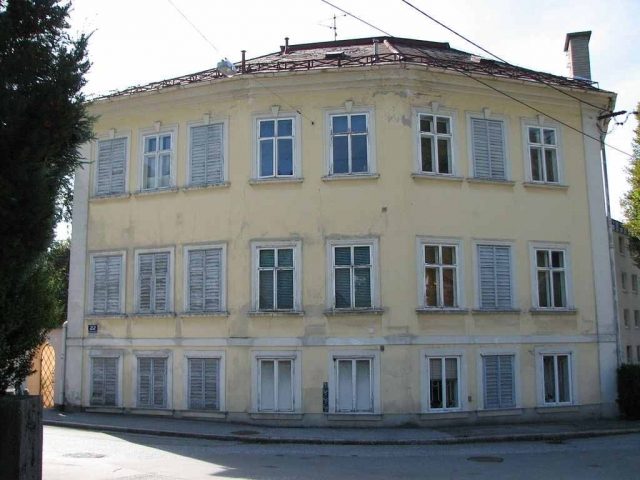
Minnesheim Castle is a 17th-century building in the Austrian city of Salzburg, in the Gnigl district. It is now owned by the municipality and is used for residential purposes.
The castle was built by Archbishop Paris Lodron as a summer residence and family seat (and specifically for his sister-in-law Countess Katharina Lodron) in 1644 on the site of the so-called Hofhölzl and is now located at Grazer Bundesstraße 22.
The draining of the Schallmooser Moor, initiated by Paris Lodron, allowed the area around present-day Gnigl to be developed. The small castle adapted to the existing road with its two wall bends. From the garden room at the front, it led into the park with its lime tree avenue.
On the castle is the inscription "Dulce oblivia vitae" (Latin, "Sweet it is to forget life"). This expresses the idea of escaping everyday worries. The castle included an artfully designed park (today: Minnesheimpark or Gnigler Park). The old Baroque garden was transformed by Franz Graf Lodron, court marshal of Archbishop Hieronymus von Colloredo around 1790 into a romantic garden in the style of Classicism and early Romanticism and a place of pleasure for everyone. The ten park vedutas were: "Small Castle", "The Dutch Manor House", "The Monument of Emperor Leopold I", "The Chapel", "The Hasenburg in the Duck Pond", "The Dovecote", "The Bust of Horace", "Commemorative Monument of 1793", "The Chinese Bridge", "The Chinese Pleasure House on the Rose Hill", "Three-sided Marble Pedestal with three Inscriptions (For solitary contemplation, For the thoughtful reader, For social pleasure)", "Chinese Aviary", "Pyramid in memory of the nouvelle Heloise" and "Family Monument of the Counts Lodron". An obelisk with its secret signs identified Count Lodron as a Freemason. Since the park was open to the public, the nobility held back. In the Franziszeischer Kataster of 1830, the park is designated as an ornamental garden with partly symmetrical, partly asymmetrical paths and squares.
Minnesheim Castle today+
Baron Helldorf, to whom Minnesheim had fallen in 1885, had all furnishings, with the exception of a single memorial stone, brought to his Tallenstein Castle near Völkermarkt in Carinthia and sold the castle to the then municipality of Gnigl in 1915. From 1915-1928, the converted house served as an elementary school. Afterwards, it was converted into an apartment building. As a result, the castle character has more or less been lost; externally, the building currently makes a dilapidated impression.
Due to the construction of the Grazer Bundesstraße, the castle building has been separated from the park. This still exists today as a 2 ha municipal park; however, the elaborate facilities have been lost. It has now been redesigned in the style of an English garden. The tree population largely dates from the park's founding period.
Until recently, the sculpture ensemble "The Four Seasons" was still installed in the park; this last remnant of former beauty has currently been removed due to vandalism. Within the four allegorical figures of the seasons is a stone cube that tells the early history of the Lodron family on three sides. A presumed relief, which would be important for the explanation, has been lost. The three inscriptions are as follows:
"SILVESTER LATERANUS BARO LODRONI PORTAM HIEROSOLIMORUM SUB GODFREDO BULLIONIO OCCUPANS PRIMUS COMES LODRONI AC CASTRI ROMANI CREATUS ALLO ML."
– Quoted from Clemens M. Hutter (2011, p. 15)
"Silvester Lateran, Baron of Lodron, when he took possession of the Jerusalem Gate under Godfrey of Bouillon. He was elevated to Count of Lodron and of the Roman camp in the year 1050" (op. cit.). The translator notes, however, that Godfrey of Bouillon's crusade first took place in 1099.
"AD PERIPATUAM REI MEMORIAM AC IN POSTERIUM EMULATIONEM FELIN IN PATRIAM PEDOX F F ANNO MLII."
– according to Clemens M. Hutter (2011, p. 15)
"For the lasting remembrance of this heroic deed and as an example for posterity, he arranged for the successful return (a trophy?) to the homeland in 1052" (op. cit.).
"DIGNORE TANTI VIRI ERECTO MONUMENTO CARA VESTIGIA INJURIAE TEMPORUM EREPTA HIC TRANFERRI JUSSIT FRENZISCUS NEPO ANNO MDCCXCV."
– according to Clemens M. Hutter (2011, p. 15)
"After the erection of a worthy monument for such a significant man, the descendant Franz ordered in the year 1795 that the precious remains be removed from possible damage by time and transferred here" (op. cit.).
Take Mobile History with you
You are reading this text for free. Premium adds what matters on the road: descriptions read aloud, sites found through your camera, whole regions taken offline.
- Every description, including the ~17,700 Premium sites
- Audio guide: have descriptions read to you on location
- AR finder: see sites through your camera, with distance and bearing
- Unlimited saved sites
14 days free, then from €2.99 a month. Cancel anytime.
Source: Wikipedia · Licence: CC BY-SA 4.0 · Image: http://commons.wikimedia.org/wiki/File:Salzburg-Gnigl_Schloss_Minnesheim.JPG
This description draws on the facts documented in the linked Wikipedia article; Wikipedia content is licensed under CC BY-SA 4.0. Wording and editing: Mobile History.
Location: 47.8140, 13.0756