CastleMirow

Mirow Castle

Mirow Castle

Museum

The Mirow Castle Island with its ensemble of buildings in Mirow in Mecklenburg-Vorpommern was one of the secondary residences of the Dukes of Mecklenburg-Strelitz.

The History of the Castle Island+

The Mirow Castle Island originated from a commandery of the Order of St. John in the 13th century. After lengthy confrontations with the Grand Masters of Sonnenburg, the Mecklenburg dukes gained influence over the appointment of the commanders during the 16th century. After the death of the last Mirow commander, the commandery was finally managed only by Protestant administrators, who mostly came from the Mecklenburg ducal house and took up their princely residence here in the manor house of the commandery. The commandery was secularized in 1648. Buildings on the castle island were constantly under construction during this period.

With the Hamburg Compromise of 1701, Mirow became a founding component of the newly formed (partial) Duchy of Mecklenburg-Strelitz. The Mirow properties in princely possession were used as a widow's residence after the death of Adolf Friedrich II; the ducal office of Mirow repeatedly had supply duties for members of the princely family.

After a major fire in 1742, large parts of the building stock were renewed. At this time, the Mirow court had briefly developed into an intellectual center of the country, despite or precisely because of its remoteness. Many important personalities who later gave decisive impulses to regional developments in the second half of the century belonged to the Mirow court society around the middle of the century.

As quickly as its rise, Mirow lost its importance again from the 1750s onwards. From the middle of the 18th century, the role of the Mirow castle ensemble was almost exclusively limited to providing a fitting setting for burial ceremonies for members of the ducal family. "Mirow is now the place of the dead," a travel writer formulated shortly before the First World War.

The Castle+

Castle Building

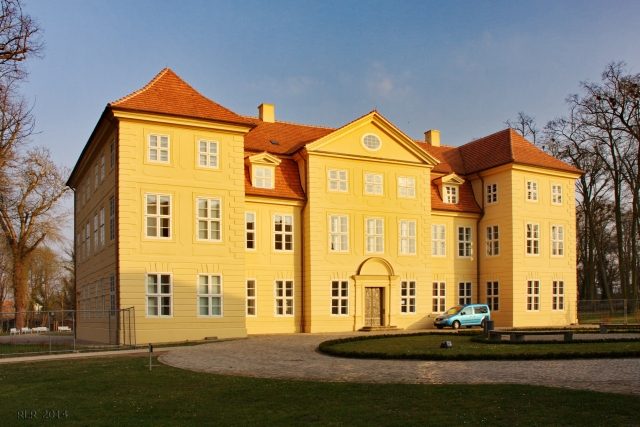
The castle's core still consists of parts of the predecessor building from 1708, which was partially destroyed in the 1742 fire. The baroque ballroom dates back to 1710. The current castle was built from 1749 to 1752 on behalf of Adolf Friedrich III, according to plans by Christoph Julius Löwe. It is a small, two-story building with an H-shaped floor plan with short, projecting, three-story wings. The facades of the eleven-axis castle are only sparsely decorated; both the central courtyard-side and the garden-side projections are crowned with a simple gable. The spatial structure was based on 18th-century French country castles. The formerly valuable furnishings are said to have come from artists who had already worked in Sanssouci, but hardly any of these works are still preserved. After the ducal family moved out, the castle repeatedly stood empty for longer periods.

The castle and castle island belong to the state of Mecklenburg-Vorpommern. The castle was extensively restored from 2003 until Pentecost 2014 and is once again open to the public.

Cavalier House

Since Mirow Castle was too modestly dimensioned for a lavish court, the Cavalier House for the court staff was built opposite the courtyard side from 1756 to 1758. The late Baroque building corresponds to the actual castle in width and number of windows and forms an enclosed courtyard with it, thus creating a stately ensemble. After a fire in the 19th century and partial destruction, the Cavalier House was subsequently restored.

Both buildings (castle and Cavalier House) were renovated by 2014. The castle is intended to serve as a museum, among other things; the Cavalier House is planned for cultural events.

The Johanniterkirche (St. John's Church)+

Parts of the Johanniterkirche still originate from the church of the Knights Hospitaller from the 14th century. It is originally a hall church built in the Brick Gothic style, which was extended and rebuilt over the centuries. The Baroque tower top dates back to a copper donation from Frederick II, who occasionally visited Mirow as crown prince and maintained friendly relations with the ducal family. The great fire of 1742 also severely damaged the church, and it subsequently received magnificent Baroque furnishings; the altarpiece was created by Charles Maucourt in 1750. At the end of World War II, the church burned out again on the night of May 1, 1945, after shelling by German soldiers. The interior was largely destroyed. Reconstruction began with simplified means after the war and was partially completed by 1950. A support association was founded in 1989 for the restoration of the destroyed tower, and a new spire was installed in 1993. Currently (September 2008), the facade of the nave is being renovated.

The princely crypt, which has been extended several times, is attached to the north side of the castle church. From 1708 onwards, members of the Mecklenburg-Strelitz line of the Mecklenburg dynasty found their final resting place here. In the currently accessible part of the princely burial site, there are still 22 rather simple coffins, including those of five of the total of eight regents of the Mecklenburg-Strelitz region.

The Gatehouse and the Lower Castle+

The oldest preserved secular building on the castle island and also in the town of Mirow is the Gatehouse. It originates from the fortification system that was built around the castle island in the 16th century, of which remnants of the ramparts still exist. The Gatehouse is dated to 1588 and built in the Renaissance style. The building, decorated with strong rustication, was renovated from 1995 to 1996. Not far from the Gatehouse, but outside the castle island, stands the Lower Castle. This Baroque building was erected in 1766 and initially remained unfinished. It replaced a simple, unadorned predecessor building, which had been built between 1735-1737 after the marriage of the so-called "Prince of Mirow" Karl (Ludwig Friedrich), a younger prince of the House of Mecklenburg-Strelitz, to Elisabeth Albertine of Saxe-Hildburghausen, and in which several of the couple's children were born, among them Adolf Friedrich IV and Karl II, later regents of the Strelitz region, as well as (Sophie) Charlotte, later Queen of England. No pictorial representations of the former birthplace of that generation of the Strelitz ducal family are known. After Adolf Friedrich IV's ascension to the throne, the ducal family moved to the main residence of Neustrelitz. Princely court life ceased in Mirow, and the castles largely stood empty after 1761. In 1820, a teacher training college moved into the Lower Castle, where elementary school teachers for manorial villages and towns in the Strelitz region were trained for more than a century.

The Park and the Isle of Love+

Surrounding the castle, the island houses the small castle park. Almost nothing remains of the original Baroque garden that surrounded Mirow Castle. The current park is designed in the style of English landscape gardens. On the "Isle of Love" is the tomb of Adolf Friedrich VI, the last Grand Duke of the Mecklenburg-Strelitz region. He died in February 1918 under unexplained circumstances and was not buried in the princely crypt.

Take Mobile History with you

You are reading this text for free. Premium adds what matters on the road: descriptions read aloud, sites found through your camera, whole regions taken offline.

  • Every description, including the ~17,700 Premium sites
  • Audio guide: have descriptions read to you on location
  • AR finder: see sites through your camera, with distance and bearing
  • Unlimited saved sites

14 days free, then from €2.99 a month. Cancel anytime.

Source: Wikipedia · Licence: CC BY-SA 4.0 · Image: Rainer Gindele

This description draws on the facts documented in the linked Wikipedia article; Wikipedia content is licensed under CC BY-SA 4.0. Wording and editing: Mobile History.

Location: 53.2772, 12.8105