Museum
CastleStadel
Mörsburg Castle (Stadel)
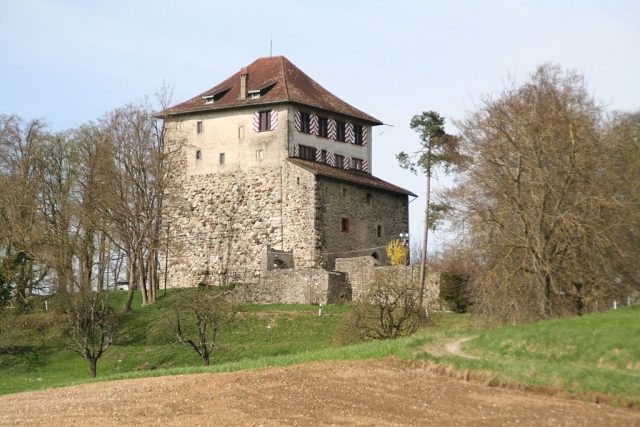
Mörsburg Castle is located northeast of Winterthur in the Swiss canton of Zurich. It is owned by the city of Winterthur. Mörsburg, or Mörsberg as it was called in the Middle Ages, is situated at an altitude of 511 meters on the southern spur of a ridge that separates Winterthur from the Thurtal valley. There is a line of sight to Kyburg Castle (9 kilometers away) and Hegi Castle (3 kilometers). In earlier times, the old trade route to Pfyn passed nearby. Nothing is known about the builders of Mörsburg. It is conceivable that a wooden castle already stood on the site of the present residential tower in the 10th century.
The residential tower was probably built in the late 10th century by the Lords of Winterthur on the site of an older structure. After 1027, the castle came into the possession of the Counts of Nellenburg. In 1111, Count Adalbert von Mörsburg is attested as owner. He was married to Mathilde von Nellenburg and adopted the name of her ancestral castle Mörsburg (today Morimont, Oberlarg). After 1125, the complex came into the possession of the Kyburgs through the marriage of Adalbert's daughter Mechthild to Adalbert I von Dillingen – Kyburg. Hartmann IV von Kyburg expanded it into a castle around 1250. Hartmann IV, the last male representative of the Kyburgs, died on November 27, 1264, at Mörsburg.
His heiress was Margaretha of Savoy. After her death, the castle passed to Rudolf von Habsburg in 1273, who gave it as a fief to the Meiers of Oberwinterthur, who from then on called themselves Meier von Mörsberg. The daughter of the last Meier married Count Egbrecht III von Goldenberg around 1360, whose father was the Austrian Vogt (bailiff) at Kyburg. Mörsburg remained in the possession of the Goldenbergs until 1569, then it passed to his sons-in-law Hans Ulrich Stockar zu Schwandegg and Max Blarer von Wartensee. The latter sold it in 1598 to the city of Winterthur, which used the building as the seat of the Amman (magistrate) until 1798. In 1799, heavy fighting between French, Austrians, and Russians took place in the vicinity of the castle, leaving severe damage to the castle. In addition, the interior furnishings were removed.
After 1841, Mörsburg stood empty for sixty years. Then the Historisch-Antiquarischer Verein Winterthur (Historical-Antiquarian Association Winterthur) moved in, which has used the castle as a museum ever since. Until 2000, the castle warden lived in an apartment on the 3rd floor of the tower; his successor now lives elsewhere.
Construction History+
The oldest verifiable traces of wood date back to around 1100, and the oldest surviving structural elements date from the first half of the 12th century. Major alterations and extensions were carried out under Hartmann IV von Kyburg, who expanded the castle with an outer bailey on the southern terraces, which is mentioned in 1253.
The existing predecessor building was probably reinforced by Adalbert von Mörsburg with massive boulders, forming a U-shaped casing that opens towards the garden. The reinforcing wall extends about five meters beyond the actual core to the south. The connection of the two ends created the bailey-like staircase, which was initially open and later covered.
In addition, a third upper floor was added to the tower. It is striking that the masonry of boulders only begins about two meters above the ground. This could be an indication that the original motte was removed, making the foundation visible. The square floor plan measures around 16 meters, and the wall thickness is almost 5 meters.
Source: Wikipedia · Licence: CC BY-SA 4.0
This description draws on the facts documented in the linked Wikipedia article; Wikipedia content is licensed under CC BY-SA 4.0. Wording and editing: Mobile History.
Location: 47.5399, 8.7686