CastleErfurt-Molsdorf

Molsdorf Castle

Molsdorf Castle

The Castle can be visited
Museum


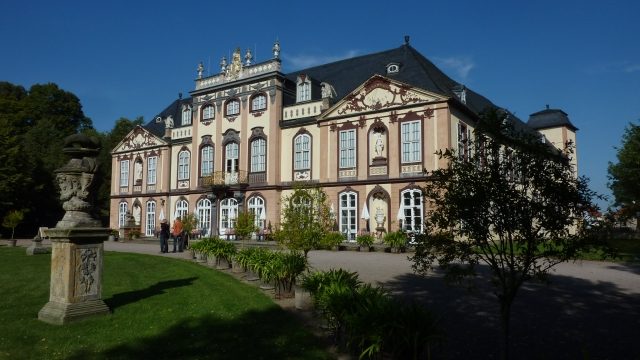
Molsdorf Castle is a Baroque castle in Molsdorf, a district of Erfurt. It is located near the Erfurt motorway junction, about 12 kilometers south of the city, and is considered one of the most beautiful Baroque castles in Thuringia. The castle now belongs to the Thuringian Castles and Gardens Foundation. A restaurant is located in some rooms on the ground floor. The museum also houses a painting collection by the painter Otto Knöpfer.

Molsdorf Castle is located in the south of the village of Molsdorf. The original castle complex includes the castle in the center of the complex, the two four-sided courtyards of the estate - later LPG - used as farm buildings in the northeast, the church in the northwest, and the adjoining park to the south.

Time until 1733

A moated castle stood on the site of the present castle since the 16th century, in the upper village to the left of the church. In 1114, the Lords of Molsdorf (Erminrich von Molsdorf) are mentioned in documents. Later, the Lords of Witzleben and von Thüna owned the moated castle (Dietrich von Witzleben, 1432; Heinrich von Witzleben, 1450; Ernst von Witzleben, 1530). In 1616, the village and castle temporarily came into the possession of the Schwarzburg-Sondershausen family, then Count Günther von Schwarzburg-Arnstadt. The castle was converted into a Renaissance castle, which was transformed into the present Baroque complex in the 18th century. At the beginning of the 18th century, the estate was acquired by "Privy Councillor Director Bachov", who left it to the British and Electoral Brunswick Legation Councillor and Landdrost, Otto Christoph Schultz (also Schulze).

Count Gotter

In 1733, Imperial Count and Prussian envoy to the Viennese court, Gustav Adolf von Gotter, acquired the castle from Schultz's widow. Between 1734 and 1740, he had it transformed into an impressive Baroque castle by the master builder Gottfried Heinrich Krohne. Johann Kupetzky and Antoine Pesne were commissioned with the artistic design. At the same time, a generous garden complex in the same style was created based on the French model, adorned with a large number of contemporary sculptures. The rear view of the moated castle became the representative garden facade of the Baroque castle. The west and east wings were built on the filled-in moats. A magnificent portal was created between the aligned tower stumps on the north side. Under Krohne's direction, not only the garden facade gained its splendor, but also the representative rooms in the south wing. The elaborate complex exceeded the builder's financial means. For his lavish lifestyle and the renovation of Molsdorf, he had spent three million thalers in a short time. Despite support from the Prussian King Frederick the Great and two lottery wins of several millions, he could not keep Molsdorf. As early as 1748, he had to sell the castle. He returned to the Prussian court as Lord High Marshal, where he was appointed Imperial Count by Frederick II and sent to Vienna.

After Gotter

Gotter's successor as owner of the castle in 1748 was the Württemberg Minister of State, Heinrich Reinhard Freiherr Röder von Schwende, who in turn sold it for approximately 80,000 thalers to Duke Friedrich III. These owners were also financially overstretched. The Baroque garden was transformed into an open landscape park around 1820 at the instigation of the Duke of Saxe-Gotha; the approximately 150 sculptures, which were said to have given it a "princely appearance", disappeared, only a few have survived. Remains of the Baroque garden can still be found on the western edge of the park. A small Baroque garden was created on the east side of the castle, where some damaged sculptures are displayed as a lapidarium. In the castle, Countess von Gneisenau had Art Nouveau alterations carried out between 1910 and 1922. In 1939, the Prussian state bought the castle and grounds; the Reichsautobahn was built on the southern border of the park.

After the Second World War, the city of Erfurt became the legal successor and owner. In the summer of 1945, the castle complex became a provisional quarter for a Polish aid organization that cared for Polish refugees and returning forced laborers. This was followed by German displaced persons and refugees. The building then served as an orphanage until 1954. The estate belonging to the castle grounds was handed over to the newly founded LPG in Molsdorf.

First restoration works took place in the 1950s. Reconstruction began in the late 1950s. The lost interior was completed with inventory pieces from expropriated manor houses and country castles in the area (e.g., Friedrichswerth Castle) with the approval of the state monument preservation. In 1966, the renovated grand ballroom was made accessible to the public. Later, extensive alterations and modernizations were carried out throughout the castle (central heating, sanitary technology, electrics, fire protection), and a castle café with a kitchen wing was created.

The castle was used as a venue for art and antique auctions by the state art trade of the GDR. Cultural events and chamber music concerts were regularly held there. From 1990, the castle was extensively renovated and then opened for viewing.

Today

A guided tour of the building, which starts every full hour, begins in the buffet room, where the festive banquets were prepared. The former banquet hall is entered through a double door. 33 paintings of reigning kings, princes, diplomats, and generals of the 18th century adorn the oak paneling of the walls, reaching up to the ceiling. Peter Weingart created the ceiling painting in 1738, which represents a special technical sophistication: it is said to be a retractable tabletop with which Gotter repeatedly amazed his guests. This ballroom is considered unique in Thuringia. In the subsequent Silver or Ladies' Hall, the walls once bore 35 portraits of the beautiful ladies admired by Gotter (perhaps not only), the "crowned heads of his heart". The Marble Hall receives atmospheric lighting from the light entering through the large windows and the balcony door, which refracts in the mirrors and portraits. Of the many paintings from that time, only a few remain today. Gotter's bedroom, once decorated with lascivious depictions, no longer shows its charm and richness today. Noteworthy are the paintings Gotter and his niece Friederike von Wangenheim in pilgrim attire from 1750 by the artist Antoine Pesne, and The Gypsy Woman by Johann Kupetzky. The two artists also created the paintings in the Marble Hall Aurora with the Sun Chariot (ceiling painting by Pesne) and Gotter in Hunting Attire (Kupetzky). The Red Salon forms the end of the garden facade; it gets its name from the red wallpaper, which dates from the 19th century and comes from Seebach Castle. The ceiling painting by an unknown master, which symbolizes Gotter's philosophy of life: Triumph of the Liberal Arts over Hell and Clergy, is noteworthy. In addition, Molsdorf Castle presents an erotica collection from the 20th century and invites visitors to regularly held chamber and park concerts. The castle belongs to the Thuringian Castles and Gardens Foundation and can be visited daily except Mondays from 10 am to 6 pm.

Take Mobile History with you

You are reading this text for free. Premium adds what matters on the road: descriptions read aloud, sites found through your camera, whole regions taken offline.

  • Every description, including the ~17,700 Premium sites
  • Audio guide: have descriptions read to you on location
  • AR finder: see sites through your camera, with distance and bearing
  • Unlimited saved sites

14 days free, then from €2.99 a month. Cancel anytime.

Source: Wikipedia · Licence: CC BY-SA 4.0 · Image: Joachim Schneeleopard

This description draws on the facts documented in the linked Wikipedia article; Wikipedia content is licensed under CC BY-SA 4.0. Wording and editing: Mobile History.

Location: 50.9007, 10.9613