Cultural Events
Museum
Mosigkau Castle
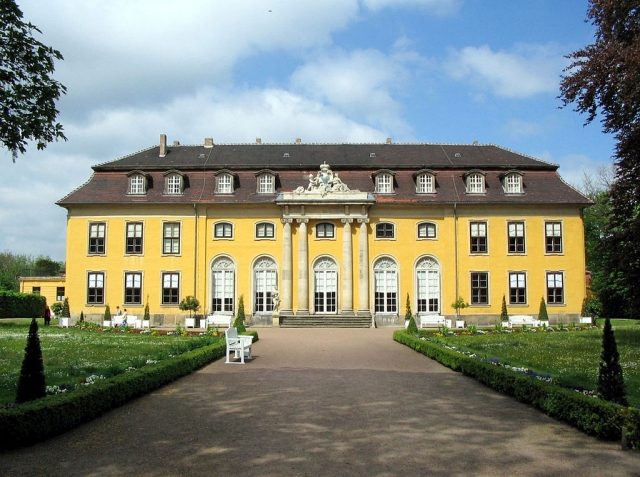
Mosigkau Palace was built as a Rococo palace between 1752 and 1757 in the heart of the village of Mosigkau, eight kilometers southwest of Dessau, as a summer residence. It is one of the last completely preserved Rococo ensembles in Central Germany. Its park is part of the UNESCO World Heritage Dessau-Wörlitz Garden Realm. Special exhibitions and concerts are regularly held in the Mosigkau Palace Museum and the Orangery.
The unmarried Anhalt princess Anna Wilhelmine, favorite daughter of Prince Leopold I of Anhalt-Dessau, had been enabled by her father in 1742/43 with a generous gift of two estates and a considerable appanage to have this splendid palace and garden complex built. The endowments are noteworthy, as Anhalt-Dessau was a truly small state and other children of Leopold I of Anhalt-Dessau (a total of ten legitimate children) also received similarly extensive appanages. At the time of Leopold I's death, he was the largest landowner in the principality.
First designs and ideas probably came from the Sanssouci architect Georg Wenzeslaus von Knobelsdorff. The actual builder was the Dessau court architect Christian Friedrich Damm, whom Anna Wilhelmine commissioned in 1752 with the construction of the summer residence. Around the courtyard of honor are the Corps de Logis, cavalier houses, and utility buildings.
After the death of the lady of the palace in 1780, a foundation for noble unmarried women was established in the palace according to her will, which existed until 1945.
Walther Pflug worked from summer 1945 on the rescue and restoration of Mosigkau Palace. In 1947, he was appointed curator of the palace by the President of the State of Saxony-Anhalt and was the first director of Mosigkau Palace from 1951 to 1954.
Interior and Gallery Hall+
From 1951, the palace became a museum for Rococo living culture. 17 rooms can be visited, some in their original condition. Here is the tapestry The Triumph of the Church over Idolatry, designed by Peter Paul Rubens around 1630, made in a Brussels workshop and originally from the City Palace in Dessau.
The cultural-historical highlight is the Gallery Hall. It is decorated with rich stucco work and houses in recessed wall panels, in a unique original Baroque (unbroken) hanging in Germany, important paintings predominantly by Flemish and Dutch masters of the 17th century from the "Oranian Inheritance," such as Zephyr and Flora by Peter Paul Rubens, The Princes of Orange by Anton van Dyck, as well as paintings by Jan Brueghel the Elder, Jacob Jordaens, Hendrick Goltzius, and Gerard van Honthorst. The palace also contains an extensive collection of portraits of Anhalt princes.
Pleasure Garden+
The garden borders the Gallery Hall to the south. It contains hedge sections with the bowling alley arbor, a fish pond, and a maze. The attraction of the Rococo garden is the Orangery with rare and some centuries-old potted plants that line the main path to the palace during the summer months.
Take Mobile History with you
You are reading this text for free. Premium adds what matters on the road: descriptions read aloud, sites found through your camera, whole regions taken offline.
- Every description, including the ~17,700 Premium sites
- Audio guide: have descriptions read to you on location
- AR finder: see sites through your camera, with distance and bearing
- Unlimited saved sites
14 days free, then from €2.99 a month. Cancel anytime.
Source: Wikipedia · Licence: CC BY-SA 4.0 · Image: https://commons.wikimedia.org/wiki/File:Schloss_Mosigkau.JPG
This description draws on the facts documented in the linked Wikipedia article; Wikipedia content is licensed under CC BY-SA 4.0. Wording and editing: Mobile History.
Location: 51.8060, 12.1508