CastleFeldkirchen an der Donau-Bad Mühllacken

Mühllacken Castle
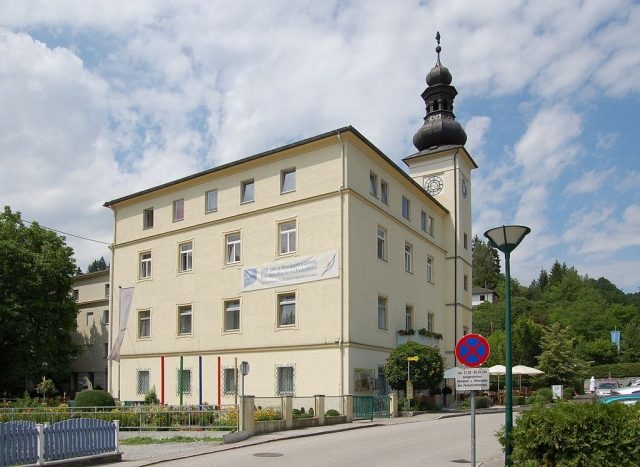
Mühllacken Castle

Residential and commercial building

Mühllacken Castle is located in the Bad Mühllacken district of the municipality of Feldkirchen an der Donau in the Urfahr-Umgebung district of Upper Austria (Bad Mühllacken 55).

Mühllacken Castle was a noble residence that exclusively served as a spa for noble guests. According to a sales calculation from 1526, it consisted of "the castle building and the bath".

The discovery of the so-called Bruno Spring is, according to legendary accounts, attributed to a squire named Bruno, servant of Count Siegmund von Schaunberg, who returned in 1364, mortally ill and exhausted from the hardships of a crusade, and was healed by the spring water in the Pesenbach Valley. By the beginning of the 16th century, the healing effect of the spring water was already recognized. The idea of combining the spa operation with a noble estate goes back to the Schmidtauer von Oberwallsee. Jobst Schmidtauer the Younger exchanged subjects with Hans Albrecht Artstetter von Rottenegg to round off his property. A document from January 2, 1607, refers to the fact that the spring originates on a wooded area and rock belonging to the Landshaag dominion, which is "owned from here" by hereditary right, and that there was also permission for the spa operation "... sub obigem Datum das Heilwasser erlaubt worden." The "holy spring," from which the water was led to the bath, is half an hour away from the castle.

Johann Georg Peisser von Wertenau acquired the castle in 1712; at that time, the property consisted of two floors (houses), one of which served for bathing and spa operations, and the other, the so-called church floor, contained a chapel with a sacristy and also served as a residence for the owners. Mühllacken Castle and Pesenbach Castle then belonged to the real estate complex of the Mühldorf estates and came to Wilhering Abbey on March 3, 1747, where they remained until 1857. In 1936, after several interim owners, Mühllacken came to the Congregation of the Sisters of Our Lady of Carmel in Linz. They renovated the buildings and established a spa operation according to the teachings of Father Sebastian Kneipp. By 1937, spa guests from Linz could already be cared for. The sisters also opened a kindergarten and taught needlework. During the Second World War, the sanatorium was confiscated and occupied by seriously ill people, who were cared for by the sisters. After the end of the war, the sisters converted the hospital into a retirement home. In 1948, the spa operation with water applications was resumed.

Mühllacken Castle today+

The main building is a four-story structure with a hip roof and a tower, topped with an onion dome and a lantern. The castle has a Baroque tower from after 1705; other parts of the building are much older. The chapel in the southwest corner was built in 1974.

Today, it houses the Kneipp Traditionshaus of the Sisters of Our Lady Bad Mühllacken. Next to the castle is the noteworthy Bad Mühllacken Herb Garden.

Take Mobile History with you

You are reading this text for free. Premium adds what matters on the road: descriptions read aloud, sites found through your camera, whole regions taken offline.

  • Every description, including the ~17,700 Premium sites
  • Audio guide: have descriptions read to you on location
  • AR finder: see sites through your camera, with distance and bearing
  • Unlimited saved sites

14 days free, then from €2.99 a month. Cancel anytime.

Source: Wikipedia · Licence: CC BY-SA 4.0 · Image: http://commons.wikimedia.org/wiki/File:Kneipp-Kuranstalt_Bad_M%C3%BChllacken_01.jpg

This description draws on the facts documented in the linked Wikipedia article; Wikipedia content is licensed under CC BY-SA 4.0. Wording and editing: Mobile History.

Location: 48.3654, 14.0642