Uninhabited
Mutzschen Castle
Mutzschen Castle is located on the edge of Mutzschen's town center, east of Grimma in the Leipzig district of Saxony, on a spur above the Mutzschener Wasser. As early as the early Bronze Age, a fortification of the Lusatian culture, a branch of the Aunjetitz culture, stood here. A Wendish castle complex dating back to the 9th century has been proven, and after the eastward settlement in the second half of the 10th century, an early burgward. No above-ground structural remains of the medieval castle have been preserved. The baroque castle visible today, a two-story building with a gabled risalit, includes the gatekeeper's house, an octagonal flanking tower, the castle bridge, the remains of the former manor house on the outer bailey, the terraced gardens, an extensive, natural park, and a dammed castle pond with a castle mill, the castle houses with the salt tavern, and the houses below the castle.
The castle is situated on an oval plateau measuring approximately 50 × 80 m on a topographical spur. This spur is up to 20 m above the Mutzschener Wasser and is surrounded on three sides by a loop of the water. A fourth side is formed by the gorge created in the Middle Ages. This resulted in the 18 m deep division of the complex visible today. Originally, a wooden drawbridge led over this gorge, which was replaced by the stone bridge visible today through redesign.
Building Description+
Castle
The castle was rebuilt in 1703 after its complete destruction in the great city fire of 1681, and renovated in 1754. The building originally had thirteen windows on the courtyard side, now twenty-seven. In front of the central risalit on the courtyard side, which is framed by Tuscan half-columns extending through both main floors, there is an open staircase with two columns supporting a wide balcony. Under the triangular gable with a Latin inscription are coupled Ionic pilasters. The inscription reads:
"This house, which Lord von Kanitz, Lieutenant General of the most powerful King of Poland and Elector of Saxony, built from the ground up in 1703, was renovated and adorned with an extension and other new structures by the famous and distinguished Lord Otto Friedrich von Zanthier, Privy Councillor to the King of Poland and Elector of Saxony, in the year 1754."
Remains of baroque painting can be found in a room on the ground floor.
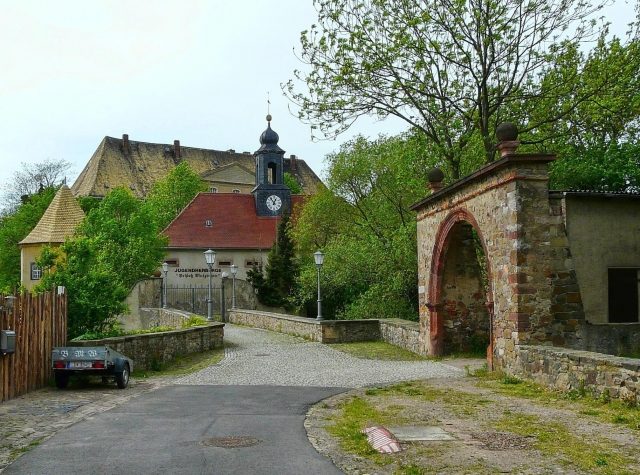
Tower Building (Gatekeeper's House)
After the great city fire of 1681, the gatekeeper's house was also destroyed down to its foundations. The tower building opposite the castle, dating to the construction period of 1754, was originally the residence of the castle administrator. The roof with its baroque tower shows similarities to the baroque dome of the main building of Hubertusburg. The former door and window sills made of Rochlitz porphyry from the previous building were reused in 1754. The weather vane was designed as a carp, indicating the numerous fish ponds laid out in this region around 1500, which led to the Mutzschen fish farming. In 1989, the company Eckelmann from Zschoppach produced a replica, which was installed during the re-roofing. In the seventies of the last century, the trees and bushes on the northern castle slope were removed. After several downpours and the associated softening of the earth, which caused the slope to slide and cracks to appear on the eastern part of the building, a part of the building began to slide off and had to be completely demolished. The local history room, which was housed in this part of the building, had to be relocated and could only move back into the gatekeeper's house in 1999 after extensive renovation work.
Flanking Tower
The flanking tower, located directly next to the main entrance, is colloquially known as the "Hungerturm" (Hunger Tower). Its purpose was to protect the inner defensive wall, secure the drawbridge, and house the guard personnel. For this, there was a heated room with a built-in bowl-tile stove. A short stone staircase leads to the windowless prison below. In its visible enclosing walls, an opening scratched by human fingers can be seen. The ground level visible today is about 2.5 m higher than at its original construction. For this reason, the door of the former guardroom became unusable over the centuries and had to be plastered over in 1960. Special exhibitions are held on the upper floor by the local history museum, for example in 2011 as part of the 3rd Saxon State Exhibition on the theme of Via Regia.
Residential Tower
Below and behind the second castle courtyard, towards the mountain spur, there is a square building, which possibly represents remains of a residential tower and is dated in the lower part of the masonry to the 10th to 11th century. Bats can be found on the recessed ceiling in winter.
Early Bronze Age Complex
The excavation carried out in 1972 under Willfried Baumann revealed that beneath the medieval layers on Mutzschen Castle Hill, there is an early Bronze Age settlement covering 0.25 ha, which was fortified by a two-meter deep and seven to eight-meter wide gorge. No rampart fortification was found during this excavation.
Early and High Middle Ages
Archaeological finds of pottery from the Leipzig group show that the mountain spur was resettled by Slavs in the 9th and early 10th centuries after the Migration Period. Due to the topographical situation, it is a natural fortification. Thus, Mutzschen, along with other castles east of the Mulde such as Wurzen, the Sonnenmühlwall in Oelschütz, Nerchau, Döben, Polkenberg, and Dahlen-Zissen, belongs to the strip of land east of the Mulde settled by Wends, which became part of the pagus Chutizi as Chutizi orientalis in the 10th century. Wilfried Baumann, and later Gerhard Billig and Karlheinz Blaschke, presumed that Mutzschen was the center of a German burgward in the second half of the 10th century. The church in the former outer bailey supports Mutzschen as a central point; although it is only attested to in 1341 with the mention of a plebanus, it has been considered by Schlesinger as a royal church or burgward church with a large parish already existing at that time. In 1081, King Henry IV granted his loyal Chitele the three villages of Mutzschen, Böhlitz (today a district of the town of Mutzschen), and Mehlis (a deserted settlement between Böhlitz and Prösitz), along with all appurtenances and all revenues, as free property, as well as the forest belonging to Mutzschen within specified boundaries in the Gau Chutizi in the county of Ekbert. The forest also later always belonged to the Mutzschen lordship as Mutzschener Heide or Wermsdorfer Forst. The document issued on March 18, 1081, in Regensburg explicitly speaks of villae and not of a castle. Nevertheless, this document is still mostly cited as proof of the existence of a castle in the 11th century. The imperial ministerialis Chitele is therefore also seen as the possible progenitor of the later noble family of the Lords of Mutzschen. The first reliable representative of this family is Konrad von Mutzschen (Cunradus de Mutsin). He participated with numerous other noble lords and ministeriales in the judicial decision of Margrave Dietrich the Oppressed regarding the demolition of Thorun Castle (see Dohna Feud) and is listed as a witness in the document issued in Dresden in 1206, and probably named himself after a castle or manor in Mutzschen.
Late Middle Ages
Probably around 1290, but certainly before 1308, the Burgraves of Leisnig acquired Mutzschen Castle and its lordship. There are no precise documents about the previous lords, who were possibly expelled from Döben by Wiprecht von Groitzsch and came to Mutzschen, Wermsdorf, and Luppa. In a document from 1308, they first refer to Mutzschen as "castrum nostrum". Since then, the names of the Lords of Mutzschen are known; they belonged to the family of the Leisnig Burgraves. Around 1350, the town of Mutzschen is first referred to as an oppidum.
Starschedel Family in Mutzschen
Around 1400, the castle passed into the possession of the von Starschedel family, also known as Starschädel. This family originated from Starsiedel. They came to Mutzschen after the Wettins took possession of Leisnig Castle in 1376 and disempowered the burgraves there. The family had very close ties to the Wettins and was wealthy, as they owned estates on the Upper Elbe, such as in Wehlen, income from hereditary tolls, and shares in silver mining in the Ore Mountains. At the Altenburg Partition in 1445, Heinrich von Starschedel is listed as a witness and owner of Mutzschen. His son Heinrich III von Starschedel was a mining captain in Schneeberg and owner of numerous mining shares. The Wettin Albrecht the Bold spent part of his childhood and youth in Leisnig; he was probably already acquainted with Heinrich at that time. When Albrecht embarked on his pilgrimage to Jerusalem, Heinrich was one of his companions. After Albrecht was appointed "Knight of the Holy Sepulchre," he also knighted Heinrich von Starschedel as "Knight of the Holy Sepulchre" and presented him with a consecrated sword. Heinrich vowed on this journey that if he returned healthy, he would found a monastery, which he did by establishing a Servite monastery in Mutzschen. This monastery was soon dissolved by the Reformation. Several monks converted to Protestant pastors; only one monk remained Catholic and lived in Mutzschen until his death. The town of Mutzschen received jurisdiction (except for the death penalty) from Heinrich von Starschedel. A court sword, a replica of Heinrich's Damascus sword, served as a symbol of jurisdiction for the town. It is now exhibited in the city museum. Heinrich von Starschedel founded numerous legacies, which his son Moritz Dietrich continued after his death in 1495. He shared the castle with his brother Ernst. Ernst became a canon in Meissen and died in 1529. Moritz Dietrich acquired Cannewitz in 1515 and died three years before his brother in 1526. His son Dietrich, as a young man, was so enthusiastic about Martin Luther's appearance in Worms in 1521 that he repeatedly recounted this experience. He became an ardent follower of Luther, visited him several times in Wittenberg, and supported him as a visitor in the dissolution of monasteries. He acted as guardian for his niece Anna Maria, Ernst's daughter, after Ernst's death. She had become engaged to a duke's son at the Wettin court after the Schmalkaldic War, which outraged the duke's father as not being of equal standing. But the marriage promise was binding. The duke turned to Luther, for whom this was a central theological question. After several years and many negotiations, the dispute was decided in the duke's favor. Thus, the son did not marry Anna von Starschedel, but the daughter of a Pomeranian duke. Dietrich von Starschedel had four sons: Heinrich, Haubold, Innocenz, and Georg. When their father Dietrich died, Tham Pflugck († 1596) became their guardian due to their minority.
Modern Era
Elector August of Saxony acquired the castle, manor, town, and associated villages (besides Mutzschen, these included Böhlitz, Roda, Wermsdorf, Mahlis, Fremdiswalde, Göttwiz, Löbschütz, Merschwitz, Poischwitz, Serka, Wetteritz, parts of Gastewitz, Jesewitz, Zschannewitz, Leipen, and "Das Reich"), as well as the fish ponds laid out around 1500, from the guardian of the four minor Starschedel children, Tham Pflugck, between 1565 and 1582, and had the castle redesigned in the Renaissance style to be more comfortable. The manorial village of Döbern was transferred to the Oschatz district. It was he who had the bridge piers built in stone and created new stone supports for the wooden drawbridge. His wife, Electress Anna, converted the economic facilities into a demesne. Already in 1556, the Lords of Starschedel had sold Wermsdorf to the Elector, so that he could now extend his rule over the Wermsdorfer Forst. August sustainably changed the political structures in Saxony, so that the Mutzschen district, with the district town of Mutzschen, was one of the offices of the Leipzig district. His representative was the district bailiff. The Elector also ordered, among other things, the creation of hereditary registers. In 1622, Elector Johann Georg I of Saxony sold Mutzschen to his favorite, the chamber councilor Dr. David Döring (1577–1638). Immediately after purchasing the estate, Döring ordered the district bailiff to vacate the castle building. Therefore, the district bailiff's house was built in baroque style on Seilerberg. During the Thirty Years' War, Holk's cavalry spread fear and terror in Mutzschen. Afterwards, the plague claimed countless victims. The already mentioned city fire completely destroyed the castle in 1681. However, since Elector August the Strong needed accommodation for his large hunting parties in the neighboring Wermsdorf hunting lodge, he issued instructions around 1703 for the reconstruction of the castle in baroque style and the construction of the stone bridge visible today. A stately two-story building with a gabled central risalit was created, which was extended and rebuilt in 1752/54. The Mutzschener Heide had been redesigned by Prince von Fürstenberg for parforce hunting, so that numerous guests stayed at the castle due to the Hubertus hunts. After Hubertusburg with its theater was completed in 1735, the actors stayed in the castle, except for the singer Faustina Bordoni, the Divine Faustina, who stayed in Hubertusburg. Through marriage, Colonel General Heinrich von Canitz acquired the property in 1740. He was highly regarded at the court of August the Strong. When he died in Dresden, his body was brought with a large escort in the Royal hearse to Mutzschen, where he was buried in the town church at his own request. With the beginning of the Seven Years' War in 1756, Mutzschen was occupied by the Prussians. The castle became an officers' quarter. Because in the Middle Ages, agate spheres, which Agricola called Mutzschen diamonds and sometimes contained inclusions of rock crystal or amethyst, were mined in the castle hill, many passages ran through the castle hill. Therefore, in 1776, the order was given to completely stop mining and close the passages, as it was feared that the buildings above would collapse. After Canitz's death, the property was inherited by his daughters, so that from then on the property appeared under changing names, for example in 1759 under the owner Mr. Otto Friedrich von Xanthier. After 1831, the peasants in Saxony were emancipated, the manors had to give up their jurisdiction and join a local court. The Canitz heirs chose the village of Böhlitz. Therefore, from this point on, the Mutzschen manor was referred to as Rittergut Böhlitz in documents. In 1847, Mutzschen Castle was owned by the Saxon court director Friedrich Hermann Gaudich from Pirna, who founded the Gaudichsroda manor. Gaudich had beautification work carried out on and in the castle. In 1852, Gaudich died and his heirs sold to the wholesale merchant Heinrich Carl Steinbrück from Erfurt, who leased it to his brother-in-law and architect Gustav Kufahl. In 1873, Paul Kleemann took over the property and sold it in 1874 to Herrmann Tränhardt. In 1901, the manor owner Emil Naumann from Sitten and Kroptewitz bought the manor as a trustee on behalf of eight of his former officer comrades. They received a larger sum of money from King Albert as a thank you for their services in the Franco-Prussian War of 1870/71, which came from the reparations payments from France given by the German Emperor to Saxony. Dr. Emil Naumann founded a foundation and appointed an administrator. On November 15, 1939, the entire ensemble with the castle, Hunger Tower, gatekeeper's house, and castle park was placed under monument protection. In Leipzig in 1942, the order was given to bring all valuable altars to the university church. From there, these, along with all transportable goods from the university church and the individual departments (geology, physics, chemistry), were brought to Mutzschen and stored in the passages of the former mine. Thus, since December 1943, the holdings of the manuscript department of the University Library Leipzig (including 7,448 manuscripts, 2,826 incunabula volumes, 155,000 autographs, and the valuable coin collection) were stored in boxes in the passages of the castle hill. The storage was so extensive that the Leipzig School of Commerce could only store books, so the passages in the castle hill were filled. The stored goods were never in Mutzschen's possession. The population had no knowledge of this and used only passages outside the castle hill during air raids. Fortunately, no bombs fell on Mutzschen and no acts of war took place. Towards the end of the war, refugees from the Rhineland came and lived briefly in the castle.
The Castle after the End of World War II
Not even the refugees learned anything about the stored goods. The Americans drove their jeeps on patrol through Mutzschen a few times, stopped at the castle, and drove back to their main base in Wermsdorf. They never learned anything about the stored artworks. Thus, in 1946, everything could be returned undamaged to the University of Leipzig. Only the Leipzig School of Commerce had lost some books due to the turmoil of war.
Use in the GDR and after the Wende
After the end of World War II, the Dr. Emil Naumann Old Foundation was expropriated in 1945 through land reform. In the summer of 1946, the castle was handed over to the youth and then to the FDJ. A district youth school was established. Concerts were held in the small hall. In 1959, a local history museum, today's Mutzschen City Museum, was set up in the gatekeeper's house by nature and local history enthusiasts. The local history room was set up in two rooms in the gatekeeper's house and in the Hunger Tower, but unfortunately, that part of the building slid off, and a provisional relocation took place, most recently to Grimmaische Straße. The current City Museum was only established in 1999. It contains exhibits from prehistory and early history to the immediate past, including ceramics, artisan tools, exhibits on school and club life, and the fire department. The lower part of the square residential tower, which was made usable by a newly broken-through entrance, was used by the community and associations for romantic events by torchlight. In 1962, the youth school era ended, and from 1963, a youth hostel with 105 beds was established. An overnight stay cost 0.25 M per child and 0.50 M per adult. From 1968 to 1970, 78 young Vietnamese women lived in the castle, learned German, and received vocational training. After German reunification in 1990, the youth hostel operation initially continued but had to be discontinued in 2003 due to exaggerated fire safety concerns. In 2000, the castle bridge was renovated. In 2003 and 2004, a building-historical and restorative investigation of the castle was carried out on behalf of an investor by the two Berlin building historians Yngve Jan Holland and Andreas Potthoff in cooperation with the restorers Sonia Cardenás and Jeanette Koletzki, in which the building's construction history was systematically recorded for the first time and presented in an expert opinion. Further expert opinions for usage concepts followed on behalf of the city of Mutzschen. Begun gutting measures were not carried out professionally, and all hopeful utilization and sales plans fell through. This also applied to the project of a natural healing center with a wellness landscape, named "Europeum," which was announced in 2009. Tangible reasons include the conviction of the officials of the city of Mutzschen that they could achieve proceeds of €600,000.00 from the sale of the property of the old foundation, which had been expropriated by land reform. In 2007, an archaeological excavation was carried out in the castle courtyard by the Department of Prehistory and Early History of the Friedrich Schiller University Jena. In addition to medieval finds, prehistoric finds were also recovered, and the trench, which was only partially cut in 1972, was fully recorded over its entire width of approx. 5 m and 1.50 m depth. The exact dating of these finds is still pending.
Trivia+
There are a number of modern ghost stories about Mutzschen Castle in Saxony. For example, a White Lady is said to haunt the castle. In 1659, a cook named Magdalena served at the castle, to whom a ghost appeared several times. Once, the ghost appeared to her with a mourning veil in the kitchen; at night, the ghost rattled through the castle. The ghost also appeared to a pastor with an elephant's trunk. This ghost, by the way, continued to be seen until the 19th century. The von Lüttichau family, who owned the castle, therefore only moved in for a few weeks a year, and the wife of one of the last owners, who lived there for a few weeks shortly before her end, was so frightened by its shouting and door-slamming that she died soon after. The staff also often heard voices calling, even though no one was in the castle.
Take Mobile History with you
You are reading this text for free. Premium adds what matters on the road: descriptions read aloud, sites found through your camera, whole regions taken offline.
- Every description, including the ~17,700 Premium sites
- Audio guide: have descriptions read to you on location
- AR finder: see sites through your camera, with distance and bearing
- Unlimited saved sites
14 days free, then from €2.99 a month. Cancel anytime.
Source: Wikipedia · Licence: CC BY-SA 4.0 · Image: Thomas Eichler
This description draws on the facts documented in the linked Wikipedia article; Wikipedia content is licensed under CC BY-SA 4.0. Wording and editing: Mobile History.
Location: 51.2610, 12.8849