Museum
Restaurant
Cultural center
Netzschkau Castle

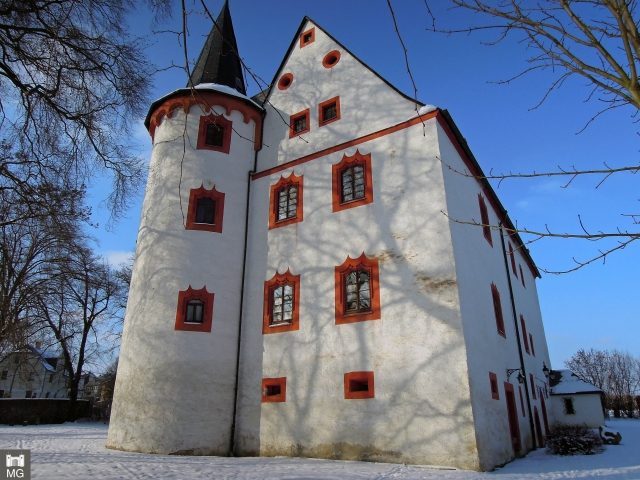
Netzschkau Castle is an unfortified residential castle built around 1490 in the town of Netzschkau in the Saxon Vogtland.
The rectangular long building with a round tower and a projecting square tower, completely restored on the outside, is located near the market opposite the church. The facade of the building is characterized by the color contrast of lime white and strong red. Also striking are the late Gothic stepped gables and the curtain arch windows.
Several ornate sandstone door frames from the castle's construction period still exist inside. Some preserved alterations to the castle date from later eras. The interiors are largely originally furnished, including a 4.10 m high tiled stove from 1627 and a rare coat of arms cabinet. On the ceilings of some interiors are the oldest forms of German stamped stucco (friezes and ornaments). Historic treasures such as a gilded wooden coffered ceiling and various possessions of the last countess are also significant.
Netzschkau Castle is one of the first castles in Saxony. At the end of the 15th century, the era of residential castles began – during this time, the nobility began to replace castles designed for defense with open, representative buildings featuring spacious halls.
The builder of Netzschkau Castle was Caspar von Metzsch. He had great influence at the Saxon court, which facilitated the financing and realization of his construction project. He probably relied on students of Arnold von Westfalen, builder of Albrechtsburg Meissen, for the construction. The longhouse with its round and square tower was built around 1490 in a construction phase lasting approximately three years. However, the Metzsch family did not build for themselves; their main residence remained the neighboring Mylau Castle. They sold Netzschkau Castle to Christoph von Reibold in 1578.
After a brief interlude of the Reibolds in the castle, Hans Ernst Bose acquired the estate and the associated manor in 1616. His son Carol von Bose (1596-1657) determined the further design of the castle. In his youth, he fought for the French king and received numerous awards. Upon returning from the war, Carol Bose met his first wife. He inherited the lordship in 1626 and was not satisfied with the castle's design. Consequently, the castle was renovated, modernized, and expanded. Among other things, numerous stucco decorations were added to the outdated wooden ceilings of the castle. Within a short time, two more building wings (north and east wings) were also built. The then horseshoe-shaped building complex also received a chapel. Initially, it was only intended for the castle owners. The inhabitants of the 200-soul village still had to climb the mountain to the neighboring village of Mylau for church services.
It was probably thanks to Bose's power and political skill that his Netzschkau property was not plundered and burned during the Thirty Years' War. Bose died in 1657 and was buried in St. Mary's Church in Zwickau. After him, his son Carl Gottfried inherited the castle, but without making major changes.
After the Bose family, the castle housed some interim residents before passing into the possession of the Lords of Schönburg-Glauchau. In the second half of the 19th century, they laid out a 4-hectare castle park in the English style. After the death of the last Countess of Schönburg-Glauchau, the city of Netzschkau acquired the castle and park in 1944. The purchase price was 100,000 Reichsmark.
Even during the time of the last countess, the castle was in a desolate state and increasingly dilapidated. In 1947, the ceiling of the concert hall collapsed. Most of the valuable stucco work was damaged in the process. Six years later, the north and east wings built by Bose had to be demolished due to acute dilapidation. The castle chapel had ceased to exist as early as 1725.
Since 1964, the "Schlossbauaktiv", the working group of the Kulturbund, carried out urgent securing and repair work voluntarily and on its own initiative.
In the 1970s, the manor house and in 1988 the "Schweizerhaus" fell victim to demolition. The park pond also had to make way for a playground. All that remained was the part of the castle that Metzsch had built around 1492. All external extensions now only exist in photos and pictures.
In 1990, funding was approved, which made a comprehensive structural and external renovation possible from 1991 to 1995.
Subsequently, excavations also took place in 1999, the results of which can be seen in the castle's permanent exhibition. The renovation of the castle began in the late 1990s.
At the beginning of the 21st century, the city of Netzschkau considered selling the castle property to an investor who planned an attached new hotel building on the site while preserving the castle. The corresponding plans were suspended indefinitely at the end of 2005 after considerable citizen protests.
Current Use+
The "Förderverein Schloss Netzschkau e.V.", founded in 1998, is responsible for the monument-appropriate use of the castle. For events, the so-called castle café with its vault, the magnificent concert hall, and the rustic fencing hall are used. The association organizes special exhibitions as well as concerts, slide lectures, readings, and dance workshops. Four to five special exhibitions are held each year. The Kurt Geipel and Fredo Bley exhibitions, among others, have received national attention. The historic ambience of the wedding room is also used by wedding parties. The annual Netzschkau Christmas market has moved to the castle square.
The castle and its permanent exhibition can be visited from April to October on weekends and public holidays.
A cooperation has existed between the Förderverein and the Netzschkau school for several years. Within this framework, the "Living Museum" course was launched, in which students are introduced to life in earlier times, an understanding of the past, and monument protection. In addition to this museum educational offer, treasure hunts or thematic events for children take place.
Take Mobile History with you
You are reading this text for free. Premium adds what matters on the road: descriptions read aloud, sites found through your camera, whole regions taken offline.
- Every description, including the ~17,700 Premium sites
- Audio guide: have descriptions read to you on location
- AR finder: see sites through your camera, with distance and bearing
- Unlimited saved sites
14 days free, then from €2.99 a month. Cancel anytime.
Source: Wikipedia · Licence: CC BY-SA 4.0 · Image: Mobile Geschichte
This description draws on the facts documented in the linked Wikipedia article; Wikipedia content is licensed under CC BY-SA 4.0. Wording and editing: Mobile History.
Location: 50.6148, 12.2485