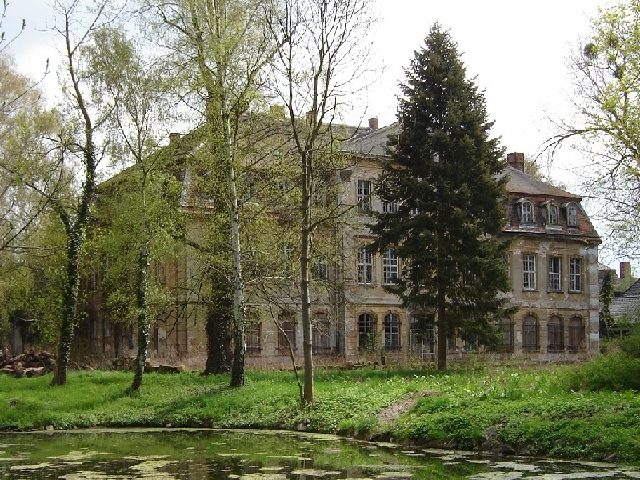
CastleKönigsborn

Neu Königsborn Castle

Neu Königsborn Castle

Uninhabited

In a document from the Magdeburg Archbishop Wichmann dating back to around 1164, Gerfridus and Heinricus de Cuningesborne were mentioned for the first time. The place name changed at the beginning of the 13th century (1205) to Konigsborne. The names are apparently derived from the location of a spring, which can still be found today near the old manor house in Königsborn. According to a village legend, a king traveling with his retinue is said to have discovered the spring.

During the 14th century, the place was abandoned by its inhabitants and fell into disrepair. This was also the time from which sources last reported on the von Königsborn family. A hundred years later, the Lorenzkloster from Magdeburg's Neustadt built an estate on the desolate area, from which the later district of Alt Königsborn developed. The monastery estate later became a knight's estate, which was initially enfeoffed to the von Alvensleben family, and then changed owners in rapid succession. One of the estate owners from 1575 to 1579 was Colonel von Ziegesar, who, richly rewarded for his war services, built a Renaissance castle on the estate. Although it was destroyed during the Thirty Years' War, it was rebuilt afterwards.

In the middle of the 18th century, War Councillor Friedrich Gossler was the lord of the manor of Alt Königsborn. In 1767, he established a silk factory in the castle, where he employed twenty foreign spinning families, thus becoming one of the pioneers of industrialization in rural areas. As a replacement for his repurposed castle, Gossler built a new Rococo-style castle one kilometer further east, which was completed in 1770, thereby founding the district of Neu Königsborn. In 1779, the silk factory had to declare bankruptcy. By the end of the 18th century, the Königsborn estate was owned by Privy Councillor von Gansauge, after which his daughter, Countess Chasot, was the owner.

Agricultural use continued in Alt Königsborn; in the 19th century, the estate comprised 480 hectares of land. In 1834, the Magdeburg entrepreneur Johann Gottlob Nathusius acquired the estate and castle; after his death, his son, the farmer and scientist Wilhelm Engelhard von Nathusius, took over both. The complex remained in the possession of the Nathusius family until 1888.

On May 5, 1945, Königsborn was overrun by Soviet troops on their march towards Magdeburg. The castle in Neu Königsborn became a retirement home. The castle of Alt Königsborn has disappeared, while Neu Königsborn Castle is now empty and left to decay.

Take Mobile History with you

You are reading this text for free. Premium adds what matters on the road: descriptions read aloud, sites found through your camera, whole regions taken offline.

  • Every description, including the ~17,700 Premium sites
  • Audio guide: have descriptions read to you on location
  • AR finder: see sites through your camera, with distance and bearing
  • Unlimited saved sites

14 days free, then from €2.99 a month. Cancel anytime.

Source: Wikipedia · Licence: CC BY-SA 4.0

This description draws on the facts documented in the linked Wikipedia article; Wikipedia content is licensed under CC BY-SA 4.0. Wording and editing: Mobile History.

Location: 52.1335, 11.7745