Conference center
Neuburg Castle

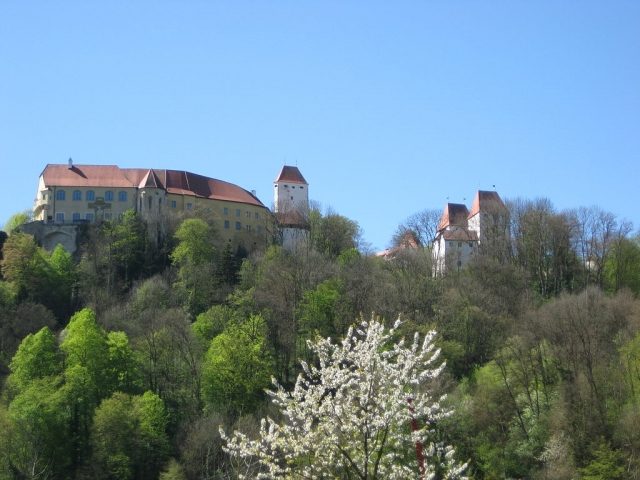
Neuburg Castle on the Inn is located in Neuburg am Inn near Passau in Lower Bavaria. The castle towers high above the Inn Valley on the border with Austria. It was once the seat of the County of Neuburg.
The castle was built in 1050 by the Counts of Formbach a few kilometers downstream from their ancestral castle. They have since named themselves after Neuburg. After their extinction, the castle came into the possession of the Counts of Andechs in 1158, before passing into Bavarian possession in 1248. From then on, the Duchies of Bavaria and Austria quarreled over the strategically located fortress. This led to constant changes of ownership. In 1310, the castle was destroyed in the Bavarian-Austrian conflict. The current building stock largely dates from the subsequent reconstruction by the victorious Austrians.
Since then, Neuburg belonged to the Habsburgs, who mortgaged it until Hanns von Rohrbach acquired the castle in 1463 and began its expansion, which his successor Sigmund von Niederthor continued. In 1528, the castle was granted to the Counts of Salm as an imperial fief. A year later, Count Niklas II von Salm had the castle redesigned in Renaissance style by the Passau master builder Wolf Huber and a spacious garden laid out. During the renovation work, only the keep, the fortifications of the outer bailey, and the castle church remained untouched.
The Counts of Salm held Neuburg until 1654. In 1654, it was redesigned in Baroque style by the new owner Count Georg Ludwig von Sinzendorf. The gardens were also extended, all the way down to the Inn. In 1680, the castle was confiscated by the Imperial Court Chamber in Vienna after Georg Ludwig von Sinzendorf was accused of high treason and other offenses. In 1698, the castle and county were initially mortgaged to the Scottish nobleman Jakob von Hamilton for 10 years; in 1701, he received them permanently. His son sold Neuburg in 1719 to the Counts of Lamberg-Spritzenstein. From them, the castle and the imperial lordship came in 1730 through Cardinal Joseph Dominikus von Lamberg to the Prince-Bishopric of Passau, where it remained until its secularization in 1803. Three years later, Bavaria sold the castle. Afterwards, it belonged to changing private owners and associations. In 1810, it was severely damaged by fire. The reconstruction of Neuburg was carried out in 1908 by the Bavarian Association for Homeland Protection and the Passau Art Association.
From 1973 onwards, the castle was the seat of the "European Academy Neuburg". From 1982, the castle stood empty and the district government of Lower Bavaria began renovation measures. From 1986-1988, the Passau district council set up the district hall in the outer bailey's economic courtyard. In 1989, the "Begegnungszentrum der Wissenschaft auf Schloss Neuburg a. Inn" association converted the old malthouse into an accommodation building. In 1996, a 4-star castle hotel, a gourmet restaurant, and a beer garden were established. Since 1998, the castle complex has belonged to the Passau district council. After extensive renovations, the castle, with its now 15 conference and event rooms, serves today, among other things, as an international meeting center for the University of Passau, as a conference venue for the Passau district council, and as a gallery for artists from the district.
Since the end of 2006, the main castle has also housed the Center for Applied Tourism Research at the University of Passau (CenTouris).
Complex+
The castle is divided into the outer bailey, the main castle with halls and loggia, and the castle tavern.
The path to the outer bailey leads from the north through the flower garden with a grotto. The castle is surrounded by a ring wall, fortified with three corner towers and a gate tower. Its original height was later reduced, leaving only the northeastern tower from around 1400. From 1985 to 1988, the other towers were rebuilt. In the inner courtyard are economic buildings from 1599, which were raised in 1738.
A bridge from 1707 leads to the main castle. The gatehouse was built in 1484 according to an inscription. Above it rises the keep. The Gothic castle chapel dates from the 14th century. The Renaissance portal, which is the entrance to the so-called "Schöne Säle" (Beautiful Halls), shows the oldest Renaissance decor north of the Alps. In the Salettl, frescoes by Fritz Seitz from 1537 are preserved. Other halls include the large Knight's Hall, the White Marble Hall, and the Red Marble Hall.
In the Baroque garden from the second half of the 17th century, there are several Callot figures, so-called Salzburg Dwarfs.
The garden pavilion with a shell grotto from 1664 is the work of Batista Carbone and Giovanni Sforzza. Around the castle complex, there is a circular path through the forest.
Take Mobile History with you
You are reading this text for free. Premium adds what matters on the road: descriptions read aloud, sites found through your camera, whole regions taken offline.
- Every description, including the ~17,700 Premium sites
- Audio guide: have descriptions read to you on location
- AR finder: see sites through your camera, with distance and bearing
- Unlimited saved sites
14 days free, then from €2.99 a month. Cancel anytime.
Source: Wikipedia · Licence: CC BY-SA 4.0
This description draws on the facts documented in the linked Wikipedia article; Wikipedia content is licensed under CC BY-SA 4.0. Wording and editing: Mobile History.
Location: 48.5065, 13.4505