CastleNeueglofsheim

Neueglofsheim Castle
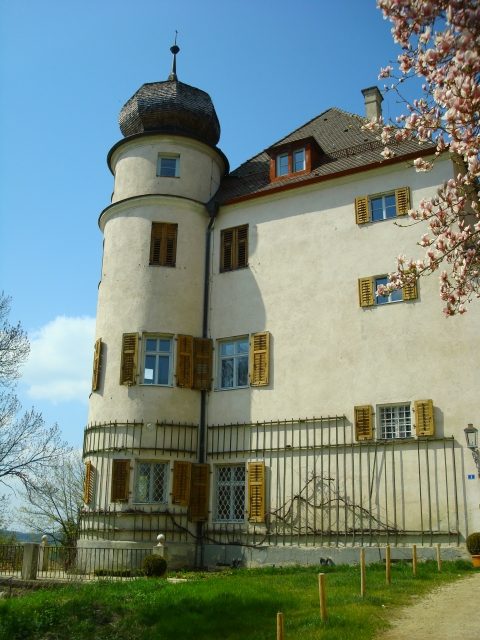
Neueglofsheim Castle

To be privately owned

Schloss Haus in the Neueglofsheim district of Thalmassing in the Regensburg district of Upper Palatinate is a small castle complex in a park of about 6 hectares.

It is surrounded by a whole series of buildings such as a manor house, a machine hall, a mill, a former inn, a farm worker's house and a summer cellar. Together, these buildings form the village of Neueglofsheim and administratively belong to the municipality of Thalmassing.

The castle itself is a 4-wing complex around a courtyard of approx. 700 m². The actual castle part is a four-story building with an impressive facade and closes off the courtyard to the south-west. Connected is the north-west wing, which includes the castle chapel as well as the supply and kitchen wing. The north-east wing is the so-called "Cavalier Building", in whose lower floor the stables for the riding horses were formerly housed. The courtyard is closed off in the south-east by a so-called "Wehrgang" (battlements), which connects the Cavalier Building and the castle.

The buildings are only partially cellared. Further cellar systems and connections between the buildings, also outside the direct castle complex, are suspected.

The castle includes a 6-hectare park with regionally typical, predominantly very old trees, meadows, small paths, a nursery with a bee house and the so-called "Sommerkeller" (summer cellar). The summer cellar is a house-like building with an ice cellar located 11m deep underneath. The ice cellar is designed as a 10 x 40 meter barrel vault and was formerly used for storing ice blocks. The ice blocks were cut from lakes in winter and used for the beer brewing process until the following autumn.

The former hilltop castle with adjacent Schloss Neueglofsheim, built by the Eglofsheimers, was first mentioned in 1314. At that time, the trend towards building noble residential castles, which began in the 11th century, was followed. Of this medieval building fabric, only the 22.5 meter high keep still exists today. It stands on a 20 by 30 meter base, which is delimited from the moat by a medieval, three-meter-high wall. These still visible foundations of the castle now form the northeastern boundary of the castle complex.

Between the 14th and 17th centuries, the ownership of the castle changed frequently. Owners after the Eglofsheimers were Albrecht Notthafft (1366), Wilhelm von Frauenberg (1388), from 1400 the Nuábergers, the Bavarian dukes (1431), Sigmund Walterhofer (1478) and then the Lords of Wallbrunn. In 1630, the castle was sold to the Regensburg monastery of Prüll (Karthaus-Prüll). After the castle was severely damaged during the Thirty Years' War, the complex was expanded in 1681 as part of the reconstruction to serve as a summer residence for the monks. The construction of the castle chapel as a central building for the Carthusians falls into this period. The present castle building shows a series of arches on the ground floor, which probably served as a cloister for accessing the surrounding buildings and rooms.

Probably from 1730, the actual castle was built in its present extent and form with residential building and stables. In the area of today's sacristy, a well system with a horse trough was probably built at this time. After the secularization in 1803, the castle was sold to the Counts of Dörnberg, who resold it to Thurn und Taxis in 1835.

The castle was now the residence of Hereditary Prince Franz Joseph von Thurn und Taxis, who used it as a hunting lodge. After Franz Joseph's marriage to Elisabeth von Braganza in 1920, the couple lived and managed Schloss Haus as an agricultural estate. In 1928, the south-west wing was extended by two floors and the castle was fundamentally modernized. Extensive forests with their own forestry were attached to the agricultural operation. A brewery and a distillery complemented the activities. At its peak, about 250 people lived and worked at Schloss Haus. The couple usually spent the winters at Schloss St. Emmeram.

Since the death of Franz Joseph von Thurn und Taxis in 1971, the castle complex remained unused and stood empty. In 1986, it was entered in the list of monuments. In 2008, the Thurn und Taxis family sold the castle. The new owners, the Weitzel family, carried out extensive renovations and modernizations, which were honored in 2009 with the Monument Protection Award of the Regensburg district.

Take Mobile History with you

You are reading this text for free. Premium adds what matters on the road: descriptions read aloud, sites found through your camera, whole regions taken offline.

  • Every description, including the ~17,700 Premium sites
  • Audio guide: have descriptions read to you on location
  • AR finder: see sites through your camera, with distance and bearing
  • Unlimited saved sites

14 days free, then from €2.99 a month. Cancel anytime.

Source: Wikipedia · Licence: CC BY-SA 4.0

This description draws on the facts documented in the linked Wikipedia article; Wikipedia content is licensed under CC BY-SA 4.0. Wording and editing: Mobile History.

Location: 48.9025, 12.1797