Cultural center
Conference center
Neuenstein Castle (Saasen)

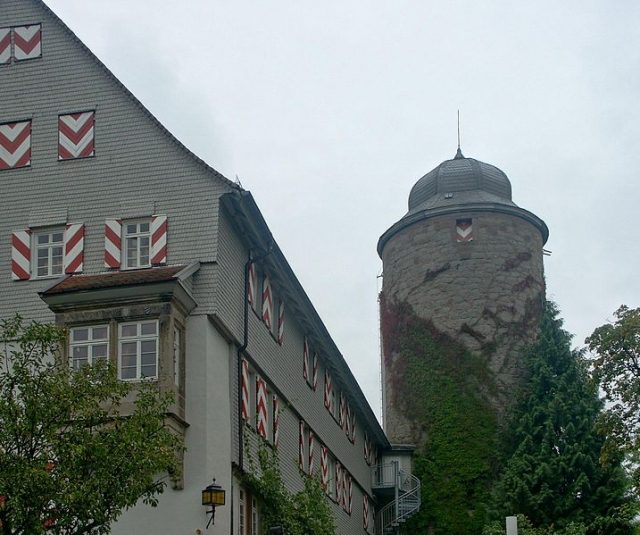
Neuenstein Castle, also known as Neuwallenstein, is a high medieval castle near Saasen, a district of the municipality of Neuenstein in the Hersfeld-Rotenburg district in North Hesse.
The hilltop castle is located on a mountain peak at 343 m above sea level in the Knüllgebirge mountains. To the northeast and directly below the castle runs the "Am Pommer" section of the Bundesautobahn 7, a downhill stretch of the motorway.
The castle was probably built around the middle of the 13th century by Albert I of Wallenstein (formerly Count of Schauenburg), who had resided since the beginning of the century at Wallenstein Castle ("Waldinsteyn"), located six kilometers northwest, and after which he had named himself since 1233. Both castles were located on the road from Hersfeld via Homberg (Efze) and Fritzlar to Kassel.
The castle was first mentioned in 1267 as "Neuwallenstein" when Albert II of Wallenstein concluded an exchange agreement with Hersfeld Abbot Heinrich III. Conrad of Wallenstein, presumably a brother of Albert I, inherited from Albert II when the latter died in 1284. Conrad thus became the founder of the new Wallenstein line. He no longer held a count's title, as in all probability his Schauenburg ancestors had already sold the high court of Ditmold (with which the count's title was associated) to the Archbishopric of Mainz in the first half of the 13th century.
In the 14th century, Simon of Wallenstein still owned half of the castle. The other half was shared by Friedrich of Schlitz (called von Steinau) and Friedrich of Herzberg. To put an end to the highway robberies of the Wallensteins, their liege lord, Hersfeld Abbot Simon I of Buchenau, allied himself with Landgrave Otto I of Hesse, Count Johann I of Ziegenhain, and the peace judge and imperial bailiff in the Wetterau, Eberhard of Breuberg. On July 24, 1318, they jointly destroyed the robber baron's nest Neuwallenstein. It was not until 1357, when Simon of Wallenstein allied himself with his new liege lord Otto I of Hesse against the Fulda Abbey, that he received permission to rebuild the castle.
In 1521, the Albertine line of the Wallensteins died out, leading to years of inheritance disputes, during which the castle often changed owners. What happened to it during the Thirty Years' War is unknown. From 1639 to 1643, the castle was rebuilt, with the palas being renovated in a castle-like manner.
After the death of Baron August Gottfried von Wallenstein, the last Wallenstein, in 1745, the castle reverted to Hesse-Kassel as an expired fief. The defensive structures were demolished, and only the 28-meter-high keep, with walls up to two meters thick, has survived to this day. The castle was then used as a landgrave's hunting lodge. From 1775 it was the seat of the Obergeis office and from 1760 to 1866 the seat of a Hessian domain rentmaster. Two buildings of the former domain still stand northwest of the castle, on the opposite slope. From 1870, a Prussian forestry office moved in, and from 1919, a Hessian one. The Neuenstein forestry office remained in the castle premises until its dissolution in 1997.
The municipality of Neuenstein bought the castle in 2000 and converted it into a conference and event center between 2002 and 2003.
Take Mobile History with you
You are reading this text for free. Premium adds what matters on the road: descriptions read aloud, sites found through your camera, whole regions taken offline.
- Every description, including the ~17,700 Premium sites
- Audio guide: have descriptions read to you on location
- AR finder: see sites through your camera, with distance and bearing
- Unlimited saved sites
14 days free, then from €2.99 a month. Cancel anytime.
Source: Wikipedia · Licence: CC BY-SA 4.0
This description draws on the facts documented in the linked Wikipedia article; Wikipedia content is licensed under CC BY-SA 4.0. Wording and editing: Mobile History.
Location: 50.9203, 9.5550