CastleNeufraunhofen

Neufraunhofen Castle
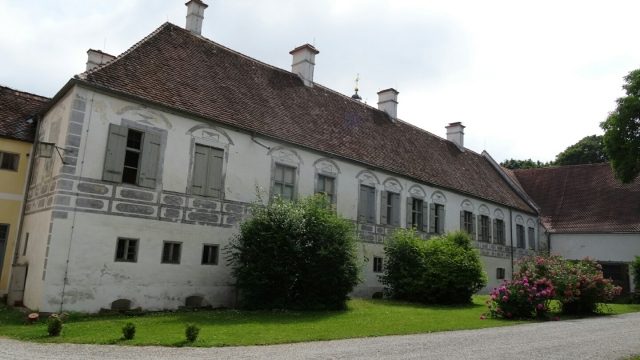
Neufraunhofen Castle

To be privately owned

Neufraunhofen Castle is a castle building located in Neufraunhofen in Lower Bavaria, with an attached church.

According to a chronicle written by Georg Graf von Soden-Fraunhofen, the place where the village of Neufraunhofen now spreads was originally a noble seat named Öd, first mentioned in a document in 1180. This was the year Otto von Wittelsbach was appointed Duke of Bavaria after the deposition of Henry the Lion by Emperor Barbarossa. The Lords of Öd held the office of cupbearer at the Wittelsbach court, which led to their ancestral seat Öd, meaning "father's property" or "hereditary farm located in a wilderness," being named "Schenkenöd" (Cupbearer's Öd). Around 1390, Wilhelm von Fraunhofen took over the seat, rebuilt the castle, and had it renamed "Neuen Fraunhofen" (New Fraunhofen), while his cousin remained in Fraunhofen, which was now called "Alten Fraunhofen" (Old Fraunhofen). Old and New Fraunhofen were imperial fiefs, subject only to the emperor. The castle buildings with the church in Neufraunhofen received their current appearance between 1709 and 1720 through partial reconstruction and expansion. At the end of 1805, both localities were incorporated into Bavaria by the Act of the Confederation of the Rhine. The castle remains in the possession of the Counts of Soden-Fraunhofen.

Architectural Description+

The irregular three-wing complex comprises the main residential building, to which the church, the former Capuchin hospice, farm buildings, a tavern (around 1646), and a former courthouse are attached. The castle is surrounded by a 19th-century park. The castle church of St. John the Baptist was built between 1709 and 1714 on the Gothic foundations from 1409 and was given a Rococo facade in 1753. In the 1730s, the church was extended to the north with a side aisle. The interior decoration dates from 1715 to 1750. In the church of the present curacy of Neufraunhofen, there are several tombs of the Lords of Fraunhofen from the 15th to the 19th century.

Take Mobile History with you

You are reading this text for free. Premium adds what matters on the road: descriptions read aloud, sites found through your camera, whole regions taken offline.

  • Every description, including the ~17,700 Premium sites
  • Audio guide: have descriptions read to you on location
  • AR finder: see sites through your camera, with distance and bearing
  • Unlimited saved sites

14 days free, then from €2.99 a month. Cancel anytime.

Source: Wikipedia · Licence: CC BY-SA 4.0 · Image: Jörg Heldt

This description draws on the facts documented in the linked Wikipedia article; Wikipedia content is licensed under CC BY-SA 4.0. Wording and editing: Mobile History.

Location: 48.3924, 12.2123