To be privately owned
Neuhaus Castle

Schloss Neuhaus in Carinthia (also Neuhäusl) is located west of Lavamünd on the right bank of the Drau in the village of Neuhaus in Carinthia.
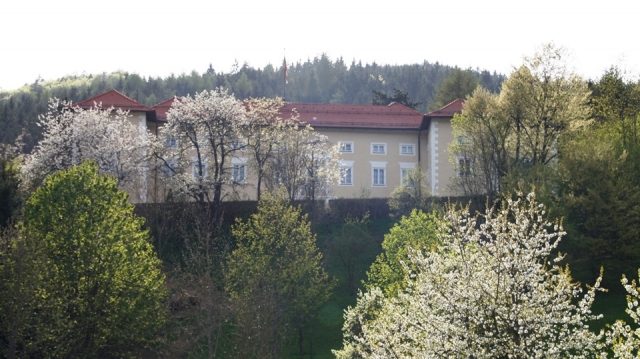
The rectangular, three-story building is situated in a commanding position above Neuhaus. The main front, facing east, is dominated by two corner towers with roof-like structures. On the north front, there is a chapel extension with an altarpiece depicting the Assumption of Mary. The walls and ceiling of the chapel are painted. On the wall opposite the altar, the coat of arms of the Counts is placed, and above it, an illustration of the castle.
The rectangular castle courtyard has arcades with massive columns on the ground floor and first floor on the northwest and south sides. The building generally reflects the architectural character of the 16th century, but there are undoubtedly remnants of an older structure on the ground floor. The spacious hall on the first floor has a dark, painted wooden ceiling supported by beams. On the south wall, below the painted names, is Andreas Edler von Prüggler, Lord and Landstand in Carinthia, and his coat of arms.
In documents from the years 1278, 1279, and 1285, a Gotschalcus de Novocastro appears as a witness. There were castles named Neuhaus in Carniola and South Tyrol, but the document from 1279 was one of Count Ulrich von Heunburg. Since the Gottschalk mentioned here appears in all three documents, Neuhaus in Carinthia is likely meant. However, Nicla von dem Newenhavse, mentioned on April 20, 1288, is unequivocally the owner of this castle, especially since this Heunburg document was issued in nearby Bleiburg. He repeatedly appears in documents from 1296. An Ulrich appearing in 1298 seems to have been his son or brother. Finally, we always see Nicla von Neuhaus in Heunburg documents, and he was therefore undoubtedly a ministerialis of the Heunburgers. In 1312, he referred to the Count of Heunburg as his lord. He sealed with an N in the shield.
After the Heunburgers, Neuhaus came to the Pfannbergers, later to the Auffensteiners, and after their fall in the second half of the 14th century, to the Habsburg Dukes of Austria and Carinthia. They left the Bleiburg dominion with its associated estates, which included Neuhaus, to various pledge lords. In 1481, Schloss Neuhaus was set on fire by the Hungarians, but it seems to have been rebuilt soon after. For almost a hundred years, we know nothing more specific. During this time, it belonged to the Bleiburg dominion, which the Lords Ungnad held; before that, it was pledged property of the Lords von Kraig. The reconstruction of the castle after its destruction in 1481 was likely carried out by Christof Ungnad. He was succeeded by Hans Ungnad in 1493.
In the 16th century, Neuhaus, or Neuhäusl as it was often called then, was owned by Georg Freiherr von Herberstein zu Neuberg und Gutenhag, hereditary chamberlain and hereditary seneschal in Carinthia, and provincial administrator of Styria. Around 1570, Georg von Herberstein sold all his hereditary rents belonging to Neuhäusl, which he had inherited from his parents, to his brother-in-law Christof von Kollnitz. In 1571, according to the statements of the subjects, the keep of the old castle site Neuhäusl was pointed out. The fence around the churches was considered the boundary of the castle district against the regional court. In this regard, there had been friction between Herberstein and the pledge holder of the Bleiburg dominion, David Ungnad. In 1574, Georg von Herberstein sold Schloss Neuhäusl to Erasmus Gall zu Gallenhofen and requested his enfeoffment. The Galls seem to have subsequently referred to themselves as Neuhaus, because in 1576, Andreas von Neuhaus owned the castle after the death of his father Hans. It is also conceivable that the Galls resold the castle in the year of their enfeoffment.
At the end of the 16th century, Neuhaus came into the possession of the Paradeisers, and in 1602, Alexander Paradeiser, the hereditary master of the hunt in Carinthia, called himself Lord of Grädisch and Neuhaus. However, Neuhaus seems to have returned to the Galls shortly thereafter, because in 1629, the brothers Christof, Max, and Hörwart Regallen zu Kranichsfeld und Prunberg and their sister Barbara, wife of Andrä Prüggler, sold Schloss Neuhaus, which had fallen to them from Salome Lamberg, née Gallen. The coat of arms of these Prügglers can still be found today in the knight's hall of the castle. Around 1676, Johann David Freiherr von Deutenhofen was the owner of Neuhaus, which he had bought in addition to his other castles such as Drasing, Mageregg, Tigring, Ebenthal, and Rosenberg.
Recent Times
After frequent changes of ownership (among others, it belonged to the Edle von Webenau family from 1821 to 1863 and from 1904 to 1910 to Franz Kupelwieser, the grandson of the painter Leopold Kupelwieser), the castle was owned by Kajetan Wutte from 1954. After Schloss Neuhaus was briefly owned by Admont Abbey, the economist Herbert Liaunig acquired it in 1988 to establish his private residence there and to house his art collection in a fitting style. Within a very short time, extensive renovation and conversion works were carried out at a cost of millions, according to the plans of architect Günther Domenig, which were completed in 1992. Since that year, Schloss Neuhaus has shone in new splendor above the village.
Take Mobile History with you
You are reading this text for free. Premium adds what matters on the road: descriptions read aloud, sites found through your camera, whole regions taken offline.
- Every description, including the ~17,700 Premium sites
- Audio guide: have descriptions read to you on location
- AR finder: see sites through your camera, with distance and bearing
- Unlimited saved sites
14 days free, then from €2.99 a month. Cancel anytime.
Source: Wikipedia · Licence: CC BY-SA 4.0 · Image: http://www.wehrbauten.at/ktn/kaernten.html
This description draws on the facts documented in the linked Wikipedia article; Wikipedia content is licensed under CC BY-SA 4.0. Wording and editing: Mobile History.
Location: 46.6420, 14.8848