Nursing home
Neuhof Castle

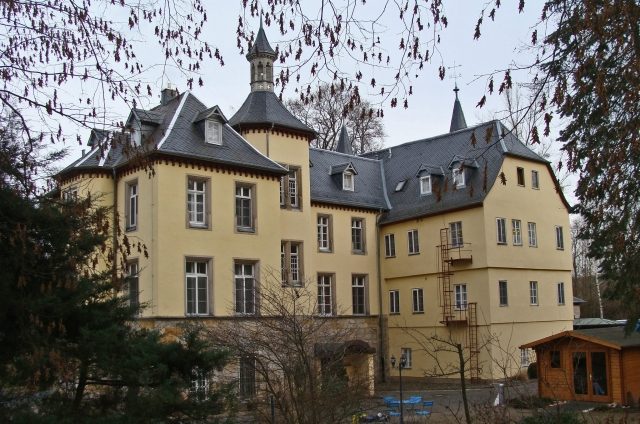
The origins of Neuhof Castle in Neu- and Neershof, a district of Coburg in the Bavarian administrative region of Upper Franconia, date back to the 14th century. Field Marshal General Count Albrecht von Roon was a prominent owner of the castle, situated in an English landscape park, from 1873 to 1879. After very turbulent changes of ownership, it now houses a therapeutic facility for people suffering from addiction.
Manor House
Neuhof Castle is first mentioned in writing in 1371 as the moated castle Newenhoff, not far from the village of the Brothers of Esselsdorf, documented as early as 1288. Through a change of name (Esselsdorf, zu den Eselsdorf, ''n Eselsdorf, Neserdorf, Nehrsdorf, Nehrshof) over the centuries, it became Neershof. The father of the later knight Albrecht von Bach, a citizen of Coburg who had gained fame and been ennobled in the Battle of Sellnitz and whose descendants provided several mayors between 1401 and 1490, can be considered the owner of the village and the castle at that time. Dietrich von Coburg, who is sometimes mentioned as an owner, only held the tithe from Neu- and Neershof and other places in the area. In 1441, Knight von Bach died. An impressive epitaph was erected for him and his father in the Raven Tower of Coburg's Morizkirche.
His descendants would hold the moated castle, situated in a shallow hollow of the hilly terrain, until 1713, though not always happily. The idyll did not survive the Thirty Years' War unscathed. In 1635, Wolf Philipp von Bach wrote to Duke Ernst I of Coburg-Sachsen and Gotha: The landscape of Coburgk has been ruined by friend and foe, and the noble castles so plundered that I, for my part, found not a single person, much less a useful animal, in my poverty at the manor house of Neuenhof... Even his son Otto Friedrich Hieronimus failed to fully restore the devastated Neuhof by his death in 1691, despite his wife Ursula's enormous dowry.
Otto's first son, Wolf Friedrich von Bach, the new owner of the manor house and a captain in Saxony-Meiningen, fell in 1706 in St. Louis, America. His reckless and dissolute brother Johann Christoph took over the property, killed the citizen Johann Nicol Guthardt at Eichhof Castle in Dörfles after a drinking tour at the Grünen Baum in Coburg, and was sentenced to death in 1708. He escaped execution by fleeing to Bamberg, which, however, caused Neuhof Castle to fall to the territorial lords in Coburg as a forfeited fief and be put up for sale in 1713.
It was not until 1730 that Sophie von Waldsachsen bought the dilapidated property. Her descendants, especially Haubold von Schönberg, restored the manor house to some extent, and Haubold sold it in 1857 to the Antwerp merchant Albert Böcking. For the first time, the property was no longer in noble possession. After some alterations, Böcking sold the entire estate in 1865 to Charles Isaac Souchay, who came from Manchester.
Renaissance Castle
The new owner began extensive redesigns of the property and its surroundings a year later. He had the existing building extended to the northeast with a new building in Neo-Gothic and Late Renaissance forms of Historicism. He was able to secure the Coburg building councilor Georg Konrad Rothbart as architect, who simultaneously gave the Palais Edinburgh a new style and planned and completed Ketschendorf Castle two years later. The lake around the castle was filled in, except for a pond where flamingos and storks strutted, and the existing wild park was transformed into an English garden, including a large greenhouse for exotic plants.
Souchay kept Neuhof Castle for only eight years. Through the mediation of Commercial Councilor Jakob Mayer (later Baron Mayer von Ketschendorf), Neuhof Castle came into the possession of Field Marshal General Albrecht von Roon, who sought recovery there from his state offices as simultaneous Prussian Minister of War, Minister of the Navy, and from 1873 Prime Minister, and from his asthma. Roon, who was friends with August Rückert, the son of Friedrich Rückert, often retreated to the poet's arbor on the Goldberg in Neuses near Coburg, within sight of Callenberg Castle. From Neuhof Castle, he sent his letter of resignation to his sovereign Wilhelm I, thus paving the way for Bismarck. Duke Ernst II of Saxe-Coburg had the Roon-Weg from Neuhof to Callenberg laid out by the ducal forest administration, which Roon often traveled with his landau. August Rückert placed a Rückert bench for him on the Goldberg. Roon died in 1879. His sons sold Neuhof Castle five years later to the Mannheim consul Ferdinand Ladenburg, who in turn gave it to his daughter Johanna as a dowry upon her marriage to cavalry captain Dorff.
Estate Nursery
Around 1900, an estate nursery was established not far west of the castle. On the property, surrounded by a high brick wall, a kitchen garden was laid out, a pump well with a round enclosure, and a small gardener's house integrated into the wall were built.
Structure+
In the current view of Neuhof Castle, partly stripped of its original Renaissance elements, the central building with a half-hipped roof is the oldest preserved part from the 16th century. The ground floor is built of fieldstones, the other two floors are executed in Franconian half-timbering, which was plastered in the 18th century. On the first floor there is a hall with a beautiful Renaissance beamed ceiling and next to it a room with a similar stucco ceiling. The ground floor rooms are cross-vaulted and formerly served as a prison.
An octagonal stair tower with a spire, whose winding stair spindle resembles those in Ahorn Castle and Untersiemau Castle, is positioned in front of the southwest side of the main building. The second tower was adapted to the existing architectural style as a stair tower for the new extension of 1866 and provided with a roof turret in the form of a bell tower.
Recent Use+
The entire estate remained in Dorff's possession until 1950, when the district of Coburg took over the castle and park. The district invested in converting the castle into an old people's home. In 1952, the residents of the closed old people's home Callenberg Castle moved in here. The head of the home became Richard Hauptmann, a Coburg local poet and displaced person of Sudeten German origin, after whose death the old people's home moved to Mönchröden in 1972.
A year later, the Schwanstecher couple took over the historic premises, converted them into a restaurant business, and successfully managed the property with its park, transformed into an organic garden, until the mid-1990s.
In 1995, the Society for Social Institutions acquired the castle and has since used it as a socio-therapeutic facility for alcoholic men and women. A total of 39 people are cared for in the residential home and the associated independent living apartments, plus four people in a training apartment. The supporting organization is the Gesellschaft für soziale Einrichtungen mbH with its headquarters in Bischofsgrün.
Every corner of the castle and the three-hectare landscape park are used by the residents: The grounds include a barbecue area, a campfire site, many seating areas for quiet hours, animal enclosures, and a herb and vegetable garden as a positive setting for living and working close to nature. In separate buildings in the park, the occupational therapy facilities for carpentry and creative work, laundry, and caretaker services are housed. In addition, there are the work areas for garden maintenance, the kitchen, and household management.
The Schloss Neuhof residential home includes a house with a garden in the immediate vicinity with space for six more stable residents, as well as three additional residential places in a single apartment and a two-room apartment in the city center of Coburg. In addition, there are four places in a training apartment, which serves for targeted independent living and as a springboard to the outside world.
The goals for the stay at Schloss Neuhof are individually agreed upon for each resident. The end of therapy is indicated when a resident has recovered and achieved their goals to such an extent that they can leave the facility with a favorable prognosis. If someone is no longer able to live without a protected environment, there is the option of a permanent residential place until the need for care arises. However, the goal of the work for the residents is to achieve lasting abstinence, regeneration, and the use of their own resources in all areas of life. The ultimate goal is full social and professional reintegration.
A total of eleven full-time employees work in the residential home. The team is supplemented by a transport service and seven night and on-call services.
Take Mobile History with you
You are reading this text for free. Premium adds what matters on the road: descriptions read aloud, sites found through your camera, whole regions taken offline.
- Every description, including the ~17,700 Premium sites
- Audio guide: have descriptions read to you on location
- AR finder: see sites through your camera, with distance and bearing
- Unlimited saved sites
14 days free, then from €2.99 a month. Cancel anytime.
Source: Wikipedia · Licence: CC BY-SA 4.0
This description draws on the facts documented in the linked Wikipedia article; Wikipedia content is licensed under CC BY-SA 4.0. Wording and editing: Mobile History.
Location: 50.2680, 11.0322