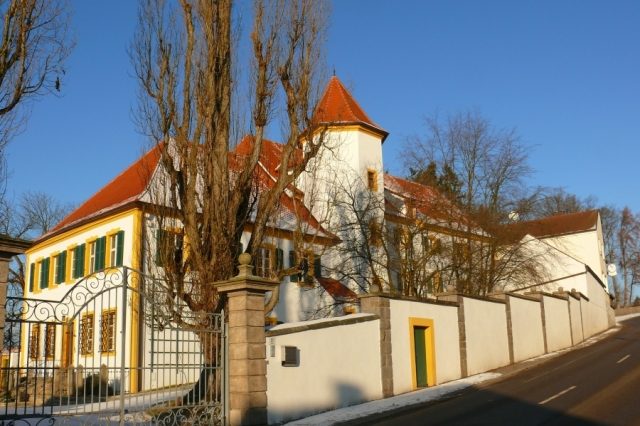
To be privately owned
Neusath Castle

Without a doubt, Neusath is an ancient settlement, predating the castle. In 1344, Neusath (Ncysaw. Neusan; interpretation of the possibly Slavic word: people living at the bottom end) first appeared in a document of the then owners of the "Muracher", who represented a widespread family in our area. It was a nobleman's estate without manorial rights.
We do not know what the castle looked like in ancient times. Only in the northeast corner has the lower part of a formerly round castle tower been preserved, containing the old oak spiral staircase. The renovation probably took place in the 18th century, as the wing features ceilings with simple stucco frames and rosettes.
The Muhrer or Murach zu Guteneck are considered the first documented owners, of whom Konrad der Muhrer owned Neusan (Neusath) in 1344 and his brother Heinrich owned Haindorf.
In 1488, Otto von Murach was the owner of Neusath. The last Muracher, Albrecht von Murach, the Elder zu Guteneck, who had an inherited gift in Lower Bavaria, owned Neusath. This Albrecht von Murach sold Neusath in 1576 to Paul Spies. From the widow, Mrs. Elisabeth Spies, née Pilger, Neusath passed in 1603 by purchase to Ludwig von Scharfenberg. He bequeathed Neusath in his will to his niece Maria Elisabeth Fuchs von Lemnitz. Since she was unmarried and died unmarried, Neusath also passed according to the will into the possession of her sister Maria Ursula von Fuchs.
She married Christoph Heinrich Meichsner von Allkofen from Chammünster (1652), whereby Neusath now came into the possession of the Meichsner family. His son, Wolf Christoph Ludwig von Meichsner, took over the estate in 1693. His son Christoph Adam Bernhard von Meichsner became the successor to Neusath in 1737. He was followed by purchase in 1774 by his daughter Maria Rosa von Nabburg, who acquired the buildings and grounds and carried out the demolition as part of the Fleischberg renovation. The castle also includes a castle park and a castle inn.
To the right of the entrance stood the hunter's and forester's house, demolished in 1956, where the respective foresters and, for three generations, the estate managers Haller lived. In 1840, Michael Haller, later the famous church composer, was born here.
Around the turn of the 18th century, Neusath was the smallest independent municipality in Bavaria. Dr. Karl Bruno Hans Reisner, Baron von Lichtenstern, was mayor for many years at that time and was then appointed honorary citizen.
In 1947, the municipality of Neusath "voluntarily" joined the municipality of Diendorf. In the municipal territorial reform of 1974, the municipality of Diendorf became part of the city of Nabburg.
Until recently, the castle was the main employer for the entire village. This has changed significantly, and in addition to a few independent farmers, the residents of Neusath are now commuters and work in various businesses in the surrounding area.
Take Mobile History with you
You are reading this text for free. Premium adds what matters on the road: descriptions read aloud, sites found through your camera, whole regions taken offline.
- Every description, including the ~17,700 Premium sites
- Audio guide: have descriptions read to you on location
- AR finder: see sites through your camera, with distance and bearing
- Unlimited saved sites
14 days free, then from €2.99 a month. Cancel anytime.
Source: Wikipedia · Licence: CC BY-SA 4.0
This description draws on the facts documented in the linked Wikipedia article; Wikipedia content is licensed under CC BY-SA 4.0. Wording and editing: Mobile History.
Location: 49.4647, 12.2106