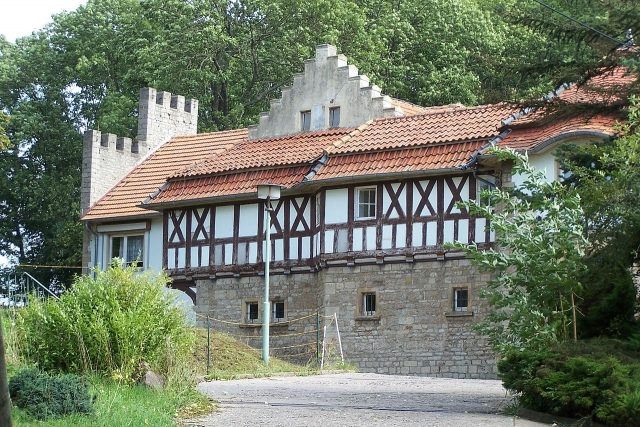
Nursing home
Neuscharfenberg

Neuscharfenberg Castle is a castle in Wenigenlupnitz, a district of the municipality Hörselberg-Hainich in the Wartburg district. It is located on the eastern edge and rises on the high bank of the Nesse river. The castle is a protected monument and today serves as a residential home for the Diakonie.
The Lords of Lupnitz and von Erffa
The first known lord of Wenigenlupnitz by name is Hermann von Lupnitz (1224–1268), who belonged to the service nobility of Fulda Abbey. A relative, Conrad von Lupnitz, was a councilor in Eisenach from 1279. The family died out with a Conrad von Lupnitz, who lived in Berka/Werra in 1440.
Among the numerous landed noble families bound to Fulda Abbey by feudal contracts in West Thuringia were the Lords of Erffa in the 13th century. Their main seat was Erffa Water Castle, located about 10 kilometers east of Wenigenlupnitz in today's Friedrichswerth, on the right bank of the Nesse. The estates in Wenigenlupnitz, transferred to Hartung von Erffa in 1357, were initially given to him in his capacity as monastic bailiff for the Lupnitz villages. However, the Eisenach Nikolaikloster and, from 1414, the Eisenach Carthusian monastery also held extensive possessions and rights in the Lupnitz area. The Erffa estates in Wenigenlupnitz consisted of a water castle located on the Nesse, which the Lords of Lupnitz had previously sold to them, as well as lands and ponds.
The Lords of Farnroda and von Uetterodt
With the consent of Fulda Abbey, the brothers Dietrich and Hans von Farnroda acquired the Erffa possessions and rights in 1493. A sister of the Farnrodas became the wife of Andreas Friedrich von Uetterodt. The family had bought Scharfenburg Castle and its associated villages in 1442, but in 1446 the Saxon Fratricidal War devastated these possessions as well; Scharfenburg was besieged and subsequently lay in ruins. Therefore, a "fortified house" was built in the village as a new residence. The Uetterodt family divided their possessions; the branch founded by Andreas Friedrich von Uetterodt took over the possessions acquired through marriage in the Nesse valley around Wenigenlupnitz and Melborn.
The water castle built on the right bank of the Nesse was probably converted into a residential castle around 1596. In addition to the castle, there was a building complex as an outwork on the Kindel - the later Künkelhof - and the estate located near the castle. Under Wolf Sigismund II von Uetterodt, a major fire in 1795 destroyed the castle, the neighboring estate, and half of the village of Wenigenlupnitz. Until his death on March 26, 1821, he managed to reunite the Uetterodt possessions. His son, Count Wolf Sigismund, was successful in Hessian military service and became a Knight of the Order of St. John. He had his center of life in Darmstadt and began building the present castle in Wenigenlupnitz in 1846. However, this was built on the slope above the former water castle, and some usable building parts of the fire ruin were certainly used. The new building was named Neuscharffenberg - a testament to the still close connection to Thal.
The Castle in the 19th Century
The residential castle, built in the "Old German style," was completed, except for the tower already under construction, most recently under the direction of the architect and building councilor Eberhardt. The Eisenach high school teacher and historian Prof. Rein often had the opportunity to visit the Count, also known as an antique collector and genealogist, in his castle. He describes the interior of the castle in an album page:
- From the spacious and various domestic-purpose basements of the main building, a wide, airy spiral staircase, its walls adorned with deer antlers, leads through the different floors. The middle floor contains the Knights' Hall, decorated according to designs by Pose in Düsseldorf with dark oak paneling and beautiful architectural painting, excellently furnished with medieval weapons, a rich credenza, etc. To the left is the reception room, whose adornment consists of several statuettes, paintings, and an old reliquary originally consecrated to the church of Melborn by the families von Farnroda and Uetterodt, recently reacquired; to the right are the bedroom and the study. In the library, besides historical, political science, and belletristic books, there is a select collection of new magnificent and copperplate works, as well as a considerable number of documents, regesta, seals, coats of arms, and tomb copies, particularly in relation to Thuringian families, whose history the owner has begun to write. On the upper floor, the living rooms are grouped around the banquet hall, decorated with family portraits and landscape paintings. From the gable rooms and the tower's platform, an extensive view to the west and east offers itself of the lovely, tree- and meadow-rich Nesse valley. At its feet spreads the tasteful park, laid out by Hermann Jäger in Eisenach, with its rich groups of trees, wide lawns, and varied flowerbeds. From here, the enclosed view was taken. To the south, the picturesque forms of the Hörselberg are situated, which block the distant view but, with their magical memories and the echoing Tannhäuser melodies, lull the imagination into colorful dreams.
The Era of the Barons
The last Count Ludwig Wolff von Uetterodt died on July 2, 1900, in Wenigenlupnitz. As there were no heirs, the property was sold and passed to
- 1900 to a Berlin construction company,
- 1902 to the Oppenheim family,
- 1904 to the estate owner Leo von Ubisch,
- 1906 to Baron Dietrich von Klitzing.
The new owner, Baron von Klitzing, wanted to establish a profitable estate economy in Wenigenlupnitz. He had a small hydroelectric power plant built west of the village and also supplied both Lupnitz villages with electricity. The properties adjacent to the estate were bought up and replaced by new buildings. The road to the castle and to Melborn was straightened, sacrificing parts of the park designed by Hermann Jäger. A coppice was planted on the meadow east of the castle, and several machines for agricultural work were acquired. With Klitzing's help, the mill near the castle was also technically modernized.
Around 1918, Baron von Helldorf took over the Klitzing property. Baron Helldorf initiated extensive construction measures at the castle and the farm buildings. These included the reconstruction of the gate with the entrance to the manor house. The wall with the Gothic-style west gate of the castle was built over with a half-timbered floor. In the 1920s, the economic crisis and inflation also affected life in rural areas. With state aid, the manor carried out drainage work on the northern plots and employed up to 100 unemployed people from Eisenach and the surrounding villages. From 1927, the Baron handed over responsibility for the manor to two administrators. Baron Helldorf then provided a guarantee for his nephew, Wolf Heinrich Graf von Helldorf, police president of Berlin, who had accumulated high debts. Attempts were made to defy the economic crisis with mortgages and forest sales. Finally, political pressures also contributed to Baron von Helldorf and his family having to leave Wenigenlupnitz; he was already heavily indebted but without obligations to the community. The last pre-war owner was Hans Tölke from Quedlinburg. He managed to reacquire the mortgaged buildings and lands and also provided job creation measures for the village population. Parts of the Kindel estate were taken over by the military as a training ground. Tölke moved to Bavaria around 1939 and sold the castle to the Eisenach real estate dealer (?) Werner Natz, who in 1941 sold it to the Berlin district of Köpenick. On April 3, 1945, Wenigenlupnitz was taken by the Americans; the damage to the estate and castle buildings was minor.
Take Mobile History with you
You are reading this text for free. Premium adds what matters on the road: descriptions read aloud, sites found through your camera, whole regions taken offline.
- Every description, including the ~17,700 Premium sites
- Audio guide: have descriptions read to you on location
- AR finder: see sites through your camera, with distance and bearing
- Unlimited saved sites
14 days free, then from €2.99 a month. Cancel anytime.
Source: Wikipedia · Licence: CC BY-SA 4.0
This description draws on the facts documented in the linked Wikipedia article; Wikipedia content is licensed under CC BY-SA 4.0. Wording and editing: Mobile History.
Location: 50.9819, 10.4333