To be privately owned
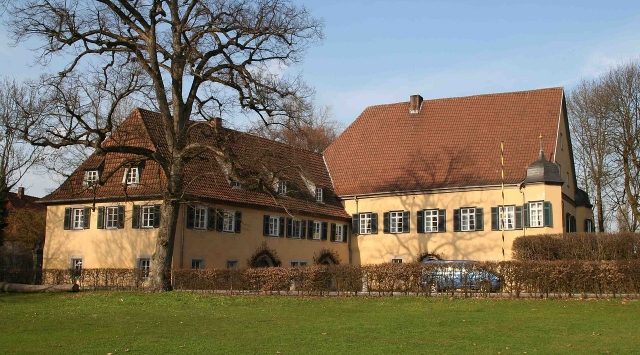
Niederfüllbach Castle

Niederfüllbach was first mentioned in 1075 as Vullebach in a document by Bishop Adalbero of Würzburg, in which he granted Abbot Adelbert of Saalfeld a number of sovereign rights over this and other places. In the 12th century, the monastic estate transformed into a knight's seat, initially owned by the Franconian noble family of Kunstat. During this time, a "burc fullebach" was also mentioned for the first time, though its exact location is unknown today.
From the 14th century, the noble family Schaumberg, and from the 17th century, the family Reitzenstein, determined the fate of the place. Their knight's seat, also called a castle, was continuously expanded and rebuilt over the centuries, even after it was destroyed in the German Peasants' War in 1525. In 1575, an "undern füllbach" was mentioned for the first time, which, as later documents also prove, indicates a division of the place and the dispute over jurisdictions (feudal obligations) between the Hennebergers and the monasteries of Bamberg and Banz. In the Thirty Years' War, the village was burned down in 1634 by Croats allied with the imperial (Catholic) troops. After the end of the war, the village was rebuilt, and in 1695 it received the (castle) church that still stands today.
In 1763, the Battle of Niederfüllbach saw physical altercations over legal jurisdiction between Niederfüllbach farmers, supported by the Lichtenfels militia and Coburg military, which were finally resolved by an arbitration ruling against the Coburgers before the Imperial Chamber Court in Wetzlar. After the extinction of the noble family of Reitzenstein, the Lords of Portzig and of Lichtenberg owned the knight's estate from 1773 to 1818. Until 1803, Niederfüllbach belonged to the Bamberg feudal association and then became part of the Kingdom of Bavaria.
With Coburg's first state treaty from 1811, negotiated between Bavaria's Prime Minister Count Montgelas and Prince Leopold of Saxe-Coburg-Saalfeld, the legal disputes over the jurisdictions for the constituent parts of Niederfüllbach (in the north) and Unterfüllbach (in the south) were clarified for the first time; both came to Saxe-Coburg-Saalfeld (from 1826 Saxe-Coburg and Gotha) and grew together into one village. In 1817, the Lord of Lichtenstein sold the knight's estate and castle to Prince Leopold of Saxe-Coburg-Saalfeld, later King Leopold I of Belgium. In 1859, the village received a railway station on the newly built railway line Coburg–Lichtenfels, which is no longer served today.
In 1907, King Leopold II of Belgium, son of Leopold I, brought large parts of his property into the Niederfüllbach Foundation. In 1911, after strong political pressure, the administration of the Niederfüllbach Foundation transferred all assets from securities, with an estimated value of 100 million Belgian francs, to the Belgian state in exchange for a one-time settlement of 1.1 million Marks. Today, the foundation primarily lives off approximately 216 hectares of land in the Coburg region.
With the end of the monarchy in 1918, following a referendum in 1919, the Free State of Coburg, which had emerged in the interim, was united with the Free State of Bavaria in 1920. Thus, Niederfüllbach definitively became part of Bavaria.
In 1966, the architect Clodt Dankwart von Pezold acquired the castle, which was slated for demolition due to lack of funds, and had it extensively renovated.
Take Mobile History with you
You are reading this text for free. Premium adds what matters on the road: descriptions read aloud, sites found through your camera, whole regions taken offline.
- Every description, including the ~17,700 Premium sites
- Audio guide: have descriptions read to you on location
- AR finder: see sites through your camera, with distance and bearing
- Unlimited saved sites
14 days free, then from €2.99 a month. Cancel anytime.
Source: Wikipedia · Licence: CC BY-SA 4.0
This description draws on the facts documented in the linked Wikipedia article; Wikipedia content is licensed under CC BY-SA 4.0. Wording and editing: Mobile History.
Location: 50.2208, 10.9911