The Castle can be visited
Museum
Nossen Castle
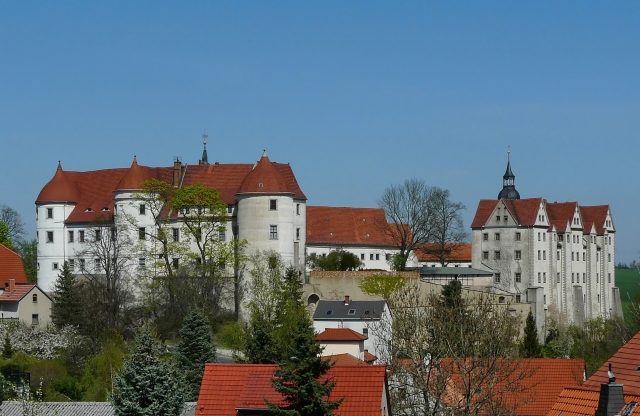
Nossen Castle is located in the town of Nossen in the district of Meißen in the German federal state of Saxony.
The imposing castle complex, situated on a rocky outcrop above the Freiberger Mulde valley, dates back to a castle probably built in the first half of the 12th century. The castle was then owned by the Knights of Nozin, whose lineage was first documented here in 1185 in the person of Petrus de nozin. The Lords of Nossen, as they are now called in reference to the current name of the town, held a strip of land between Pitzschebach and Mulde as a fief from the Bishop of Meißen. In the largely unsettled land, village settlements such as Breitenbach, Gruna, Keseberg (today's Augustusberg) and Niedereula emerged under the protection of the landlords. The village settlement at the foot of the castle later developed into the town of Nossen.
After the bishops' fief to the Lords of Nossen was completed, the castle, of whose architectural form little is known today, returned to ecclesiastical possession in 1315, into the possession of Withego II von Colditz, and served as the seat for the Bishops of Meißen. Bishop Thimo von Colditz pledged it to his cousin Otto von Colditz in 1403, before the complex, together with the town of Nossen, passed into the possession of the Cistercians of Altzella Monastery in 1436 for the sum of 4,200 Rhenish guilders. They used the castle as an abbot's residence, but due to lack of money, the complex increasingly fell into disrepair.
In the course of the Reformation, the monastery was dissolved in 1540 and passed into the possession of the Electorate of Saxony. Elector August had the west wing of the present castle, distinctive with its three half-towers, built as a travel and hunting lodge between 1554 and 1557, using the foundations and vaults of the castle and demolition material from Altzella Monastery. Among the most remarkable rooms of the new building was the so-called Giant's Hall, which could accommodate several hundred people to consume the game caught during hunts. On the walls of the hall in 1714 were, among other things, ...27 stag heads with antlers on green and gilded shields.... In addition, the castle housed the Electoral Saxon Office of Nossen, founded in 1555 through the secularization of Altzella Monastery, for which new buildings were erected in the southern part of the castle in 1628–30, in the northern part in 1631, and in the northwestern part in 1659–67. This made the remaining parts of the castle complex, still standing in the middle of the castle courtyard, superfluous, so they were demolished in 1667. The castle received its final form with the completion of the gate tower (1682) and the construction of the stone castle bridge (1714), which replaced the wooden drawbridge.
During the Seven Years' War, the castle was severely damaged by the Prussians between 1756 and 1763. By 1775, the Renaissance complex had literally gone out of fashion architecturally and was abandoned as a hunting and travel lodge, but continued to serve as an official residence. In 1808, prisons were built in the east and north wings to replace the dilapidated Amtsfrohnfeste (official prison) located outside the castle.
After the dissolution of the Nossen office in 1857, the castle served exclusively for administrative purposes and housed the pension and justice office, including the district court and prison. For this use, a fundamental renovation of the interiors took place, during which the Giant's Hall was also divided into small rooms. In 1877, the justice office was dissolved. Subsequently, an auxiliary correctional facility of the Zwickau correctional facility was established in the south wing, which in turn was relocated in 1889 and made way for a state educational institution for mentally handicapped girls. In 1905, this was also dissolved. Since no further administrative use was sought, the establishment of apartments in the castle complex began in 1910. After the tax office moved out (1934), further living spaces were created. Parts of the castle have also been used as a museum since 1954.
Famous People at Nossen Castle
- The notorious cooper Christian Eckholdt from Lips Tullian's robber gang, the Black Guard, is said to have been a prisoner at Nossen Castle after his arrest on October 18, 1712, in Roßwein. Eckholdt was executed in Dresden on March 8, 1715.
- Countess Cosel stayed here from November 23 to December 24, 1716, for a month due to illness before her onward transport to Stolpen.
- Napoleon used the castle as his headquarters on the night of May 7-8, 1813.
Present Day+
Since the early 1980s, the castle has been undergoing renovation and reconstruction. The complex has been entirely owned by the Free State of Saxony since 1994 and is maintained as a state castle operation together with Altzella Monastery. In 1996, a comprehensive exhibition on the castle's history was opened in the former electoral rooms. The current museum also houses a library containing approximately 6000 books. However, it is not accessible to the public and is only used for research purposes. Today, concerts, events, and guided tours take place at the castle.
Take Mobile History with you
You are reading this text for free. Premium adds what matters on the road: descriptions read aloud, sites found through your camera, whole regions taken offline.
- Every description, including the ~17,700 Premium sites
- Audio guide: have descriptions read to you on location
- AR finder: see sites through your camera, with distance and bearing
- Unlimited saved sites
14 days free, then from €2.99 a month. Cancel anytime.
Source: Wikipedia · Licence: CC BY-SA 4.0 · Image: Thomas Eichler
This description draws on the facts documented in the linked Wikipedia article; Wikipedia content is licensed under CC BY-SA 4.0. Wording and editing: Mobile History.
Location: 51.0582, 13.3019