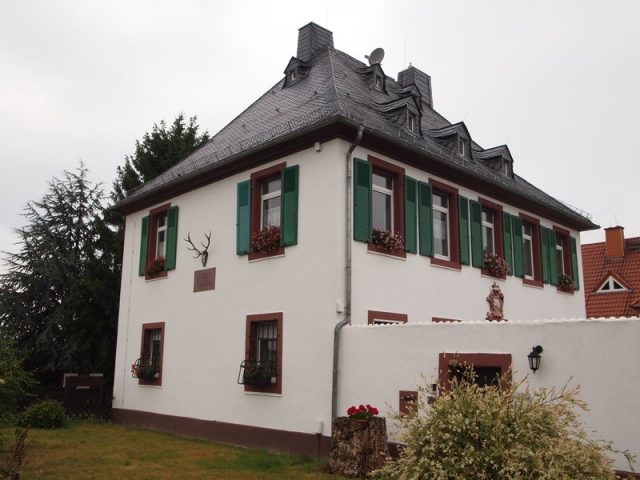
CastleOber-Olm

Ober-Olm Castle

Ober-Olm Castle

To be privately owned

The Electoral Palace in Koblenz+

The Electoral Palace in Koblenz, located on the banks of the Rhine, is one of the most important examples of early French Neoclassicism in southwestern Germany. It was built between 1777 and 1793 as a residence for the last Elector of Trier, Clemens Wenceslaus of Saxony.

History+

Construction and Use by the Elector

The construction of the palace was preceded by a long planning phase. Elector Clemens Wenceslaus of Saxony, who resided in Koblenz from 1763, initially lived in the Ehrenbreitstein Fortress. However, he desired a more comfortable and representative residence in the city. After several rejected designs, the French architect Antoine-François Peyre was commissioned in 1776 to design the new palace.

Construction began in 1777. The palace was built on a newly created terrace directly on the Rhine. The main building, a three-winged complex, was completed in 1786. The interior work continued until 1793. The Elector was only able to enjoy his new residence for a short time, as French revolutionary troops occupied Koblenz in 1794, forcing him to flee.

French Occupation and Secularization

During the French occupation, the palace was used for various purposes, including as a military hospital and barracks. After the secularization in 1803, the palace became Prussian property. It was then used as a residence for the Prussian governor and later as a school and administrative building.

19th and 20th Century

In the 19th century, the palace underwent several alterations and additions. From 1842 to 1845, it served as a residence for Crown Prince Frederick William (later Emperor Frederick III) and his wife Victoria, daughter of Queen Victoria of Great Britain. During this time, the palace was extensively renovated and redecorated.

During World War II, the Electoral Palace was severely damaged by bombing raids in 1944. Only the exterior walls remained. After the war, the palace was rebuilt in a simplified form between 1950 and 1951. The interior was modernized and adapted for use as an administrative building.

Current Use

Today, the Electoral Palace houses various federal agencies, including the Federal Office for Equipment, Information Technology and In-Service Support of the Bundeswehr (BAAINBw). The palace garden is open to the public and offers a beautiful view of the Rhine and the Deutsches Eck.

Architecture+

The Electoral Palace is a prime example of early French Neoclassicism. The architect Antoine-François Peyre was inspired by classical antiquity and French palace architecture of the 17th century. The palace is characterized by its clear, symmetrical structure and its restrained, elegant facade.

The main building is a three-winged complex with a central main facade facing the Rhine. The facade is structured by colossal pilasters and a balustrade. The central projection is crowned by a triangular pediment with allegorical sculptures.

The interior of the palace was originally richly decorated with stucco, frescoes, and valuable furniture. Although much of the original interior was lost during the war, some elements, such as the grand staircase, have been preserved or reconstructed.

Significance+

The Electoral Palace in Koblenz is an important cultural monument and a testament to the architectural history of the 18th century. It reflects the political and cultural ambitions of the last Elector of Trier and is an outstanding example of Neoclassical architecture in Germany.

The palace also plays an important role in the urban landscape of Koblenz and is a popular destination for tourists and locals alike. Its prominent location on the Rhine and its impressive architecture make it one of the city's most recognizable landmarks.

Take Mobile History with you

You are reading this text for free. Premium adds what matters on the road: descriptions read aloud, sites found through your camera, whole regions taken offline.

  • Every description, including the ~17,700 Premium sites
  • Audio guide: have descriptions read to you on location
  • AR finder: see sites through your camera, with distance and bearing
  • Unlimited saved sites

14 days free, then from €2.99 a month. Cancel anytime.

Source: Wikipedia · Licence: CC BY-SA 4.0 · Image: http://www.wehrbauten.de/thread.php?threadid=899&sid=246e8c9fdbfa80ccf9a3497b2adfd6ed

This description draws on the facts documented in the linked Wikipedia article; Wikipedia content is licensed under CC BY-SA 4.0. Wording and editing: Mobile History.

Location: 49.9511, 8.1893