Local government
Öhringen Castle
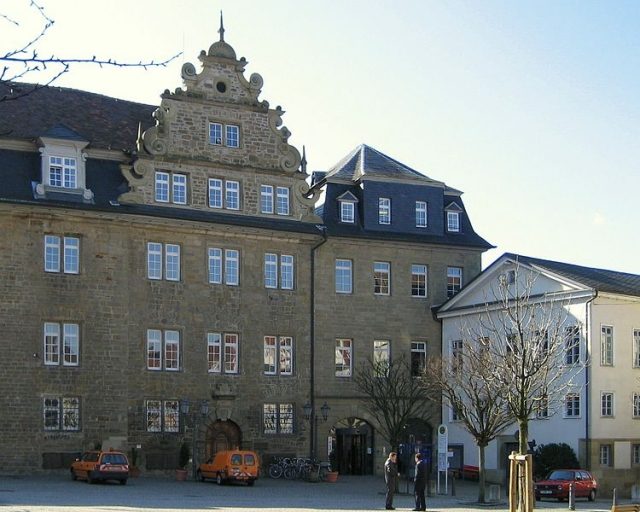
The medieval market square is the heart of the city. There you will find the former Hohenlohe Castle, which, together with the Collegiate Church, is the landmark of the city. The Renaissance castle was the residence of the Counts and Princes of Hohenlohe.
It was built on a site south of the Collegiate Church. There stood the curia house and the schoolhouse, which had to make way for the new building. The oldest part, the Long Building, was built as the widow's residence for Countess Magdalena von Hohenlohe (* 1547; † 1633, sister of William of Orange) between 1611 and 1616 according to plans by the master builder and Neuenstein castle bailiff Georg Kern from Forchtenberg.
Until 1633, the widow of Count Wolfgang von Hohenlohe-Neuenstein inhabited the castle. After that, it stood largely empty until it fell to Count Johann Friedrich I von Hohenlohe-Neuenstein-Öhringen in 1677 after an inheritance division. To use the castle as a residence, he had the stable building added. The volute gables were demolished and attached to the newly erected stable building. Johann Friedrich II, who was elevated to prince in 1764, extended the castle in 1714/15 with courtyardside corridors. The entire building received a mansard roof instead of the gable roof, and the Renaissance gables were retained. On the ground floor, these were executed as arcades with flat arches. From 1770 to 1775, the castle was extended by a coach house, which adjoined the stable and appeared as a bourgeois house towards the market square.
Prince August zu Hohenlohe-Oehringen added the Prince's Building to the coach house in 1812/13. It served as a residence for the hereditary prince and outwardly had the form of a classical bourgeois house. From 1845 to 1847, the state rooms Blue Hall, Dining Room, and White Hall were renovated. The style of the Blue Hall is a mixture of Italian Renaissance and early Baroque, the name is attributed to the blue color used.
Already with the Long Building, a church passage, a bridge from the castle to the Collegiate Church, was built around 1616. This church passage was altered in 1817/18 and demolished with the renovation of the Collegiate Church in 1888/89. Traces of it can still be seen on the castle and the church.
The princely family moved their residence from Öhringen to Slawentzitz in Upper Silesia in 1848/49. After the loss of the Upper Silesian possessions, August zu Hohenlohe-Oehringen returned to Öhringen Castle with his family in 1945, inhabiting its south wing until his death in 1962. Various tenants were accommodated in the other parts of the castle. In 1961, the city bought the castle with the court garden from the Hohenlohe family for 1.5 million Marks and renovated it from 1976 to 1987. The castle was converted into the town hall.
The 120-meter-long vaulted cellar of the castle continues to be used as a cellar by the princely winery Verrenberg after the sale of the castle, according to a special regulation. Approximately 500,000 liters of wine are stored in the cellar.
Take Mobile History with you
You are reading this text for free. Premium adds what matters on the road: descriptions read aloud, sites found through your camera, whole regions taken offline.
- Every description, including the ~17,700 Premium sites
- Audio guide: have descriptions read to you on location
- AR finder: see sites through your camera, with distance and bearing
- Unlimited saved sites
14 days free, then from €2.99 a month. Cancel anytime.
Source: Wikipedia · Licence: CC BY-SA 4.0 · Image: https://commons.wikimedia.org/wiki/File:%C3%96hringen_Schloss.JPG
This description draws on the facts documented in the linked Wikipedia article; Wikipedia content is licensed under CC BY-SA 4.0. Wording and editing: Mobile History.
Location: 49.2000, 9.5028