To be privately owned
Onnens Castle

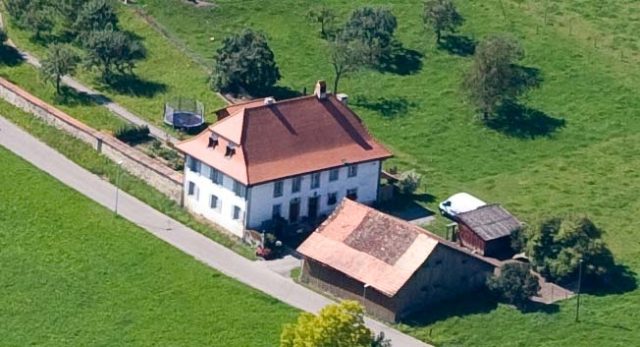
The upper "Château", which became the schoolmasters' residence in 1950, is a country house. It dates from the last quarter of the 18th century. The "country house" is the common term for this type of building - often only used in summer - intended for the patricians of Fribourg. These were wealthy landowners, both in Onnens and in many other places. The villagers called these residences "Châteaux" because they were the only houses built entirely of stone.
At the time of construction, the owner was the patrician Francois Pierre Brunisholz, the former bailiff of Saint Aubin, who died on February 26, 1783. He was the last representative of this lineage. During the beautiful season, patrician families from Fribourg inhabited the château: von Weck von Onnens in the 19th and early 20th centuries, then the family of Marcel Von der Weid and his brother-in-law, Pierre Aeby, after whom a street in Fribourg was named. In 1950, it became the property of the school district, and the château had classrooms in a fitted annex on the floor of a parochial hall. This annex replaced the gallery that was attached to the château. The magnificent park disappeared - unfortunately! - during the renovation of the château.
The first von Weck, from the Onnens branch, was Charles-Francois-Xavier, who died in 1796. Before becoming bailiff of Estavayer-le-Lac from 1784 to 1789, he was an officer in French service. His son (1794-1882), inherited, among other things, the extensive property of Onnens (the château where he lived and the large estate, which also included the Davaud end). Louis von Weck was a member of a family that maintained close contact with the conservative party. He played an important role in the Sonderbund War and during the third conservative uprising of Carrard against the radical government in 1853. During his military training in Thun, he had the future Emperor of the French, Napoleon III, as a comrade. His talent for painting was well known. The von Weck family – as they are often called, or Weck, as they called themselves, meaning: without a particle – shaped the life of Onnens. Both Louis and his son Charles were very interested in local life; they belonged for a long time to the communal or parochial councils. In numerous cases, when they had money problems, the community resorted to their lords of the manor for loans. Charles von Weck (1837-1931), was a State Councillor from 1881 to 1906. Afterwards, the château was inhabited during the beautiful season by the family of Marcel Von der Weid. He was a State Councillor from 1914 to 1937 and died in 1948. His brother-in-law, Pierre Aeby, who was a university professor, legal advisor of Fribourg, president of the national council in 1945, and chairman of the Swiss Conservative Party (SKP), also spent his summers in the château of Onnens, before residing in his beautiful property in the village near Lovens. He died in 1957.
In his 1894 work on local geography, Léon Genoud calls the upper château: the Weck Château, and the lower one: the Affry Château. The latter is currently the property of the family of Charles Chatagny. It is a very beautiful "country house", initially intended for patrician families.
At the end of the 18th century, Joseph Nicolas Bruno von Maillard, an old banneret of Fribourg and former bailiff of Farvagny, lived there. He was a member of the Council of Sixty. This referred to the sixty patrician families who monopolized public services. Afterwards, the lower château passed to Féguely, probably to Francois-Xavier, citizen of Onnens in 1793, and it was inhabited by a Gottofray family. On May 2, 1811, it was bought by Charles-Claude-Esprit von Rigot, Marquis of Montjoux, and his wife Françoise-Catherine-Sabine von Agoult. They were French Royalists who had fled to Switzerland during the French Revolution. They also acquired Riedera. The burial steles, which stood in their memory in the old church of Onnens, were reused in 1911 in a facade of the new church. In 1837, the heirs of the Marquis of Montjoux sold the property to Marie-Julie-Barbe von Affry. In his notes, found in the parochial archives, the parish priest of Onnens, Theodor Moullet, repeatedly records various donations from Miss Julie von Affry, from Fribourg, owner of Onnens. She was buried in Fribourg in 1863. In 1865, this manor house was bought by Louis-Francois-Nicolas Von der Weid. In 1876, the farmer Lucien Guisolan, originally from Noréaz, bought the master's house and the estate. His daughter Eugénie married Isidore Chatagny from Corserey in 1896. Thus, the lower château came into the hands of the Chatagny, first through Isidore, then Michel, and finally Charles.
Take Mobile History with you
You are reading this text for free. Premium adds what matters on the road: descriptions read aloud, sites found through your camera, whole regions taken offline.
- Every description, including the ~17,700 Premium sites
- Audio guide: have descriptions read to you on location
- AR finder: see sites through your camera, with distance and bearing
- Unlimited saved sites
14 days free, then from €2.99 a month. Cancel anytime.
Source: Wikipedia · Licence: CC BY-SA 4.0
This description draws on the facts documented in the linked Wikipedia article; Wikipedia content is licensed under CC BY-SA 4.0. Wording and editing: Mobile History.
Location: 46.7766, 7.0402