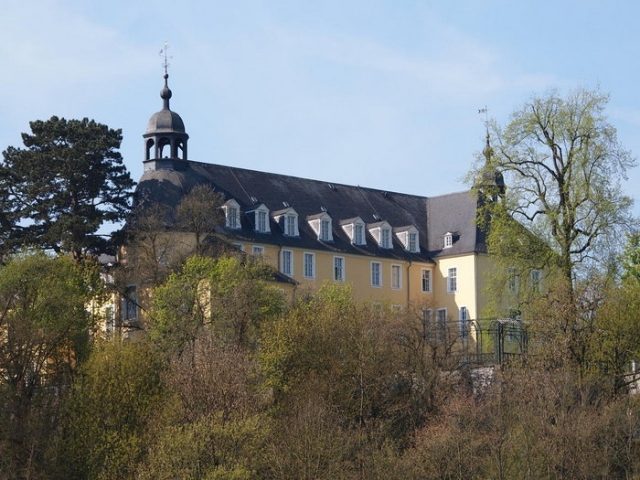
CastleDiez

Oranienstein Castle

Oranienstein Castle

Headquarters of the Medical command II (German Army)

Oranienstein Castle in Diez an der Lahn was built from 1672 to 1681 as a widow's residence for Countess Albertine Agnes of Orange-Nassau of Diez on the ruins of the former Benedictine monastery of Dierstein. It is one of the ancestral castles of the Dutch Royal House.

During the original construction, parts of the Romanesque monastery buildings were incorporated. From 1704 to 1709, the castle was first rebuilt under Albertine's daughter-in-law Henriette Amalie. The plans for the conversion into a Baroque castle were provided by the French architect Daniel Marot, a son of the builder of the Versailles complex. Essentially, the five-winged structure that still exists today was created at that time. The rich stucco decorations are by the Italians Eugenio Castelli and Antonio Gentone, and the frescoes by the Dutchman Jan van Dyk.

With the unification of all Ottonian lines of the House of Nassau and the reorganization of the dominion, Oranienstein Castle lost its significance as a residential castle in 1743 in favor of the residence in Dillenburg. It was not until 1801 that a member of the House of Nassau Oranienstein, Wilhelm V of Orange, again used it as a residence. Wilhelm V of Orange commissioned Friedrich Ludwig von Sckell with the planning for the castle's garden design.

In 1806, the castle fell to the Grand Duchy of Berg. Napoleon had all of the castle's furnishings auctioned off in 1811. After the Congress of Vienna, Oranienstein fell to the newly formed Duchy of Nassau.

In 1866, after the German War, in which Nassau sided with the loser Austria, the Duchy was annexed by Prussia as a future administrative district. Initially, the Prussian government planned to house the Provincial Asylum in the castle, but this was abandoned after protests from the Dutch Royal House. A year later, Prussia established a cadet institution in Oranienstein. In the following years (1874–1876), the castle was expanded with barracks. Further administrative buildings followed between 1900 and 1907.

After the First World War, the cadet institution was dissolved and the castle was occupied by French troops. On the occasion of the 600th anniversary of the city of Diez in 1929, the castle was renovated and released; at the same time, the "Nassau Homeland Museum" was housed there. From 1934 to 1945, the castle was used as a "National Political Education Institute".

After the Second World War, the French initially confiscated the castle with all its outbuildings. In their legal succession, Oranienstein fell in 1947 to the newly founded state of Rhineland-Palatinate, which, however, could not raise the considerable costs for the war and consequential damages. In 1957, the Je Maintiendrai Nassau Foundation was established in Delft, Netherlands, which saw it as its task to ensure the maintenance of all buildings reminiscent of the House of Nassau-Orange. Prompted by a memorandum from the Diez Museum and History Association on the reuse of Oranienstein Castle, the then Minister President of Rhineland-Palatinate, Peter Altmeier, succeeded in persuading the then Federal Minister of Defense, Franz Josef Strauß, to have the castle taken over by the Bundeswehr, which then took place on March 23, 1962.

The Federal Ministry of Defense initiated a comprehensive renovation and restoration of the valuable stucco work and ceiling paintings. The ceremonial handover to the Bundeswehr and the simultaneous opening of the "Oranien-Nassau Museum" took place on May 23, 1962. A few days earlier, the staff of the 5th Panzer Division had moved in there.

In 1994, Oranienstein received new owners after further extensive renovation work. Since the staff of the 5th Panzer Division had been moved from Diez to Mainz, the Hospital Regiment 74 and the Panzer Brigade 34 moved into the castle. From 2001 to 2012, the Medical Command II, among others, was based in Oranienstein Castle. In 2013, the Regional Medical Support Command was established there, replacing the dissolved Medical Command II as a large unit.

Oranienstein Castle is one of the four "mother houses" of the Dutch Royal House. The name refers to William of Orange. In addition to Diez, Oranienburg Castle in Brandenburg and Oranienbaum Castle near Dessau are among the ancestral castles of the Dutch Royal House. The fourth house, Oranienhof near Bad Kreuznach, no longer exists.

Take Mobile History with you

You are reading this text for free. Premium adds what matters on the road: descriptions read aloud, sites found through your camera, whole regions taken offline.

  • Every description, including the ~17,700 Premium sites
  • Audio guide: have descriptions read to you on location
  • AR finder: see sites through your camera, with distance and bearing
  • Unlimited saved sites

14 days free, then from €2.99 a month. Cancel anytime.

Source: Wikipedia · Licence: CC BY-SA 4.0 · Image: http://www.wehrbauten.de/thread.php?threadid=932

This description draws on the facts documented in the linked Wikipedia article; Wikipedia content is licensed under CC BY-SA 4.0. Wording and editing: Mobile History.

Location: 50.3837, 8.0107