CastleOrtenberg

Ortenberg Castle

Ortenberg Castle

Youth hostel

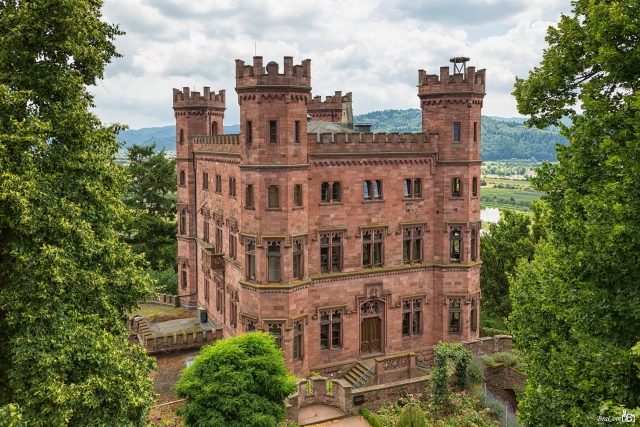
Ortenberg Castle is the landmark of the Ortenau region and is located above the town of Ortenberg at the end of the Kinzig Valley between Offenburg and Gengenbach.

The origins of Ortenau Castle date back to a castle complex from the 11th/12th century. Originally, Ortenau Castle was built by the Zähringer family to secure the Kinzig Valley; today, Ortenberg Castle houses a youth hostel.

After the construction of Ortenberg Castle by the Zähringer in the 11th/12th century, the castle was used as the seat of the regional bailiffs of Ortenau during the Hohenstaufen rule. The administrative seat for the Ortenau bailiwick was a central point for imperial taxes, a court, and a customs authority. The castle complex underwent its first expansions in the 15th century when it was extended with defensive towers (rondels) equipped with cannons. The castle suffered its first destruction in 1678 during the Franco-Dutch War, when Louis XIV had the castle destroyed by Marshall Créqui. After a reconstruction in the following years, the castle was destroyed again in 1697. As a result of this renewed destruction, the official seat of the regional bailiffs was henceforth moved by Bailiff Franz de Neveu to Offenburg. The current castle was built between 1838 and 1843 by Baron Gabriel Leonhard von Berckholtz (1781-1863) from Livonia, who had it rebuilt in the English style on the medieval ruins by Friedrich Eisenlohr. He entrusted the construction management to his student Georg Jakob Schneider. Since 1942, the castle has been used as a youth hostel. Further structural maintenance measures to preserve the building fabric followed in the years 1974-1981. In the years 1984-1985, the Painter's Tower was restored. The Schimmel and Jacob's Towers followed in the years 1986-1988.

It was named "Monument of the Month February 2010" by the Baden-Württemberg Monument Foundation.

Architecture+

Towers

Painter's Tower

The Painter's Tower was once the painting studio of Alexandra von Berckholtz, the daughter of the castle builder Gabriel L. Berckholtz. In the 15th century, the tower was built as a powder tower (arsenal) and is now used by the municipality of Ortenberg as a wedding room.

Jacob's Tower

During the reconstruction from 1838-1843, the two original preserved floors of the lower bailey were extended with another tower. Jacob's Tower, named after the son of the castle builder, served to defend against enemies who had penetrated the moat. Jacob's Tower was renovated internally in 1986/1987.

Schimmel Tower

The Schimmel Tower is the highest tower of the complex (Middle High German Schimmel = main), it was renovated internally in the years 1986-1988 and received its current stair turret, which was blown off in 1678. Already around 1840, the actual tower was raised again in Gothic style; today, the tower contains a staircase that was not originally present. The doors visible today do not originate from the original construction. The Schimmel Tower housed the former dungeon; prisoners were lowered into the dungeon via a winch and were surrounded by 4-meter-thick walls. Even after the destruction in 1679-97, the dungeon was still used as a prison until the imperial bailiwick prison was built in the village in 1770. It is located in the Old Town Hall.

Chapel Tower

The Chapel Tower is a former battery tower from the 15th century; the tower was partially blown up in 1678. In the years 1838-1843, it was renovated and used as a castle chapel.

Rock Cellar

Even today, the rock cellar, plundered in 1678, awaits its excavation.

Take Mobile History with you

You are reading this text for free. Premium adds what matters on the road: descriptions read aloud, sites found through your camera, whole regions taken offline.

  • Every description, including the ~17,700 Premium sites
  • Audio guide: have descriptions read to you on location
  • AR finder: see sites through your camera, with distance and bearing
  • Unlimited saved sites

14 days free, then from €2.99 a month. Cancel anytime.

Source: Wikipedia · Licence: CC BY-SA 4.0 · Image: © BraCom (Bram)

This description draws on the facts documented in the linked Wikipedia article; Wikipedia content is licensed under CC BY-SA 4.0. Wording and editing: Mobile History.

Location: 48.4437, 7.9731